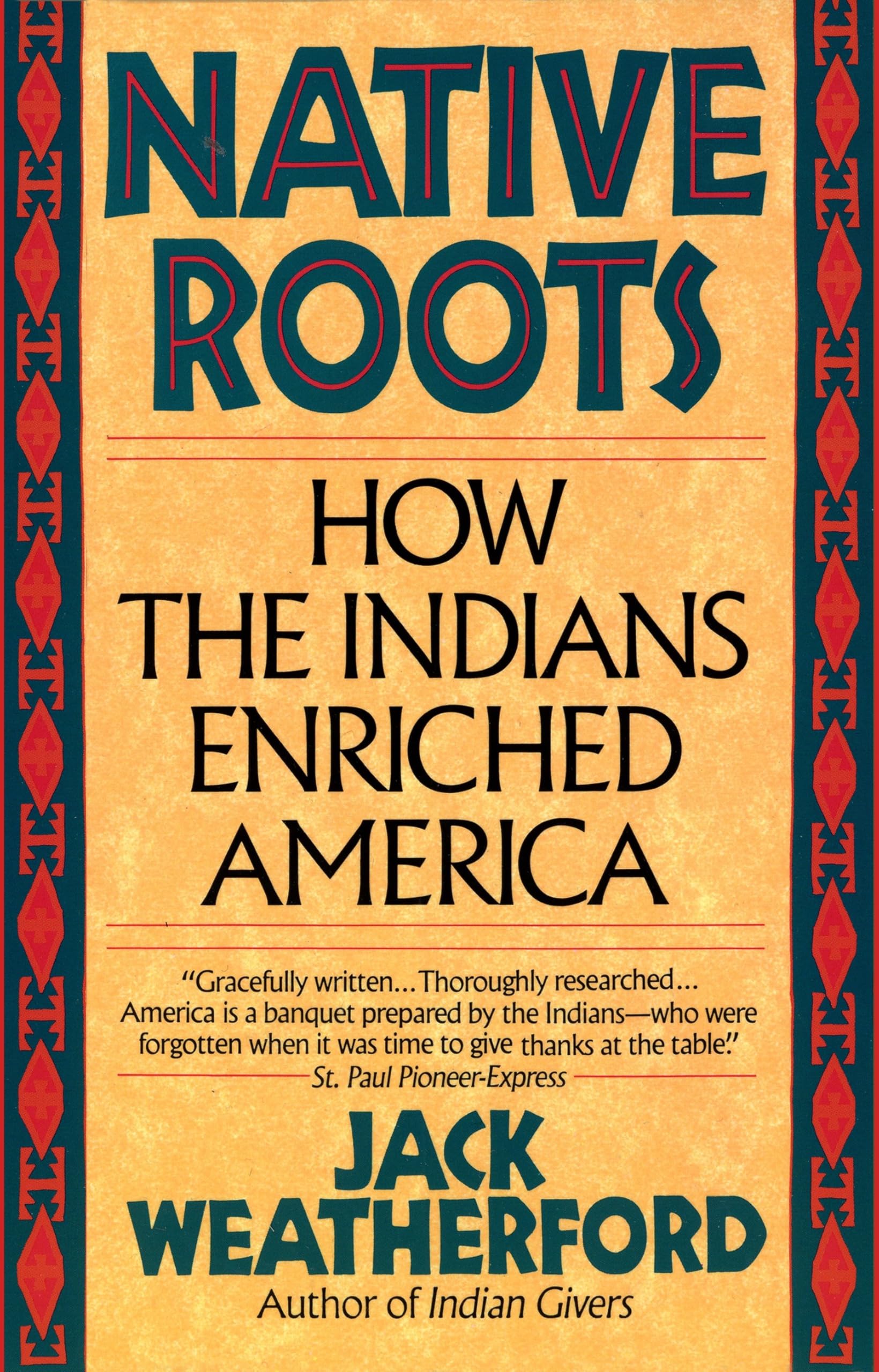



“Gracefully written . . . thoroughly researched . . . America is a banquet prepared by the Indians—who were forgotten when it was time to give thanks at the table.”— St. Paul Pioneer-Express “Well written, imagery-ridden . . . A tale of what was, what became, and what is today regarding the Indian relation to the European civilization that ‘grafted’ itself onto this ‘ancient stem’”— Minneapolis Star Tribune In Indian Givers, anthropologist Jack Weatherford revealed how the cultural, social, and political practices of the American Indians transformed the world. In Native Roots, Weatherford focuses on the vital role Indian civilizations have played in the making of the United States. Conventional American history holds that the white settlers of the New World re-created the societies they had known in England, France, and Spain. But, as Weatherford so brilliantly shows, Europeans in fact grafted their civilizations onto the deep and nourishing roots of Native American customs and beliefs. Beneath the glass-and-steel skyscrapers of contemporary Manhattan lies an Indian fur-trading post. Behind the tactics of modern guerrilla warfare are the lightning-fast maneuvers of the Plains Indians. Our place names, our farming and hunting techniques, our crafts, and the very blood that flows in our veins—all derive from American Indians in ways that we consistently fail to see. In Weatherford’s words, “Without understanding Native Americans, we will never know who we are today in America.” ritten, imagery-ridden...A tale of what was, what became, and what is today regarding the Indian relation to the European civilization that 'grafted' itself onto this ancient system.'" MINNEAPOLIS STAR TRIBUNE Conventional American history holds that the white settlers of the New World re-created the societies they had known in England, France, and Spain. But as anthropologist Jack Weatherford, author of INDIAN GIVERS, brilliantly shows, the Europeans actually grafted their civilization onto the deep and nourishing roots of Native American customs and beliefs. Our place names, our farming and hunting techniques, our crafts, the very blood that flows in our veins--all derive from American Indians ways that we consistently fail to see. "Well written, imagery-ridden...A tale of what was, what became, and what is today regarding the Indian relation to the European civilization that 'grafted' itself onto this ancient system.'" MINNEAPOLIS STAR TRIBUNE Conventional American history holds that the white settlers of the New World re-created the societies they had known in England, France, and Spain. But as anthropologist Jack Weatherford, author of INDIAN GIVERS, brilliantly shows, the Europeans actually grafted their civilization onto the deep and nourishing roots of Native American customs and beliefs. Our place names, our farming and hunting techniques, our crafts, the very blood that flows in our veins--all derive from American Indians ways that we consistently fail to see. Jack Weatherford is the New York Times bestselling author of Genghis Khan and the Making of the Modern World , Indian Givers: How the Indians of the Americas Transformed the World , The Secret History of the Mongol Queens , and The History of Money , among other acclaimed books. A specialist in tribal peoples, he was for many years a professor of anthropology at Macalester College in Minnesota and now divides his time between the United States and Mongolia. 1 America ends at Tuktoyaktuk. There the land yields to the Arctic Ocean and the polar ice cap. Except for a few distant islands, human habitation stops. The frozen world beyond Tuktoyaktuk belongs to the seal-hunting polar bears that eternally wander the ice, and to the small herds of caribou and wild musk oxen that inhabit the most northern islands of the earth. The treeless, nearly barren Tuktoyaktuk Peninsula juts hesitantly from the Canadian mainland into the cold Arctic waters, but for most of the year the ice covering the land of frozen bogs and lakes looks much like the ice covering the ocean. The only landmarks separating Tuktoyaktuk Peninsula from the Arctic Ocean are the scattered pingos, the small, round ice volcanoes that poke up out of the earth like ruptured navels. In contrast to the frozen sea, the frozen land also serves as home to a band of nine hundred native Inuvialuit who built their village around a rocky bay at the base of the peninsula. Tuktoyaktuk also hosts a second settlement, a radar station huddled within its own fence and protected by its secretive domes. The United States military operates the station as part of the DEW line, the Distant Early Warning system, across the Arctic. No two cultures could seem more different than this native village of polar bear and beluga hunters next to a compound of radar technicians, electronics specialists, and computer personnel. One group belongs to the frozen land where it has lived for millennia, and the other is to