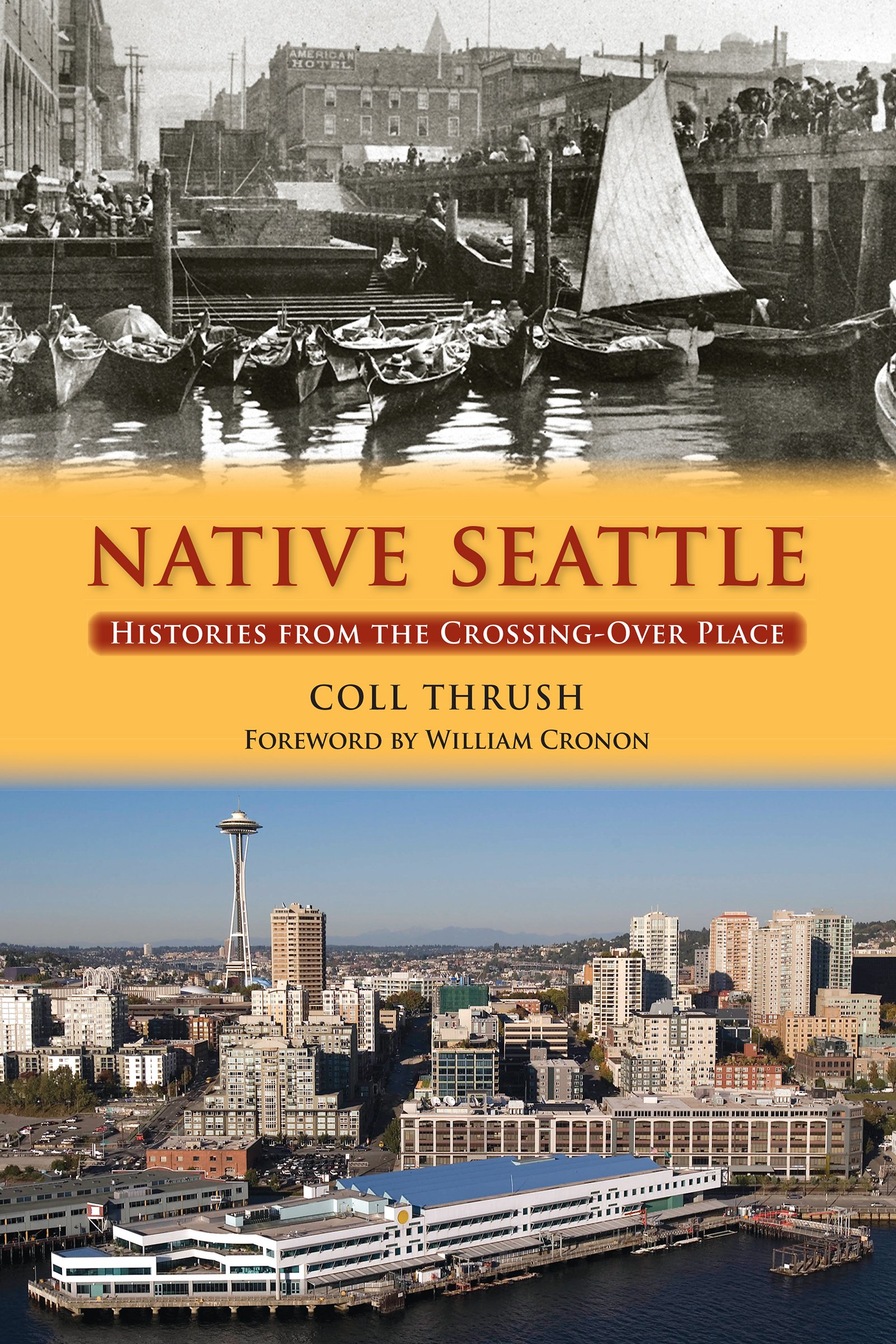
Native Seattle: Histories from the Crossing-Over Place (Weyerhaeuser Environmental Books)
$50.00
by Coll Thrush



Winner of the 2008 Washington State Book Award for History/Biography In traditional scholarship, Native Americans have been conspicuously absent from urban history. Indians appear at the time of contact, are involved in fighting or treaties, and then seem to vanish, usually onto reservations. In Native Seattle , Coll Thrush explodes the commonly accepted notion that Indians and cities-and thus Indian and urban histories-are mutually exclusive, that Indians and cities cannot coexist, and that one must necessarily be eclipsed by the other. Native people and places played a vital part in the founding of Seattle and in what the city is today, just as urban changes transformed what it meant to be Native. On the urban indigenous frontier of the 1850s, 1860s, and 1870s, Indians were central to town life. Native Americans literally made Seattle possible through their labor and their participation, even as they were made scapegoats for urban disorder. As late as 1880, Seattle was still very much a Native place. Between the 1880s and the 1930s, however, Seattle's urban and Indian histories were transformed as the town turned into a metropolis. Massive changes in the urban environment dramatically affected indigenous people's abilities to survive in traditional places. The movement of Native people and their material culture to Seattle from all across the region inspired new identities both for the migrants and for the city itself. As boosters, historians, and pioneers tried to explain Seattle's historical trajectory, they told stories about Indians: as hostile enemies, as exotic Others, and as noble symbols of a vanished wilderness. But by the beginning of World War II, a new multitribal urban Native community had begun to take shape in Seattle, even as it was overshadowed by the city's appropriation of Indian images to understand and sell itself. After World War II, more changes in the city, combined with the agency of Native people, led to a new visibility and authority for Indians in Seattle. The descendants of Seattle's indigenous peoples capitalized on broader historical revisionism to claim new authority over urban places and narratives. At the beginning of the twenty-first century, Native people have returned to the center of civic life, not as contrived symbols of a whitewashed past but on their own terms. In Seattle, the strands of urban and Indian history have always been intertwined. Including an atlas of indigenous Seattle created with linguist Nile Thompson, Native Seattle is a new kind of urban Indian history, a book with implications that reach far beyond the region. "The accomplishments of this book are many, most notably the merging of Native American and urban history, which for too long have developed as fields isolated from one another, or have even been considered antithetical. Furthermore, Thrush writes with great skill, combining an engaging narrative with sharp analysis that moves fluidly between social and cultural history. The end result is that this is a book that will serve a variety of audiences, including scholars across a range of disciplines and fields, undergraduates in urban studies and Native American studies courses, and interested readers among the general public."― H-Net H-Urban "This masterfully written study will appeal to those interested in the history of the Pacific Northwest, cities, and American Indians . . . . By including environmental and cultural information about local, indigenous place-names, this important atlas dovetails with the overall goal of this study, helping others see more than the stereotypes they expect to see."― Western Historical Quarterly "Thrush demonstrates how Seattle's native and non-white population are related, and how agency continues to exist in communities circumscribed by the dominant population. In this sense, Native Seattle is a model that deserves attention."― H-Net " Native Seattle is not an ordinary narrative of Seattle history. It has an environmental outlook, yes, but it also contains elements of Native American history, urban history, and geography. Thrush may have created a new field, the urban indigenous frontier . . . . Thrush makes his points and he cinches them up with argument and evidence, not the least of which are 32 well-chosen illustrations."― Columbia: The Magazine of Northwest History "Coll Thrush's book has importance far beyond the history of Seattle and the Pacific Northwest. . . . revolutionary in his approach to the broad nature of Seattle's indigenous history. . . . This book will endure."― Pacific Northwest Quarterly "As an urban Indian palimpsest, by grounding Seattle and Puget Sound geography with Native names and by documenting the continuity of Native peoples over time and place, [ Native Seattle ] succeeds as a benchmark book."― American Historical Review " Native Seattle is an important book both in and of itself and for the challenge it throws down to historians of other cities to rethink their pa