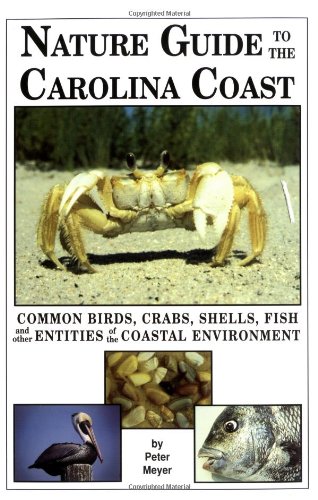
Nature Guide to the Carolina Coast: Common Birds, Crabs, Shells, Fish, and Other Entities of the Coastal Environment
$20.90
by Peter Meyer



An entertaining, practical, reader-friendly guide to common plants, animals, and the physical environment of the NC/SC coast. Fully illustrated -- over 100 color photographs, plus additional diagrams and drawings with in-depth information on each subject. A beachcomber's handbook, a valuable companion for seaside explorers of all ages. Scientifically accurate, yet written in language the lay public can understand. A neat little manual that explains in clear, concise terms what our coast is like....the text is simple, but not simpleminded. -- Carolina Adventure Coastal residents, visitors, fishermen, or anyone who enjoys walking along the beach watching the birds and waves will find this a practical, reader-friendly guide. -- SC Wildlife Don't visit the beach without it. -- The Coastal Carolinian One of the most useful and practical guides to the North and South Carolina coast. -- The Island Packet, Hilton Head The type of guide most of us have been waiting for. -- Brunswick Beacon This book deserves to find its way into many beach-bound suitcases. -- The State 55,000 plus copies sold to date. BIRDS Birds -- what is it about them that fascinates us so? Perhaps it is birds' similarities to humans and other mammals: Like us, birds are warm-blooded vertebrates. Or is it birds' mastery of flight that enamors us? Many among us dream of flying like a bird. Perhaps the beautiful and varied feather patterns of birds just please our eye? Or maybe humans anthropomorphize, giving birds human-like qualities: It is easy to think of birds as clean, sharp, capable, parental, etc. While the specific attributes that attract us to birds are elusive, the characteristics that set birds apart are clear: Birds are animals with a backbone, are homeothermic (warm-blooded), and possess wings and feathers. Feathers, more than anything else, define birds. Only birds have feathers, and it is feathers which make birds masters of the air. Just as fur is distinctive and important to mammals, so are feathers to birds. Feathers are made of keratin, the same substance of human nails and reptiles' scales (not surprising, as birds evolved from reptile-like ancestors). On either side of the central shaft of a feather are a hundred or more filaments. Each filament is similarly composed of numerous smaller filaments or barbules. The smaller elements overlap in different ways, depending on the function of the feather. The functions of feathers are many. The most obvious function of feathers is flight. Other animals glide, and a few, like bats and insects, fly well -- but birds are the true masters of flight. Feathers further serve birds in the same manner as fur serves mammals -- as insulation. Feathers actually provide better insulation than fur and are crucial in maintaining the temperature of warm-blooded birds. Feathers keep birds dry; feathers, combined with bird oils, are waterproof. And, finally, the colors and patterns of feathers serve in camouflage, territorial displays, and sexual identification and attraction. In addition to wings and feathers, birds have adapted to flight in other ways. Avian bones are thin and hollow to minimize weight. Similarly, birds have lost the heavy jaws and teeth of their reptilian ancestors. And, all birds lay eggs; to carry developing young would hinder flight. But, benefits are not without risks. Because they are warm-blooded, birds must incubate their eggs; they cannot bury their eggs and leave them, like reptiles. And, while sitting on the nest, birds are vulnerable to enemies. Birds have adapted in other ways to succeed. The beaks of birds vary greatly in size and shape, depending on the diet of each species. Consider the differences in just the birds common to the Carolina coast: The thin bill of the tiny Sanderling is used to probe the sand for Mole Crabs. The huge beak of the Pelican, with its loose sac of skin underneath, sucks in small fish when the Pelican dives. The unique beak of the Skimmer, the lower half longer than the upper, skims the water and snaps up surface fish. Similarly, the feet of birds vary in function, and thus in size and shape. Again, consider only the differences in a few coastal Carolina birds: The webbed feet of the Cormorant are used to swim on and below the water. The sharp-taloned feet of the Osprey are used to snatch live fish from the water. The Great Blue Heron, having huge feet with four long, thin toes, is stabilized on the marsh mud. Whatever the overall appeal of birds is, the species of the Carolina coast have a large allotment of the allure. Few can deny the magic and enjoyment of watching our widely-varied species. BROWN PELICAN How can a bird be awkward and ungainly, yet graceful and spectacular? How can a bird bring to mind ancient pterodactyls, yet easily master both sky and water? The Brown Pelican is/does all of these; Pelicans are a true delight to watch flying and feeding. Brown Pelicans are huge birds, with wingspans of six to