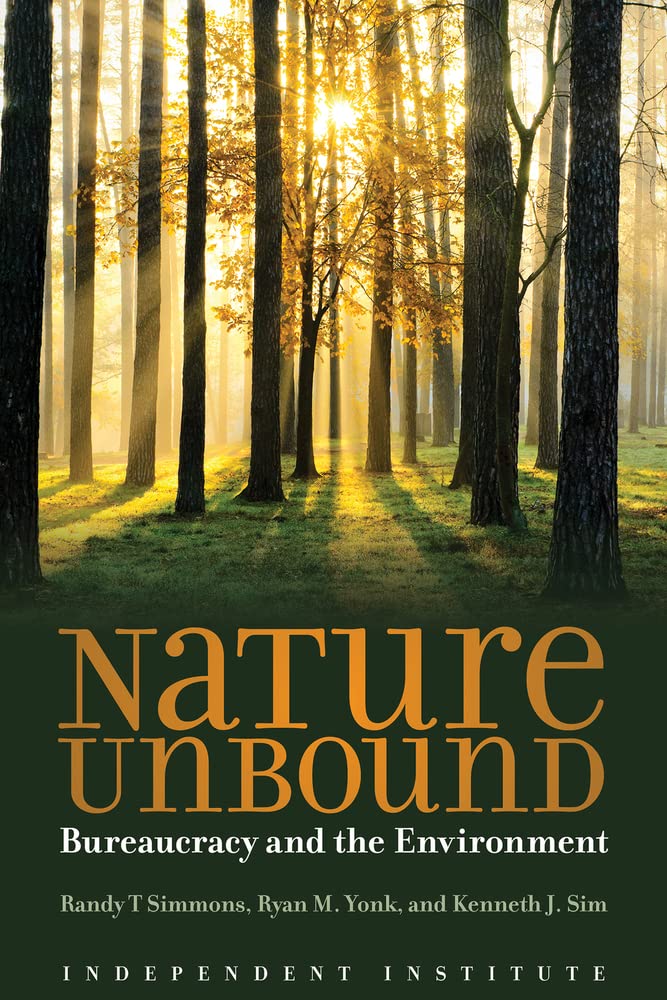
Nature Unbound: Bureaucracy vs. the Environment (Independent Studies in Political Economy)
$22.95
by Randy T. Simmons



What if what we think we know about ecology and environmental policy is just wrong? What if environmental laws often make things worse? What if the very idea of nature has been hijacked by politics? What if wilderness is something we create in our minds, as opposed to being an actual description of nature? In 1934, former U.S. Forest Service offcial Aldo Leopold, a godfather to the modern environmental movement, wrote that “restrictive laws” had “largely failed” in their mission to conserve America’s forests, rivers, and other natural resources. Less than forty years later, however, as various events pushed environmental concerns into the public spotlight, lawmakers from both parties championed legislation far more sweeping and restrictive than any Leopold had witnessed. How well did these “restrictive laws” work to right environmental wrongs? Why did so many miss the mark? And how should we go about improving our policies? In Nature Unbound , authors Randy Simmons, Ryan M. Yonk, and Kenneth J. Sim offer a devastating critique of federal environmental policy by scrutinizing it through the lenses of biological ecology and political ecology. This powerful framework, they show, reveals that environmental policy has been guided since the late 1960s by demonstrably false assumptions responsible for a host of ineffective or wasteful, command-and-control policies—on air pollution, water pollution, endangered species, wilderness, renewable energy, and more. The mistakes have also empowered political entrepreneurship in ways that have encroached on property rights, burdened the general public, and degraded the civic landscape. More than a critique of false assumptions and flawed policies, Nature Unbound offers bold principles to help us rethink environmental objectives, align incentives with goals, and af?rm the notion that human beings are an integral part of the natural order and merit no less consideration than Earth’s other treasures. Ultimately, nothing less can succeed in our efforts to restore natural resources and revitalize our social and political ecosystem. “Read this book and learn the diverse ways in which organized interest groups, and prominent individuals, have sought to impose their idealizations of nature as ecological equilibrium on the rest of us. There is no such thing as nature undisturbed, and bureaucratic bad management is often the unintended consequence of our limited knowledge of ecosystem complexity. Improvement, if attainable, must be more marginal, more decentralized, and focused on learning because no one can know final right answers.” -- Vernon L. Smith , Nobel Laureate in Economic Sciences; George L. Argyros Endowed Chair in Finance and Economics and Professor of Economics and Law, Chapman University “In the well written and highly informative book, Nature Unbound , Simmons, Yonk, and Sim develop the twin concepts of political ecology—the idea that in Washington science is politics—and political entrepreneurship—the notion that every significant political action provides an opportunity for special interest groups to steer the action in their direction. They apply the concepts as they scan the last 40 years of the U.S. environmental saga, stopping occasionally to do in-depth analyses of intentions and outcomes. Theirs is not a normative anti-environment cry for deregulation, but rather a carefully reasoned and documented effort to explain how environmental actions based on faulty but popularized notions of science lead inevitably to botched outcomes that fail to redress true environmental concerns. Nature Unbound should be read, studied and debated by all who take the environment seriously.” -- Bruce Yandle , Dean Emeritus, College of Business and Behavioral Science, Clemson University; Distinguished Adjunct Professor of Economics, Mercatus Center, George Mason University “Nature Unbound provides a fascinating look at bureaucracy and environment in the context of a new view of ecology. The new ecology rejects the ideologically based concept of a ‘balance of nature’ and recognizes variability is fundamental in ecological systems whether or not humans are involved. The book examines the role of politics and entrepreneurship in environmental policy, in the context of the new ecology, and provides an absorbing narration of natural resource legislation, legal activities and court decisions as well as management policies. The book concludes with five principles for redesigning and incentivizing institutions to be applied to specific individual resource and environmental programs.” -- Roger A. Sedjo , Senior Fellow, Resources for the Future “In striving to improve our environmental stewardship, it is important to take off our rose-colored glasses and contemplate the imperfections in our system. In Nature Unbound, Simmons, Yonk, and Sim focus on identifying and explaining deficiencies in long-standing environmental laws. Some readers may find the analysis uncomfortable