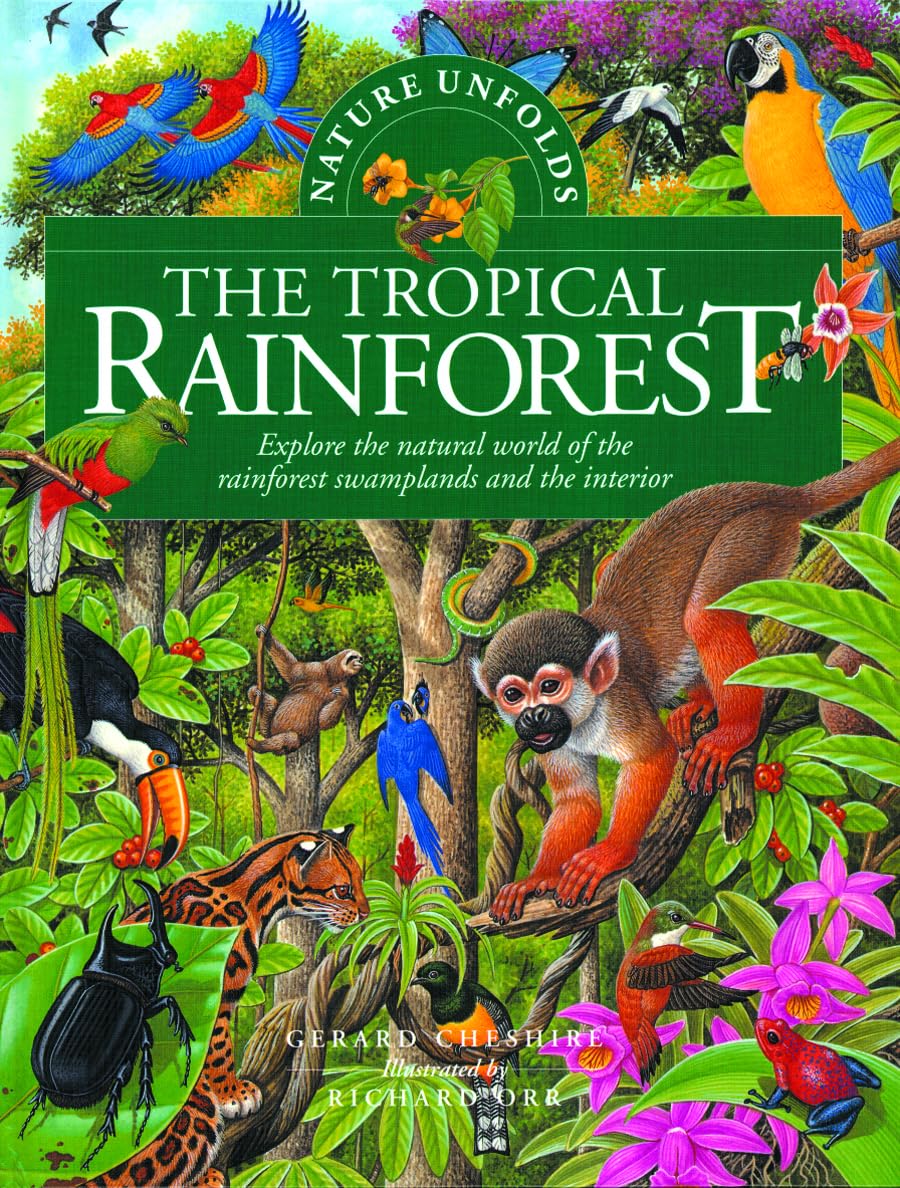



Children will be fascinated by the colorful animals and plants in Nature Unfolds The Tropical Rainforest, a lavishly illustrated new book that takes readers on a journey from the swamplands of the Amazon delta up through the layers of the tropical rainforest - two separate but linking habitats. Amazing information and two spectacular fold-out illustrations help children identify the wildlife and plants that live: - in the Amazon estuary - in its wetlands and marshlands - at the forest's edge - in the upper canopy - in the lower canopy - in the understory - on top and beneath the forest floor Grade 4-8-Each volume opens with two foldout panoramas of related ecological vistas, one horizontal, the other vertical. The first book includes the Amazon River basin and the rainforest while the second explores the Antarctic and Arctic regions. Following each foldout is a series of spreads that provide more detail about one quadrant of the larger work. For example, the Amazon swamplands are subdivided into estuary, wetlands, marsh land, and forest edge. A paragraph summarizes the characteristics of each area. The accompanying pages contain numerous small pictures of and a few sentences about indigenous animals. Orr's masterful illustrations fill the pages with color and movement and unflinchingly depict birth and death. Although the foldout views show the relative sizes of animals, those proportions are lost in the close-ups, where an anaconda doesn't appear much larger than a spoonbill. Keys to each panoramic scene are included. Libraries owning Moira Butterfield and Orr's Nature Cross-Sections (DK, 1995) plus introductions to the polar regions and/or tropical rainforest can probably forgo these titles. However, where reader interest or curriculum requirements warrant additional coverage, these books could serve as supplementary materials. Kathy Piehl, Minnesota State University, Mankato Copyright 2002 Reed Business Information, Inc. Swamplands The Amazon River in South America carries more water than any other river. Many smaller rivers, called tributaries, flow into the Amazon. They add water to it as it flows toward the Atlantic Ocean. Rocks, dirt, twigs, and other materials get carried along too. The river flows more slowly as it nears the ocean. The soil, rocks, and dead plants start falling to the river bottom because the water no longer moves quickly enough to carry them. Fertile soil builds up at the river's mouth. It makes the water much shallower, and water plants are able to grow there. When enough soil builds up, it rises above the water's surface in places and becomes home to land animals and plants.