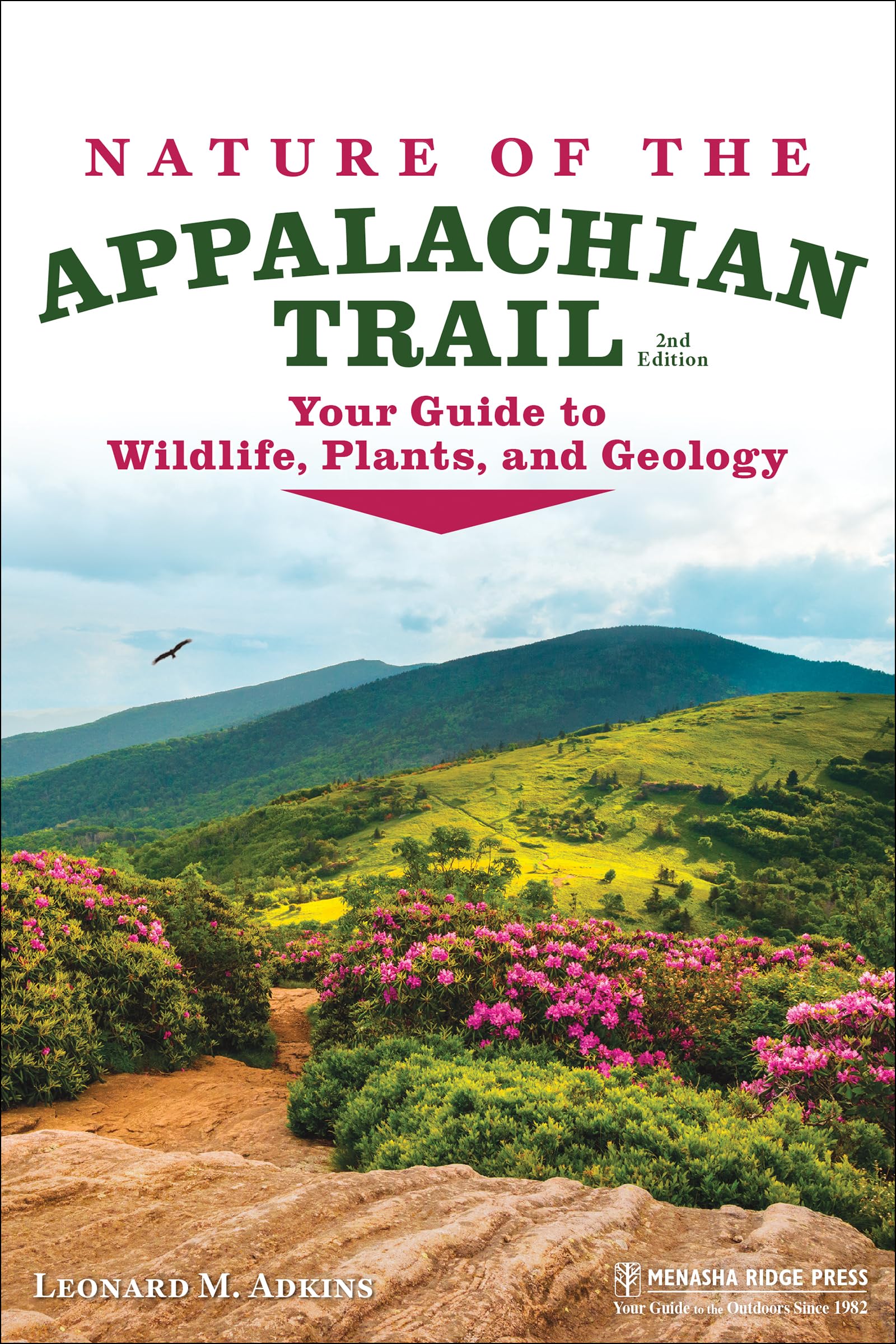
Nature of the Appalachian Trail: Your Guide to Wildlife, Plants, and Geology
$11.29
by Leonard M. Adkins



Hike the AT, and Get to Know Its Nature The Appalachian Trail’s soaring elevations and precipitous terrain are complemented by lush vegetation, abundant wildlife, and some of the most beautiful views in the world. You can conquer part or all of the AT on foot. Along the way, immerse yourself in its nature. Leonard M. Adkins has thru-hiked the AT five times, and he has spent countless hours studying it. Now, he’s sharing his expertise with you. Nature of the Appalachian Trail is an overview of more than 2,000 miles worth of information! There’s no need to shoulder dozens of different books in your backpack. This comprehensive naturalist’s guide includes a look at the mountains’ history, a study of the land’s geology, and detailed information about the trail’s birds, mammals, trees, flowers, reptiles, amphibians, and more. Inside you’ll find: Complete overview of the entire trail - Detailed guide to its flora and fauna - In-depth discussion of the region’s history and geology - Expert insights from a professional naturalist Nature of the Appalachian Trail is your visitor’s companion to unbroken forest from Georgia to Maine. It is applicable to the states of Connecticut, Georgia, Maine, Maryland, Massachusetts, New Hampshire, New Jersey, New York, North Carolina, Pennsylvania, Tennessee, Vermont, Virginia, and West Virginia. Leonard M. Adkins has been intimately involved with the Appalachian Trail for several decades. He has hiked its full length five times and lacks just a few hundred miles to complete it for a sixth. He has maintained a section of the trail near McAfee Knob and was a ridgerunner for the Appalachian Trail Conservancy. He has also served as an AT Natural Heritage Site Monitor, aiding the conservancy and the National Park Service in overseeing the welfare of rare and endangered plants. In addition, he has served on the boards of directors of the Roanoke Appalachian Trail Club and the Old Dominion Appalachian Trail Club. Among other long-distance trails, Leonard has completed the Continental Divide Trail from Canada to Mexico, the Pacific Northwest Trail from Glacier National Park to the Pacific Ocean, and the Pyrenees High Route along the border of France and Spain. In all, he has walked more than 20,000 miles, exploring the backcountry areas of the United States, Canada, Europe, New Zealand, and the Caribbean. Leonard is the author of 20 books on travel and the outdoors. His Wildflowers of the Appalachian Trail was presented the National Outdoor Book Award, while The Appalachian Trail: A Visitor’s Companion received the Lowell Thomas Travel Journalism Award. He has also written more than 200 articles for magazines such as Blue Ridge Country, Backpacker, Islands, The Roanoker, and Blue Ridge Outdoors. Along with his thru-hiking wife, Laurie, he lives in Virginia, within easy striking distance of the AT. 5. The Grand Floral Parade One of the greatest pleasures to be found during a visit with the Appalachian Trail is the opportunity to enjoy the grand parade of colors, shapes, sizes, and varieties of wildflowers as their procession of blooms starts in late winter, proceeds into the spring rains, continues throughout the hot summer months, and lingers long into the cooler temperatures of the fall. An amazingly large number of the wildflowers that grow throughout the eastern United States can be observed on even just one short walk along the trail. (Unless otherwise noted, all of the flowers in this chapter may be found ranging―at least in small isolated spots―in all of the states through which the AT passes from Georgia to Maine.) Whenever hiking wildflower enthusiasts get together, it seems that one of their favorite topics of discussion is about which flower is actually the first to emerge as winter begins to lose its grip on the mountains. There is no one answer, of course. Elevation, latitude, the severity of the winter, and a myriad of other things all affect which flower you’ll find first. Due to Virginia’s overall lower elevation and resulting warmer temperatures, hikers on that portion of the AT may actually encounter some flowers earlier in the year than people afoot amid the mountains of Georgia, North Carolina, or Tennessee. Walkers sauntering along the shoreline of a low-lying lake in central Maine may enjoy the spring flowers sooner than trekkers traversing ridgelines in the White Mountains. No matter where you are, though, there are those harbingers of spring which do make their appearance year in and year out before any of the other flowers in a particular region. One of the earliest plants to emerge from the ground (and also one of the most unique looking) is skunk cabbage, which grows in moist woods and meadows. If you want to find out how this plant received its name, just rub it a bit and bring your hand up to your nose. Although Native Americans inhaled the aroma as a cure for headaches, once you take a sniff you probably won’t want to do so again! As a mechanism to wit