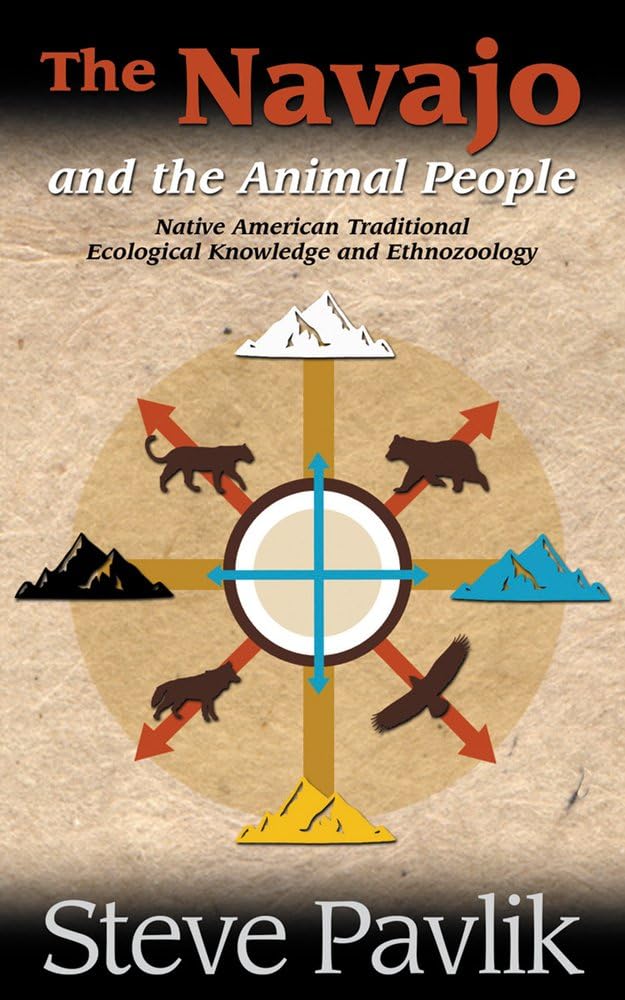
Navajo and the Animal People: Native American Traditional Ecological Knowledge and Ethnozoogly
$14.64
by Steve Pavlik



This text examines the traditional Navajo relationship to the natural world. Specifically, how the tribe once related to the Animal People, and particularly a category of animals, which they collectively referred to as the naatl' eetsoh - the "ones who hunt." These animals, like Native Americans, were once viewed as impediments to progress requiring extermination. Steve Pavlik taught Native American Studies and Native Environmental Science at Northwest Indian College, Bellingham, Washington, and had over thirty-five years of teaching experience in the field of American Indian education. Mr. Pavlik held a MA in American Indian Studies and a M. Ed. in American History from the University of Arizona. He authored or edited four books including Destroying Dogma: Vine Deloria, Jr. and His Influence on American Society (edited with Daniel R. Wildcat) and over 70 other published articles, essays, and reviews. His academic specialty areas include Native American religion and spirituality, ethnozoology, cognitive ethology, and environmental ethics. The Navajo and the Animal People Native American Traditional Ecological Knowledge and Ethnozoology By Steve Pavlik, Benton Yazzie Fulcrum Publishing Copyright © 2014 Steve Pavlik All rights reserved. ISBN: 978-1-938486-64-7 Contents 1. Preface, 2. References, 3. Foreword, 4. Introduction, 5. The Powerful Mountain People, 6. Will Big Trotter Reclaim His Place?, 7. The Defamation of Slim Trotter, 8. The One Who Walks Silently, 9. Mysteries of the Spotted Lion, 10. Children of the Monster Bird, 11. A Serpent's Tale, 12. Notes on Other Hunting People, 13. References, 14. About the Author, CHAPTER 1 The Powerful Mountain People This chapter was originally presented as a paper at the Western Social Science Association Conference held in Reno, Nevada, April 19, 1996. An edited version was published as "The Role of Bears and Bear Ceremonialism in Navajo Orthodox Traditional Lifeway" in The Social Science Journal, Volume 34, Issue 4, 1997. The high mountain trail was wide and well worn by generations of humans and animals, both wild and domestic. Ahead of me a few feet walked Will Tsosie. From time to time, Will would stop to point out a particular plant growing along the trail and explain how the Navajos traditionally used this plant. We were making no particular effort to be quiet, which surprised me considering the nature of our quest that morning on the mountain: we were hunting for bear. The genesis of this trip had come the evening before, when Will and I sat in my living room in Chinle drinking coffee and talking about the Navajo traditional relationship to the natural world. As usual, much of our conversation dealt with Navajo religion and ceremonialism and, on that particular evening, a topic that I was especially interested in, the Mountainway — a Navajo healing ceremony that focused on illnesses brought on by bears. At some point in our discussion, I mentioned the fact that despite the considerable amount of time I had spent hiking and hunting the mountains of Navajo Country, I had never seen a bear. Will was surprised. "Really, you haven't seen a bear? We'll go up to Yellow Gate tomorrow morning and I'll show you a bear." And so here we were. An hour earlier we had passed through the yellow gate from which this area of the Lukachukai Mountains received its name. Soon after that we crossed a pasture where Will's aunt and uncle kept their sheep in the summer, to a point where a trail began that climbed higher up into the mountains. Almost immediately upon reaching the trail, we began to see bear sign. The unmistakable tracks, raspberry and serviceberry bushes smashed down as if by small tanks, rocks turned over in the quest for the tasty insect life that hid beneath, and scat — bear droppings so saturated with berries that one could seemingly scoop them up and put them right into a pie for baking. Everywhere I looked I saw evidence of bear. And then we saw one. We had rounded a slight bend and found ourselves face-to-face — and I do mean face-to-face — with a very large black bear standing right in the middle of the trail in front of us. The bear, which was actually brown rather than black in color, looked up at us with an alert, yet somewhat disinterested, look. I would guess that no more than ten feet separated us. This sudden encounter brought all three of us to an immediate halt. I remember that my initial thought was how "ratty" the bear looked. Strands of dead, shaggy hair hung like drapes from its body. Still, he — perhaps it was a she — was obviously in good physical condition, a beautiful, if somewhat disheveled, animal in the prime of its life. For what seemed like minutes but was in fact only seconds, men and bear stared at each other. Then the spell was broken by the sound of Will's voice. I don't recall the exact words he said, but the gist of it was a clear message to the bear to let us humans pass by. Will said th