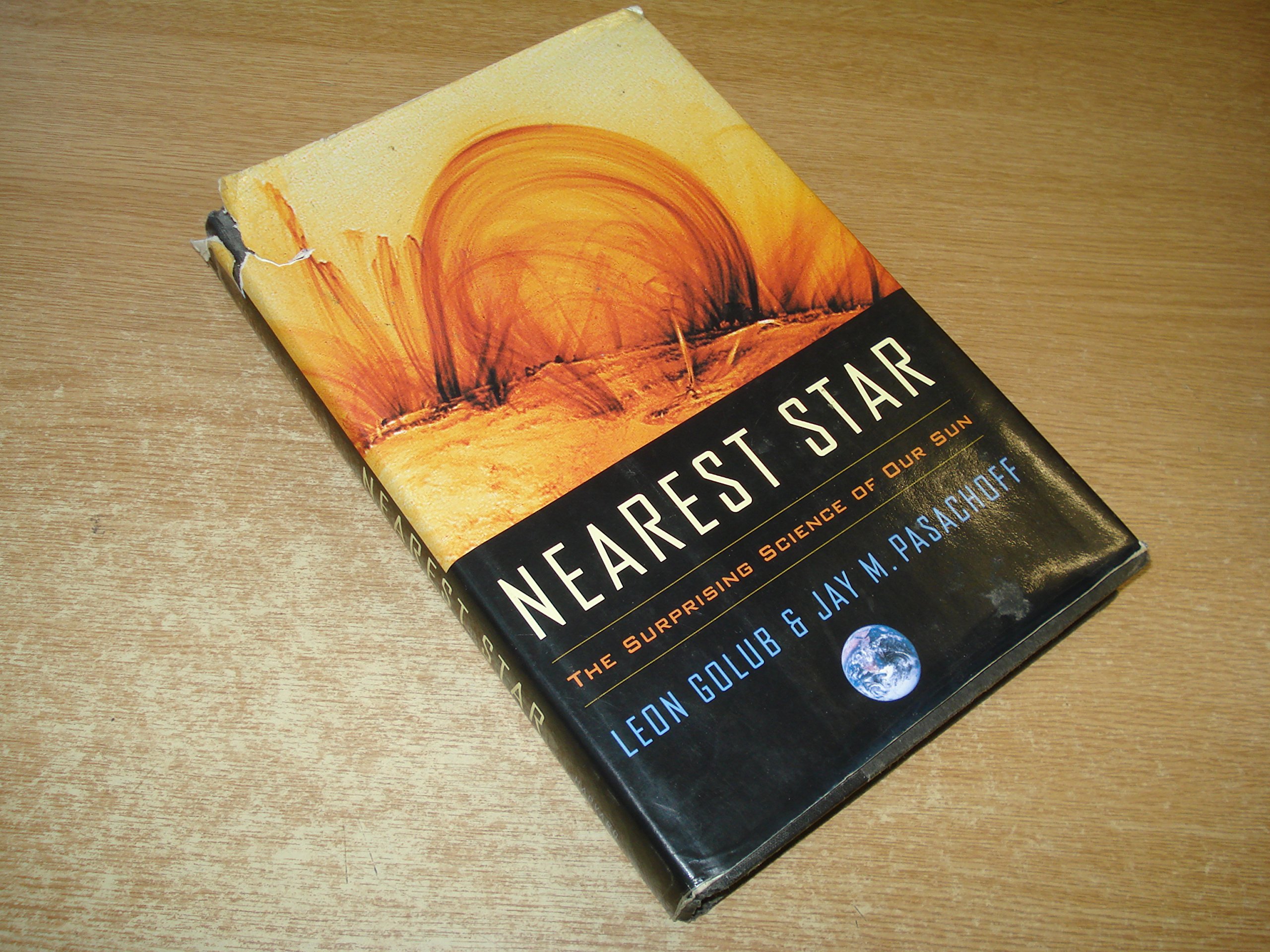



Unlike the myriad points of light we gaze at in the night sky, our nearest star allows us to study the wonders of stellar workings at blindingly close range--from a mere 93 million miles away. And what do we see? In this book, two of the world's leading solar scientists unfold all that history and science--from the first cursory observations to the measurements obtained by the latest state-of-the-art instruments on the ground and in space--have revealed about the Sun. Following the path of science from the very center of this 380,000,000,000,000,000,000-megawatt furnace to its explosive surface, Nearest Star invites readers into an open-ended narrative of discovery about what we know about the Sun and how we have learned it. How did the Sun evolve, and what will it become? What is the origin of its light and heat? How does solar activity affect the atmospheric conditions that make life on earth possible? These are the questions at the heart of solar physics, and at the center of this book. Having made optical solar observations with many solar telescopes and in the rockets and satellites, the authors bring their extensive personal experience to this story of how astronomers study the Sun, and what they have discovered about phenomena from eclipses to neutrinos, space weather, and global warming. Richly illustrated with an assortment of pictures from the latest solar missions and the newest telescopes, this book is a very readable, up-to-date account of science's encounter with our nearest star. Coauthors Golub (astrophysics, Harvard Smithsonian Ctr. for Astrophysics) and Pasachoff (astronomy, Williams Coll.) describe for a nonspecialist audience what is currently known of the structure of the sun, the source of its enormous energy, its history and future, its various effects on Earth and its atmosphere, and the fascinating phenomena that occur during total solar eclipses. Some relevant tales from the history of solar research are also included. The strength of the book is that it is a "state of the art" report from two bona fide experts in the field. Weak portions of the work include the introductory chapter, which plunges readers into the thick of the subject matter, and a section that describes various future space missions. The latter portion is tedious, with many acronyms and technical details. The authors would have done well to omit this section and devote more attention to the details of the nuclear fusion processes that supply the sun's energy. With these reservations, the book is recommended for public and academic libraries. Jack W. Weigel, Ann Arbor, MI Copyright 2001 Reed Business Information, Inc. For an object that has remained generally the same for billions of years (without such equability, life on Earth never could have flowered and thrived), the sun is stunningly turbulent and changeable. Golub and Pasachoff, who study the sun professionally, offer amateurs a brilliant, richly illustrated survey of the current state of solar knowledge. That knowledge is amassed most vitally from analyzing the spectra of light, whose varying wavelengths dictate how deeply into the sun astrophysicists may observe. Another source of information is, amazingly, sound and seismic waves, and solar eclipses still attract scientists who study the corona. Although we know now that nuclear fusion powers the sun's pyrotechnics, the detailed workings of its core still puzzles us, for the core produces fewer neutrinos than had been theorized, and its causation of the sun's enormously powerful magnetic field is a complete mystery, as is its relation to the 11-year sunspot cycle. Golub and Pasachoff describe the sun's dynamism and effects on Earth in a crystalline, nontechnical fashion perfectly suited to nonspecialist readers. Gilbert Taylor Copyright © American Library Association. All rights reserved Soul-stirring, mind-blowing reading...[Golub and Pasachoff] have put together a superb profile of the sun. They don't assume any special knowledge on the part of their readers, so they explain their subject starting with broad overviews and theories...and they glide smoothly between fundamental questions...and more arcane but immediately relevant topics...[Their] discussions...can take your breath away...The sun is simply peerless from any angle and this enlightening biography shows it in all its glory--as bright as daylight. ( Kirkus Reviews 2001-03-01) A brilliant, richly illustrated survey of the current state of solar knowledge...Golub and Pasachoff describe the sun's dynamism and effects on Earth in a crystalline, nontechnical fashion perfectly suited to nonspecialist readers. (Gilbert Taylor Booklist 2001-03-01) Coauthors Golub and Pasachoff...describe for a nonspecialist audience what is currently known of the structure of the sun, the source of its enormous energy, its history and future, its various effects on Earth and its atmosphere, and the fascinating phenomena that occur during total solar ecli