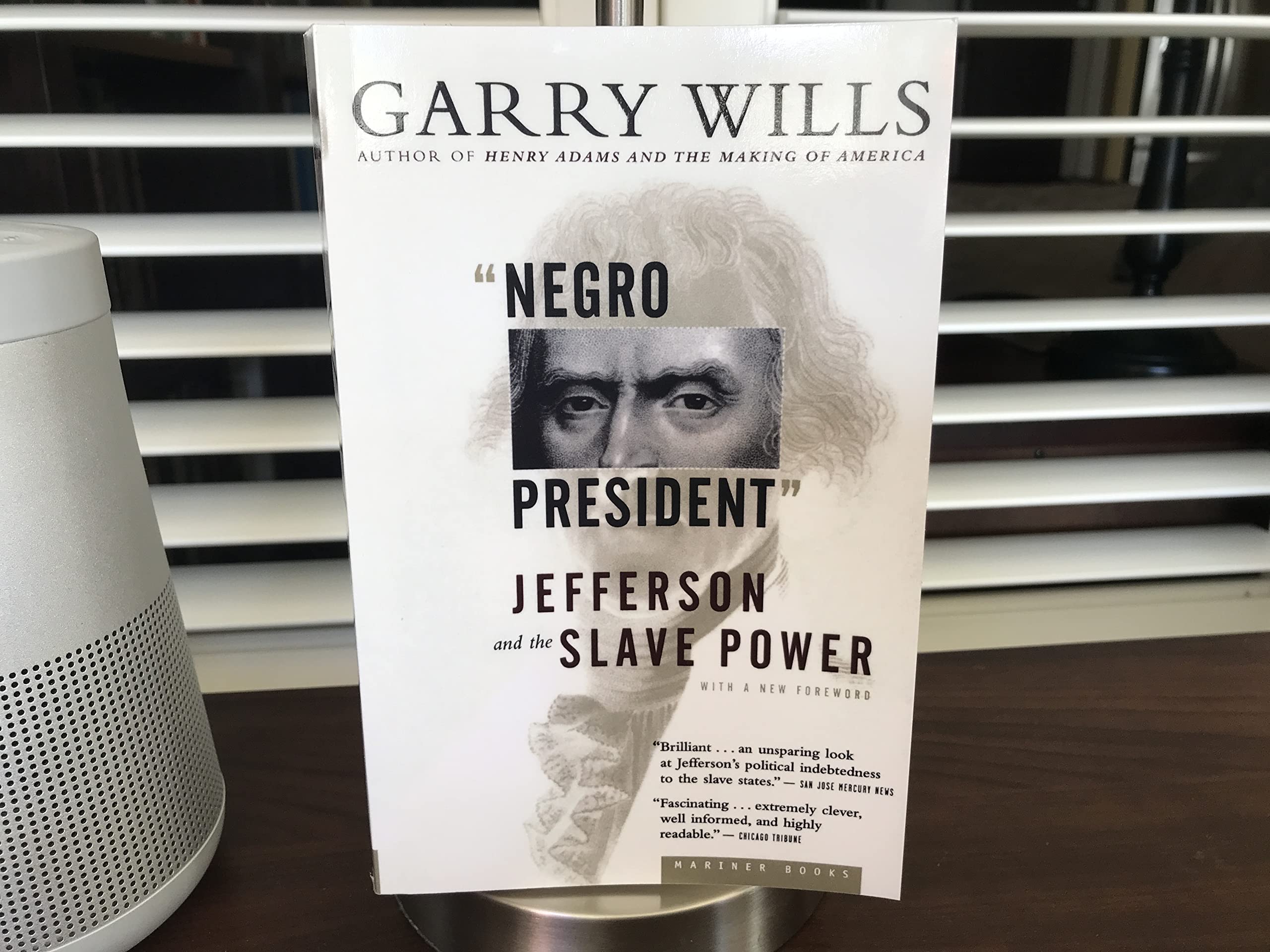



Offers a new look at Thomas Jefferson and his presidency, his election due to the "slave power" vote, the relationship between the power of the slave states and his administration's policies, and the opposition he faced. Garry Wills' "Negro President": Jefferson and the Slave Power , despite its title, is not a profile of the Jefferson Presidency. Rather, the book offers a richly detailed study of the United States' tragic constitutional bargain with slavery, and meanders through the lives of several key figures in antebellum American history along the way. While Thomas Jefferson does play a significant role in Wills' book, the real heroes are the relatively unknown abolitionist Timothy Pickering and, to a lesser degree, John Quincy Adams. Pickering offered a consistent voice of opposition to Jefferson's often secret campaign against Federalist power. Though he could never match Jefferson's charismatic persona, Pickering succeeded in his battle to undo Jefferson's embargo of England--an embargo that Pickering recognized as Jefferson's attempt to undermine the economic prosperity and power of the North. Pickering's ill-fated attempt to secede from the Union, while misguided, would fuel the latter-day abolitionist John Quincy Adams to threaten a similar revolution as the Civil War loomed. Ultimately, "Negro President" is a book that recovers slavery as a context for understanding early American political life. At times Willis focuses too much on Jefferson, Pickering, or Adams, and the discussion is derailed by his fascination for the moral successes and failures of each personality. Nevertheless, the book addresses a long-neglected subject in American studies and will prove invaluable to readers interested in understanding America's early struggle to balance Northern versus slave-state power. --Patrick O'Kelley Bashing Thomas Jefferson threatens to become a national pastime. Many of the recent attacks on Jefferson, particularly those by Joseph Ellis, are unfair and mean spirited. However, Pulitzer Prize-winning historian Wills is an unabashed admirer of Jefferson. So, his analyses of some of Jefferson's actions as secretary of state, president, and the "sage of Monticello" after his presidency cannot be easily dismissed. Wills begins with the premise that the "three-fifths compromise" at the Constitutional Convention ensured southern slave-state domination of the Federal government until the eve of the Civil War. With slave populations counted, southern states were granted "unfair" representation in the House of Representatives. They also had inflated power in the electoral college, which gave Jefferson victory in the extremely close election of 1800. Jefferson believed passionately in "agrarian virtues," and he feared the growing economic and political power of the northern states. Wills asserts that many of Jefferson's actions, including his hostility to the Haitian revolution and his opposition to the Missouri Compromise, were efforts to fight dilution of the political power of southern states. The result of his actions, of course, was to maintain the "slave power" of a relatively small number of plantation owners. Wills takes no joy in his criticism. Rather, he views Jefferson as well as many other southern politicians as trapped by an evil system they still felt obliged to defend. This is an important and disturbing book, which will undoubtedly intensify the ongoing controversy regarding Jefferson and slavery. Jay Freeman Copyright © American Library Association. All rights reserved "An eye-opening, carefully argued expose of . . . one of the big sleeper issues in American political history." -- Review GARRY WILLS, a distinguished historian and critic, is the author of numerous books, including the Pulitzer Prize–winning Lincoln at Gettysburg, Saint Augustine, and the best-selling Why I Am a Catholic. A regular contributor to the New York Review of Books, he has won many awards, among them two National Book Critics Circle Awards and the 1998 National Medal for the Humanities. He is a history professor emeritus at Northwestern University. Introduction: The Three-Fifths Clause The election of Mr. Jefferson to the presidency was, upon sectional feelings, the triumph of the South over the North — of the slave representation over the purely free. — John Quincy Adams What did Thomas Jefferson"s Federalist critics mean, after 1800, when they called him the "Negro President"? A person first encountering the term might, in the not too distant past, have thought it referred to Jefferson"s private life at Monticello. In those hagiographical days, calling him a "Negro president" might have been interpreted to mean that he was a pro-Negro president, an ami des noirs who sympathized with the plight of slaves, though he could not do much about it. That was the line I heard when I first visited Monticello more than forty years ago. More recently still, the term might be taken to mean that he lov