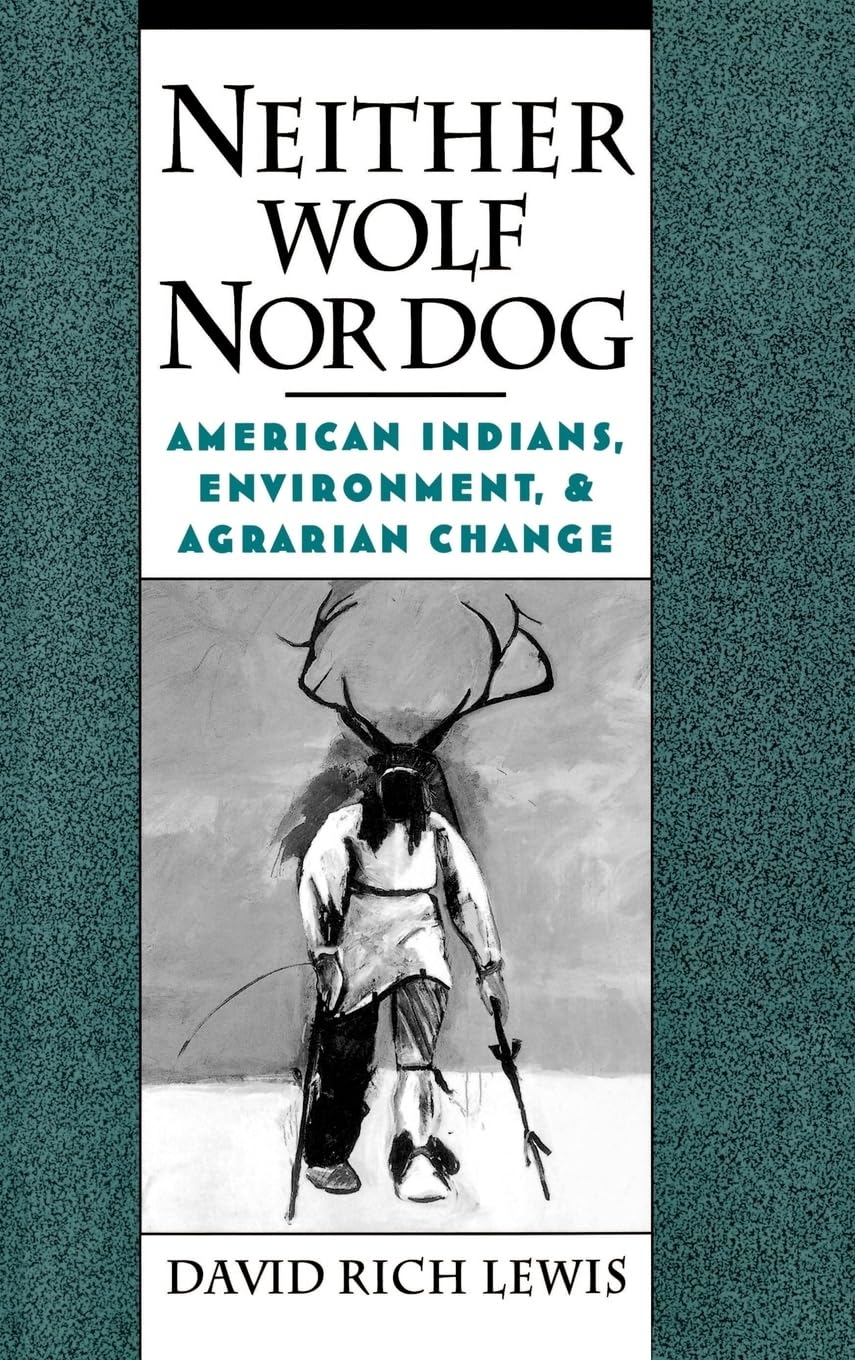
Neither Wolf Nor Dog: American Indians, Environment, and Agrarian Change
$31.37
by David Rich Lewis



During the nineteenth century, Americans looked to the eventual civilization and assimilation of Native Americans through a process of removal, reservation, and directed culture change. Policies for directed subsistence change and incorporation had far-reaching social and environmental consequences for native peoples and native lands. This study explores the experiences of three groups--Northern Utes, Hupas, and Tohono O'odhams--with settled reservation and allotted agriculture in the nineteenth and twentieth centuries. Each group inhabited a different environment, and their cultural traditions reflected distinct subsistence adaptations to life in the western United States. Each experienced the full weight of federal agrarian policy yet responded differently, in culturally consistent ways, to subsistence change and the resulting social and environmental consequences. Attempts to establish successful agricultural economies ultimately failed as each group reproduced their own cultural values in a diminished and rapidly changing environment. In the end, such policies and agrarian experiences left Indian farmers marginally incorporated and economically dependent. "An important addition to the growing body of literature about the origins of Native American economic dependency....Recommended for readers at all levels."-- CHOICE "The solid prose in Neither Wolf Nor Dog reflects thorough research and scholarship....By making American Indians historical actors and by listening to their voices, Lewis makes this a model study."-- Nebraska History "An excellent book....This study will be useful for anyone interested in the agricultural and environmental history of the West. Moreover, much of his study concerns the twentieth century, and it can be used to generalize about the agricultural and environmental experiences of Native Americans throughout the region as they attempted to accommodate a white-controlled world."-- Environmental History Review "David Rich Lewis has written an extraordinarily perceptive analysis of attempts of the United States to force agriculture upon three nineteenth-century Native American tribes....Lewis's book is well-researched, documented, and nicely-written. It will be useful to students and scholars in a variety of disciplines surrounding western American history and Native American studies. I highly recommend the book."-- New Mexico Historical Review "[A] highly sophisticated study."-- Utah Historical Quarterly "David Richard Lewis's Neither Wolf Nor Dog provides a richly detailed history..."-- Wisconsin Magazine of History " Neither Wolf Nor Dog is a splendid book that represents the best in current ethnohistorical writing."-- The Annals of Iowa "David Rich Lewis has produced a rich, interdisciplinary Romparative study....This is an important book....His work strongly suggests even broader inquiry."-- Montana During the nineteenth century, Americans looked to the eventual civilization and assimilation of Native Americans through a process of removal, reservation, and directed culture change. Underlying American Indian policy was a belief in a developmental stage theory of human societies in which agriculture marked the passage between barbarism and civilization. Solving the "Indian Problem" appeared as simple as teaching Indians to settle down and farm and then disappear into mainstream American society. Such policies for directed subsistence change and incorporation had far-reaching social and environmental consequences for native peoples and native lands. This study explores the experiences of three groups - Northern Utes, Hupas, and Tohono O'odhams - with settled reservation and allotted agriculture in the nineteenth and twentieth centuries. Each group inhabited a different environment, and their cultural traditions reflected distinct subsistence adaptations to life in the western United States. Each experienced the full weight of federal agrarian policy yet responded differently, in culturally consistent ways, to subsistence change and the resulting social and environmental consequences. Attempts to establish successful agricultural economies ultimately failed as each group reproduced its own cultural values in a diminished and rapidly changing environment. In the end, such policies and agrarian experiences left Indian farmers economically dependent and on the periphery of American society. David Rich Lewis is at Utah State University.