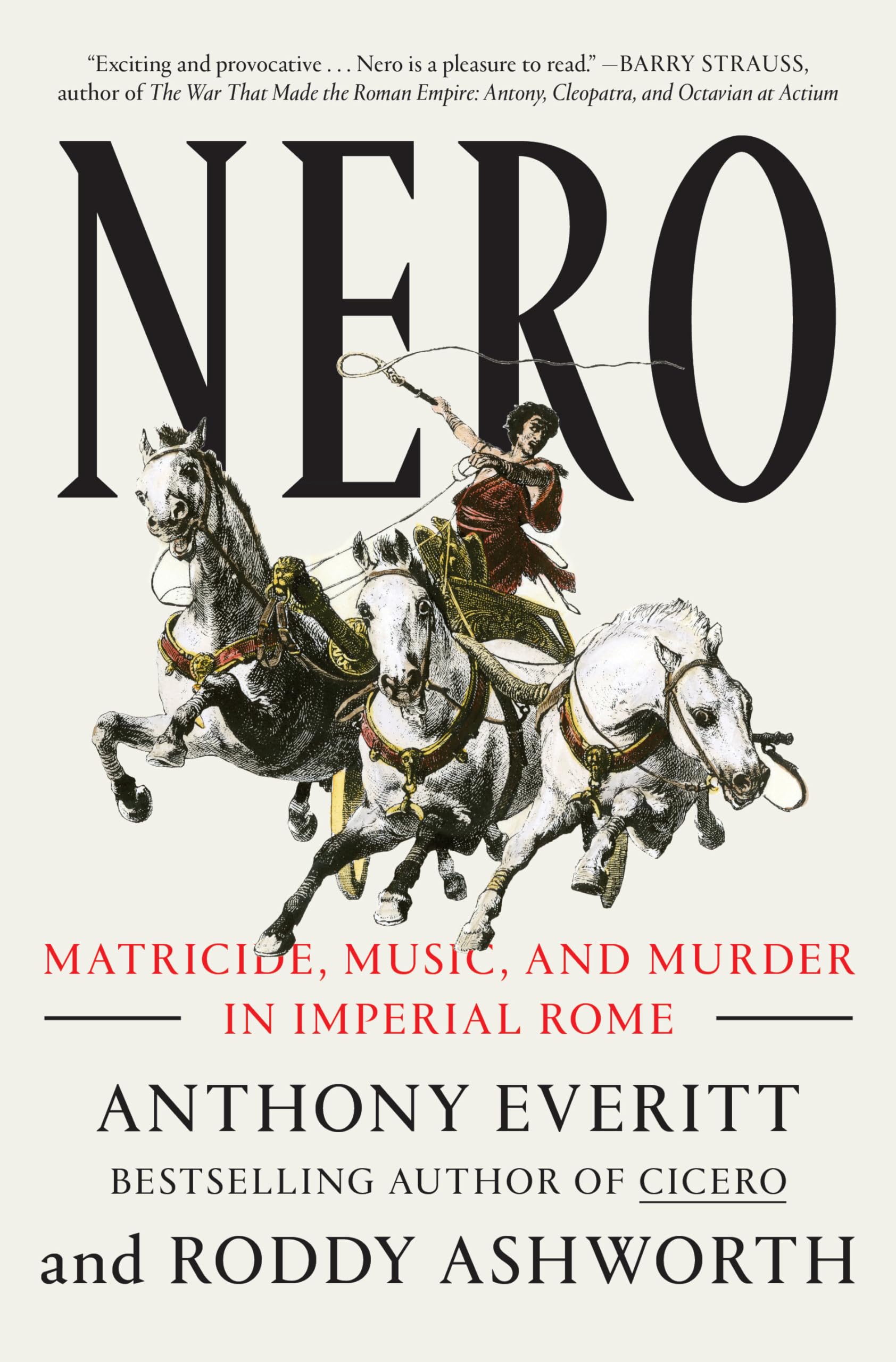



A striking, nuanced biography of Nero—the controversial populist ruler and last of the Caesars—and a vivid portrait of ancient Rome “Exciting and provocative . . . Nero is a pleasure to read.”—Barry Strauss, author of The War That Made the Roman Empire: Antony, Cleopatra, and Octavian at Actium The Roman emperor Nero’s name has long been a byword for cruelty, decadence, and despotism. As the stories go, he set fire to Rome and thrummed his lyre as it burned. He then cleared the charred ruins and built a vast palace. He committed incest with his mother, who had schemed and killed to place him on the throne, and later murdered her. But these stories, left behind by contemporary historians who hated him, are hardly the full picture, and in this nuanced biography, celebrated historian Anthony Everitt and investigative journalist Roddy Ashworth reveal the contradictions inherent in Nero and offer a reappraisal of his life. Contrary to popular memory, the empire was well managed during his reign. He presided over diplomatic triumphs, and his legions overcame the fiery British queen Boudica who led one of the greatest revolts Rome had ever had to face. He loved art, culture, and music, and he won the loyalty of the lower classes with fantastic spectacles. He did not set fire to Rome. In Nero , ancient Rome comes to life: the fire-prone streets, the deadly political intrigues, and the ongoing architectural projects. In this teeming, politically unstable world, Nero was vulnerable to fierce reproach from the nobility and relatives who would gladly usurp him, and he was often too ready to murder rivals. He had a vision for Rome, but, racked by insecurity, he perhaps lacked the stomach to govern it. This is the bloodstained story of one of Rome’s most notorious emperors: but in Everitt and Ashworth’s hands, Nero’s life is also a complicated, cautionary tale about the mettle required to rule. “This exciting and provocative book grabs the reader while supporting its arguments with careful classical scholarship. The authors write with authority and elegance. Nero is a pleasure to read.” —Barry Strauss, author of The War That Made the Roman Empire: Antony, Cleopatra, and Octavian at Actium “A nuanced biography of Roman emperor Nero, who ruled from 54 to 68 BCE . . . [Anthony Everitt and Roddy Ashworth] evoke the period with wit and precision. Ancient history buffs will be pleased.” — Publishers Weekly Praise for Anthony Everitt Alexander the Great “Reads as easily as a novel . . . [Anthony] Everitt has a wealth of anecdotes and two millennia of histories to work with, and he delivers and interprets them flawlessly. Nearly unparalleled insight into the period and the man make this a story for everyone.” — Kirkus Reviews (starred review) The Rise of Rome “Fascinating history and a great read.” — Chicago Sun-Times “Everitt writes for the informed and the uninformed general reader alike, in a brisk, conversational style, with a modern attitude of skepticism and realism.” — The Dallas Morning News “Elegant, swift and faultless.” — The Spectator Anthony Everitt , a former visiting professor in the visual and performing arts at Nottingham Trent University, has written extensively on European and classical culture. He is the author of Cicero , Augustus , Alexander the Great , Hadrian and the Triumph of Rome , The Rise of Rome , and The Rise of Athens . He has served as secretary general of the Arts Council of Great Britain and lives near Colchester, England’s first recorded town, founded by the Romans. Roddy Ashworth is an award-winning investigative journalist, former national news editor, and visiting lecturer in media ethics at City University, London. Chapter 1 The New Order The youth was seventeen years old. His face had the temporary good looks of the teenager, but an observant eye could detect the unappealing lineaments of the man-to-be. He was of average height, with light blond hair and blue eyes. He was somewhat shortsighted. His neck was too thick, his body spotty and, apparently, malodorous. His legs were spindly and his stomach protruded. This was Nero—or, to give him his full name and titles, Nero Claudius Caesar Augustus Germanicus. It was the autumn of a.d. 54 and he had just become emperor of Rome. Surrounded by senior politicians, all wearing the dark togas of mourning, he was leading the funeral rites of his predecessor and adoptive father, Tiberius Claudius Caesar Augustus Germanicus, whom we know more succinctly as Claudius. The ceremony unfolded on the Campus Martius, the Field of Mars, a five-hundred-acre grassland that stretched away north of Rome’s city walls. It was a lung for the world’s first megalopolis, which was home to an estimated one million inhabitants. The Campus was a park, dotted with temples and other public buildings, and people of every class escaped there from the city’s noise, crowds, and smells and engaged in leisure pursuits. The wealthy