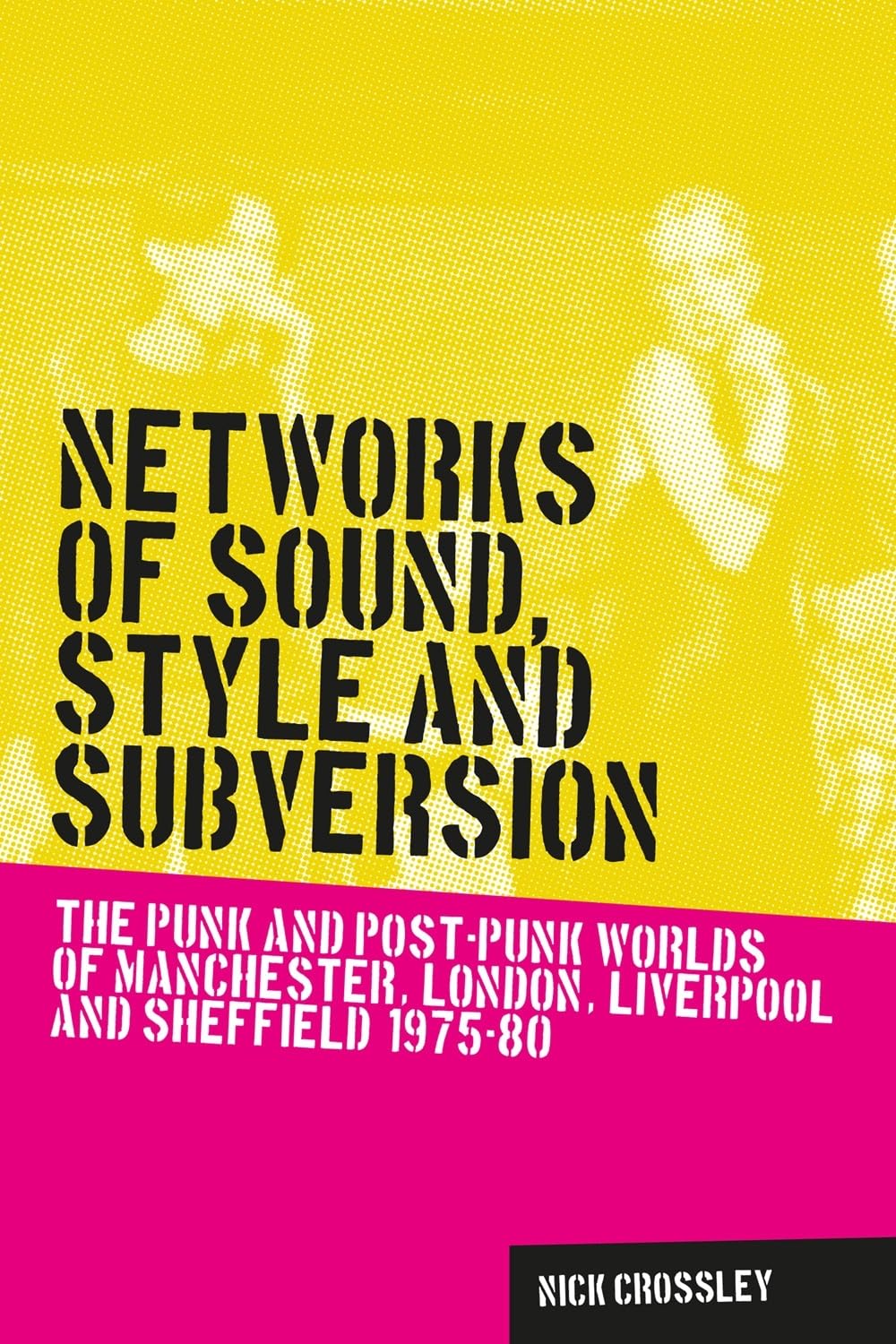
Networks of sound, style and subversion: The punk and post–punk worlds of Manchester, London, Liverpool and Sheffield, 1975–80 (Music and Society)
$88.12
by Nick Crossley



This book examines the birth of punk in the UK and its transformation, within a short period of time, into post-punk. Deploying innovative concepts of ‘critical mass’, ‘social networks’ and ‘music worlds’, and using sophisticated techniques of ‘social network analysis’, it teases out the events and mechanisms involved in punk’s ‘micro-mobilisation’, its diffusion across the UK and its transformation in certain city-based strongholds into a variety of interlocking post-punk forms. Nick Crossley offers a detailed review of prior work in this area, a rich exploration of new empirical data and a highly innovative and robust approach to the study of ‘music worlds’. Written in an accessible style, this book is essential reading for anybody with an interest in either UK punk and post-punk or the impact of social networks on cultural life and the potential of social network analysis to explore this impact. In sum, Networks of Sound, Style and Subversion can be appreciated on a number of different levels: as a case study of micro-mobilisation, as a demonstration of the explanatory powers of social network analysis, and as an account of 1970s punk and post-punk that breathes new life into a well worn subject. 'This book should appeal ultimately not just to scholars of punk or post-punk, but also to anyone interested in the process through which musical styles emerge.' Brian F. Wright, Fairmont State University, Quarterly Journal of the Music Library Association, June 2016 ‘This is the most recent contribution to punk scholarship and in many ways one of the most sophisticated, both in terms of empirical research and data analysis.’ WILKINSON, D., WORLEY, M. and STREET, J. (2016) ‘“I Wanna See Some History”: Recent Writing on British Punk’, Contemporary European History , pp. 1–15 This book examines the birth of punk in the UK and its transformation, within a short period of time, into post-punk. In this important book Nick Crossley examines the birth of punk in the UK and its transformation, within a short period of time, into post-punk. Dominant explanations of these developments have tended to focus upon strains and frustrations, both social and aesthetic, which are said to have provoked a generation of young people into rebellious action. Crossley identifies a number of problems with such explanations, stressing in particular their failure to explore punk s micro-mobilisation . UK punk emerged within the interactions of a small, circumscribed and geographically concentrated network of music enthusiasts, he argues, and sociological analysis of it must start there; with this network and the events and mechanisms which allowed it to grow to a national scale, diffusing punk culture. Similarly, to fully understand post-punk we must investigate the various city-based networks, generated in some part through excitement about punk, which incubated both frustration at what it soon became and creative attempts to transcend its limitations.Deploying innovative concepts of critical mass , social networks and music worlds , and using sophisticated techniques of social network analysis, Crossley engages with the detail of punk s emergence, diffusion and subsequent transformation into post-punk, offering a highly original and robust account of these fascinating and culturally important processes.Written in an accessible style, this book is essential reading for anybody with an interest in either UK punk and post-punk or the impact of social networks on cultural life and the potential of social network analysis to explore this impact. In this important book Nick Crossley examines the birth of punk in the UK and its transformation, within a short period of time, into post-punk. Dominant explanations of these developments have tended to focus upon strains and frustrations, both social and aesthetic, which are said to have provoked a generation of young people into rebellious action. Crossley identifies a number of problems with such explanations, stressing in particular their failure to explore punk’s ‘micro-mobilisation’. UK punk emerged within the interactions of a small, circumscribed and geographically concentrated network of music enthusiasts, he argues, and sociological analysis of it must start there; with this network and the events and mechanisms which allowed it to grow to a national scale, diffusing punk culture. Similarly, to fully understand post-punk we must investigate the various city-based networks, generated in some part through excitement about punk, which incubated both frustration at what it soon became and creative attempts to transcend its limitations. Deploying innovative concepts of ‘critical mass’, ‘social networks’ and ‘music worlds’, and using sophisticated techniques of social network analysis, Crossley engages with the detail of punk’s emergence, diffusion and subsequent transformation into post-punk, offering a highly original and robust account of these fascinating and culturally important proces