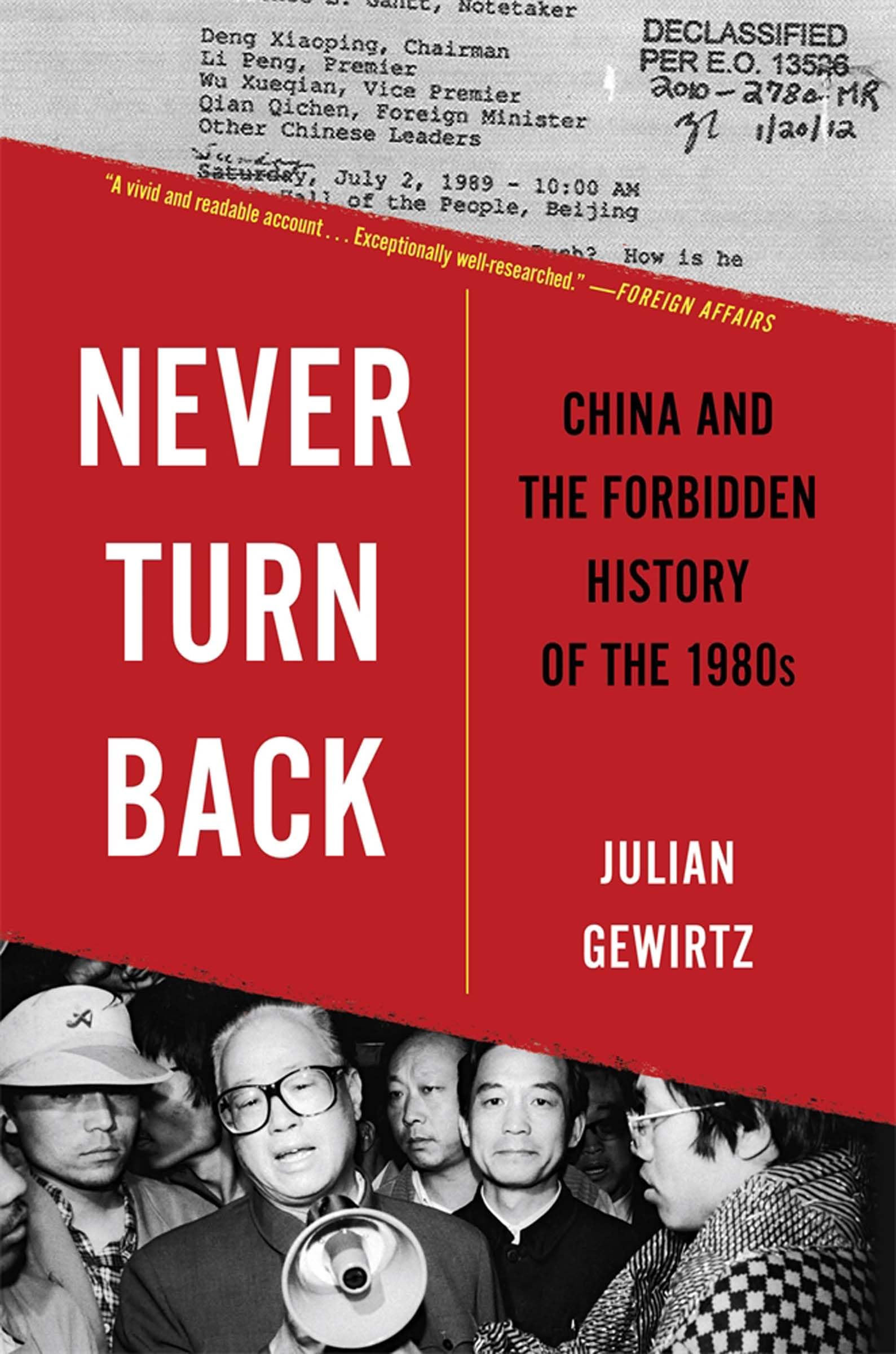



A Foreign Affairs Best Book of the Year A BBC History Magazine Best Book of the Year “Excellent…A fascinating, authoritative account of the paths for China’s future explored during a decade long buried by official, state-sponsored history.”―Julia Lovell, Foreign Policy “A vivid and readable account…Exceptionally well-researched.” ―Andrew Nathan, Foreign Affairs "The definitive book on China in the 1980s in terms of the depth of research and originality of the argument." ―Minxin Pei, author of The Sentinel State "A gift to our understanding of today’s China."―Evan Osnos, author of Age of Ambition On a hike in Guangdong Province in January 1984, Deng Xiaoping was warned that his path was a steep and treacherous one. “Never turn back,” the Chinese leader replied. That became a mantra as the government forged ahead with reforms in the face of heated contestation over the nation’s future. Recovering the debates of China in the 1980s, Julian Gewirtz traces the Communist Party’s diverse attitudes toward markets, state control, and sweeping technological change, as well as freewheeling public argument over political liberalization. Deng Xiaoping’s administration considered bold proposals from within the party and without, but after Tiananmen, Beijing systematically erased these discussions of alternative directions. Using newly available Chinese sources, Gewirtz details how the leadership purged the key reformist politician Zhao Ziyang, quashed the student movement, recast the transformations of the 1980s as the inevitable products of consensus, and indoctrinated China and the international community in the new official narrative. Never Turn Back offers a revelatory look at how different China’s rise might have been and at the foundations of strongman rule under Xi Jinping, who has intensified the policing of history to bolster his own authority. “A vivid and readable account of the period from Mao’s death until shortly after Tiananmen, with a focus on the role of Zhao [Ziyang]…It is easy to see why Gewirtz believes that had Zhao stayed in power, he would have fundamentally changed China…Exceptionally well-researched.” ― Andrew J. Nathan , Foreign Affairs “A richly researched addition to this literature, enhanced by access to internal Chinese documents and interviews with former officials and intellectuals active at the time.” ― The Economist “Excellent…provides the most detailed analysis so far written in English of the intense arguments about China’s political, economic, and social futures that raged throughout the 1980s…A fascinating, authoritative account of the paths for China’s future explored during a decade long buried by official, state-sponsored history.” ― Julia Lovell , Foreign Policy “[This book’s] aim is to refresh our understanding of the role played by Zhao in the shaping of modern China as well as to revive his luster as a statesman.” ― Tunku Varadarajan , Wall Street Journal “Well-written and accessible to nonspecialist readers, Never Turn Back deserves to become the definitive history of the 1980s’ open-ended political exploration and its suppression.” ― Sabina Knight , Los Angeles Review of Books “Gewirtz looks at the road not taken―and a tantalizing glimpse, perhaps, at the political possibilities that remain still.” ― Emily Feng , NPR Books “A delectable rehabilitation of a momentous decade…Today, China touts its brand of state capitalism as though it were an item plucked―with supreme foresight and wisdom―from the menu of modernity. Gewirtz debunks this myth and shows us how China came to convince the world of it.” ― Chang Che , New Republic “Gewirtz challenges many preconceptions about China and its history…He develops an almost literary arc of a tragic, yet forgotten figure in the character of Zhao Ziyang. In this way, Zhao becomes a metaphor for China itself. It conveys a desire to reform, yet a tragic flaw prevents genuine reform from taking hold.” ― Justin Kempf , Democracy’s Paradox “The question of when and how things went wrong in China is also the focus of Julian Gewirtz’s important new book…As Gewirtz shows, the ‘reform and opening’ associated with Deng Xiaoping led not just to an economic transformation but to a period of intellectual turmoil, in which all sorts of hitherto forbidden ideas were debated.” ― Gideon Rachman , Financial Times “Gewirtz depicts the critical decade of the 1980s, when China began its economic takeoff, as a time of intellectual ferment and ardent experimentation driven for the most part by two ill-fated lieutenants of Deng, Hu Yaobang and Zhao Ziyang.” ― Howard W. French , New York Review of Books “As this robust work of narrative scholarship shows, the Eighties was an era of free-ranging debate and diversity of opinion towards everything from opening the economy to political liberalization, and even the separation of Party and state and an independent judiciary. Gewirtz…illustrates how the upheav