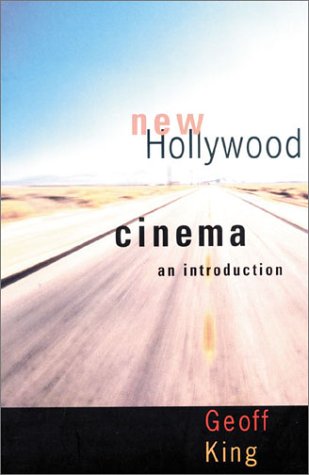



What is "New Hollywood"? The "art" cinema of the Hollywood "Renaissance" or the corporate controlled blockbuster? The introverted world of Travis Bickle or the action heroics of Indiana Jones, Buzz Lightyear, and Maximus the Gladiator? Innovative departures from the "classical" Hollywood style or superficial glitz, special effects, and borrowings from MTV? Wholesale change or important continuities with Hollywood's past? The answer suggested by Geoff King in New Hollywood Cinema is all of these and more. He examines New Hollywood from three main perspectives: film style, industry, and the social-historical context. Each is considered in its own right, sometimes resulting in different ways of defining New Hollywood. But one of the book's central arguments is that a combination of these approaches is needed if we are to understand the latest incarnations of the cinema that continues to dominate the global market. King looks at the Hollywood "Renaissance" from the late 1960s to the late 1970s, industrial factors shaping the construction of the corporate blockbuster, the role of auteur directors, genre and stardom in New Hollywood, narrative and spectacle in the contemporary blockbuster, and the relationship between production for the big and small screens. Case studies considered include Taxi Driver, Godzilla , and Gladiator , tracing the roots of New Hollywood from the 1950s to the start of the twenty-first century. Examining American filmmaking from both a social and an industrial standpoint, King (media, Brunel Univ., West London) seeks to define the "New Hollywood." He begins with an analysis of key films from Tinseltown's Renaissance in the late 1960s (e.g., Bonnie and Clyde, The Graduate, Easy Rider) before exploring changes in the realms of film authorship, genre, stars, narrative vs. spectacle, and big screen vs. small screen (TV) in the 1980s and 1990s. His discussion of genre is one of the most reasonable to be found anywhere. Also illuminating is a comparison between Spartacus and Gladiator from such perspectives as director/camera detachment and average shot length (ASL). It will not surprise veteran moviegoers that Spartacus's ASL was 7.89 seconds while Gladiator's was 3.36. (King also realizes that Gladiator bears much resemblance to 1964's The Fall of the Roman Empire.) This work, which may be supplemented by Ray Greene's more downbeat Hollywood Migraine: The Inside Story of a Decade in Film, confirms that British film historians generally outperform their American cousins. Recommended for academic and larger public libraries. Kim Holston, American Inst. for Chartered Property Casualty Underwriters, Malvern, PA Copyright 2002 Reed Business Information, Inc. When some film buffs speak of "New Hollywood," they are referring to the artistic renaissance of the late 1960s and '70s, when directors like Scorsese and Coppola shook up the studio system; others use the label to describe the blockbuster phenomenon launched in the '70s by Jaws and Star Wars , and continued by even-more-corporate behemoths ever since. For King, the term encompasses both, and he ambitiously attempts to show how the Hollywood product of the past three decades differs from that of the studio era in filmmaking style ("post-classical," he calls the more recent kind), industrial context, and sociohistorical context. He has a good handle on both the commercial and the artistic aspects of cinema, which is necessary for comprehending the topic, and he states his case in an academic yet generally accessible manner. He gets theoretical at times, but through such effective procedures as a detailed comparison, down to each film's average shot length, of Spartacus (1960) and Gladiator (2000), he clearly demonstrates the progression--or regression--of the industry. Gordon Flagg Copyright © American Library Association. All rights reserved A first-rate contribution to the field of film studies. (Chris Wyatt Cinescape ) Whatever your opinion of developments in American cinema over the last 30 years, you will be confirmed and challenged by King's aim of showing how these films can be approached and discussed in more than one way.... this is going to be a useful resource for student, tutor, aficionado and historian alike. ( Film Quarterly ) King has a good handle on both the commercial and the artistic aspects of cinema, which is necessary for comprehending the topic, and he states his case in an academic yet generally accessible manner. ( Booklist ) [King's] discussion of the genre is one of the most reasonable to be found anywhere... recommended. ( Publishers Weekly ) Film professor King explores how popular films of the 60's through the 90's have been affected by Hollywood's primary function as a multibillion-dollar international business. ( Variety ) Geoff King is lecturer in film and television studies at Brunel University in West London. His books include Film Comedy, Spectacular Narratives, and, with Tany