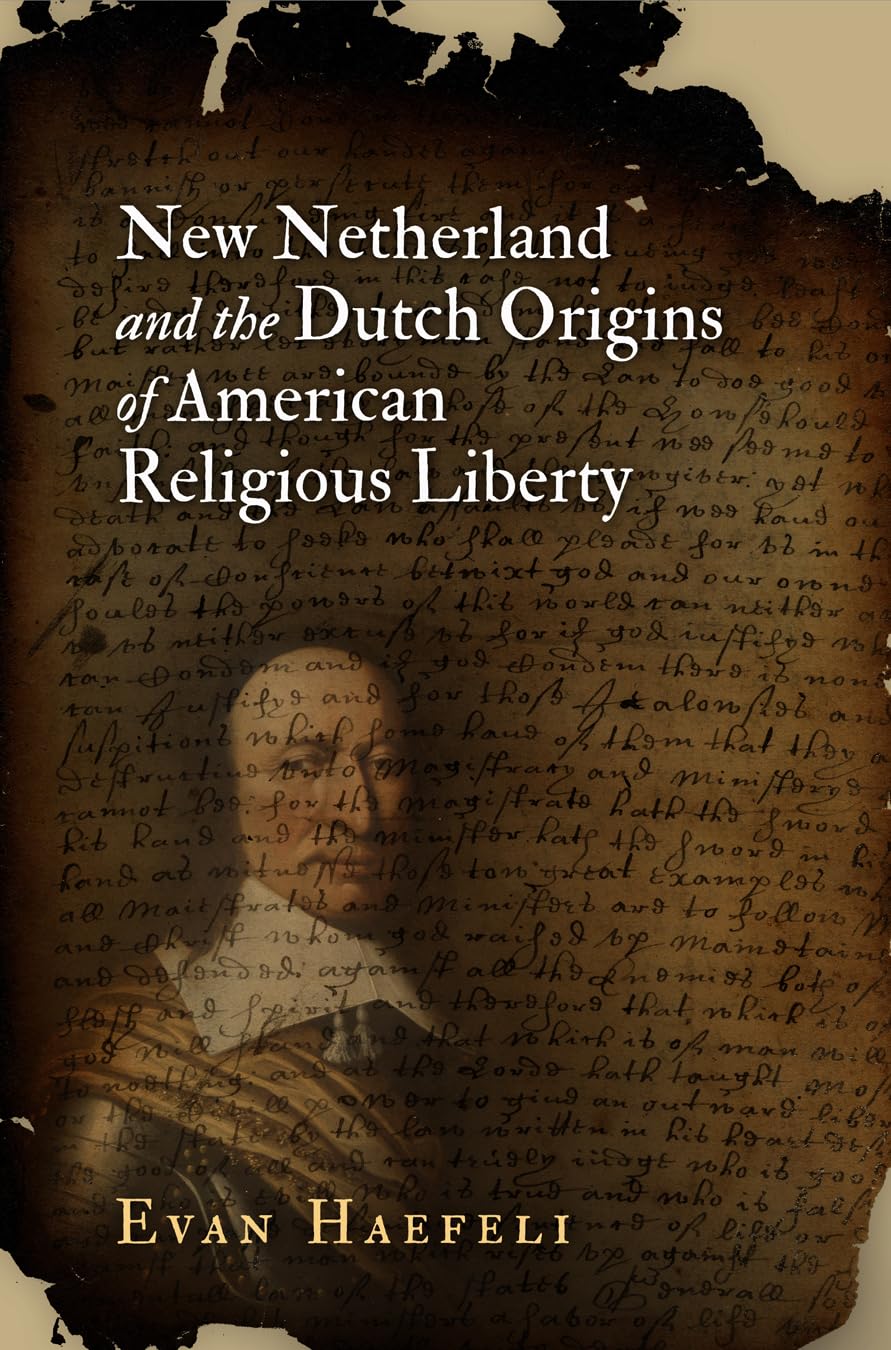
New Netherland and the Dutch Origins of American Religious Liberty (Early American Studies)
$26.50
by Evan Haefeli



The settlers of New Netherland were obligated to uphold religious toleration as a legal right by the Dutch Republic's founding document, the 1579 Union of Utrecht, which stated that "everyone shall remain free in religion and that no one may be persecuted or investigated because of religion." For early American historians this statement, unique in the world at its time, lies at the root of American pluralism. New Netherland and the Dutch Origins of American Religious Liberty offers a new reading of the way tolerance operated in colonial America. Using sources in several languages and looking at laws and ideas as well as their enforcement and resistance, Evan Haefeli shows that, although tolerance as a general principle was respected in the colony, there was a pronounced struggle against it in practice. Crucial to the fate of New Netherland were the changing religious and political dynamics within the English empire. In the end, Haefeli argues, the most crucial factor in laying the groundwork for religious tolerance in colonial America was less what the Dutch did than their loss of the region to the English at a moment when the English were unusually open to religious tolerance. This legacy, often overlooked, turns out to be critical to the history of American religious diversity. By setting Dutch America within its broader imperial context, New Netherland and the Dutch Origins of American Religious Liberty offers a comprehensive and nuanced history of a conflict integral to the histories of the Dutch republic, early America, and religious tolerance. " New Netherland and the Dutch Origins of American Religious Liberty does nothing less than expand and transform our understanding of religious diversity and toleration in colonial Dutch North America. It will become required reading for anyone seriously interested in the early history of the mid-Atlantic colonies, the genesis of religious pluralism in America, or the history of religious toleration in the Dutch world." ― Reviews in History "Through an examination of the too-often neglected Dutch colony of New Netherland that places its subject firmly in the Atlantic context, Evan Haefeli makes vital contributions both to colonial American history and to American religious history writ large." ― Francis Bremer, author of John Winthrop: America's Forgotten Founding Father "Evan Haefeli has written an original and quite provocative study of the alleged Dutch origins of religious toleration as a truly American value. The book eschews oversimplified revaluation and presents a nuanced picture of the colony's religious history. Of particular value is the author's familiarity with the literature in Dutch, quite rare even among American historians of New Netherland." ― Willem Frijhoff, VU University Amsterdam Evan Haefeli is Associate Professor of History at Texas AandM University. Preface Religious tolerance has become a matter of great debate in recent years. When I first wrestled with the topic in the 1990s, it had seemed a fairly straightforward matter. However, since then, incidents and controversies on both sides of the Atlantic coupled with a new burst of more sophisticated scholarship have convinced me that tolerance is a much more complicated matter than we think. Though it is a central theme of American history, there is still much that we do not understand about what tolerance is or how it came to America. Dutch tolerance in particular became a topic of political controversy during the uproar over New York's so-called "9-11 Mosque" in the summer of 2010. Mayor Michael Bloomberg invoked the legacy of Dutch tolerance in defense of the construction of an Islamic religious center in lower Manhattan, while Dutch politician Geert Wilders drew on it to oppose the very same institution. How could the religious tolerance of New Netherland lead to two such diametrically opposed interpretations? Barriers of language, culture, and history make the case of the Dutch and their way of managing toleration particularly difficult for Americans to understand. Nonetheless, as Bloomberg and Wilders made clear, it remains a vital part of American culture and politics. What follows is a new telling of an old story. This is not the first account of religious toleration in New Netherland, nor have I uncovered a trove of hitherto unused sources, though I have cast my research net wider than earlier scholars. Many of the Dutch sources I rely on are published and have been available in English translation for a hundred years or more (though it is always best to go back to the Dutch originals). Yet my version is significantly different from earlier accounts, in both scope and approach. Recent work in several languages by scholars on both sides of the Atlantic has helped me to set the story of Dutch America firmly within its broader Dutch context. Though I am an American historian, and my training and interests in that field led me to this topic, I have gone to some lengt