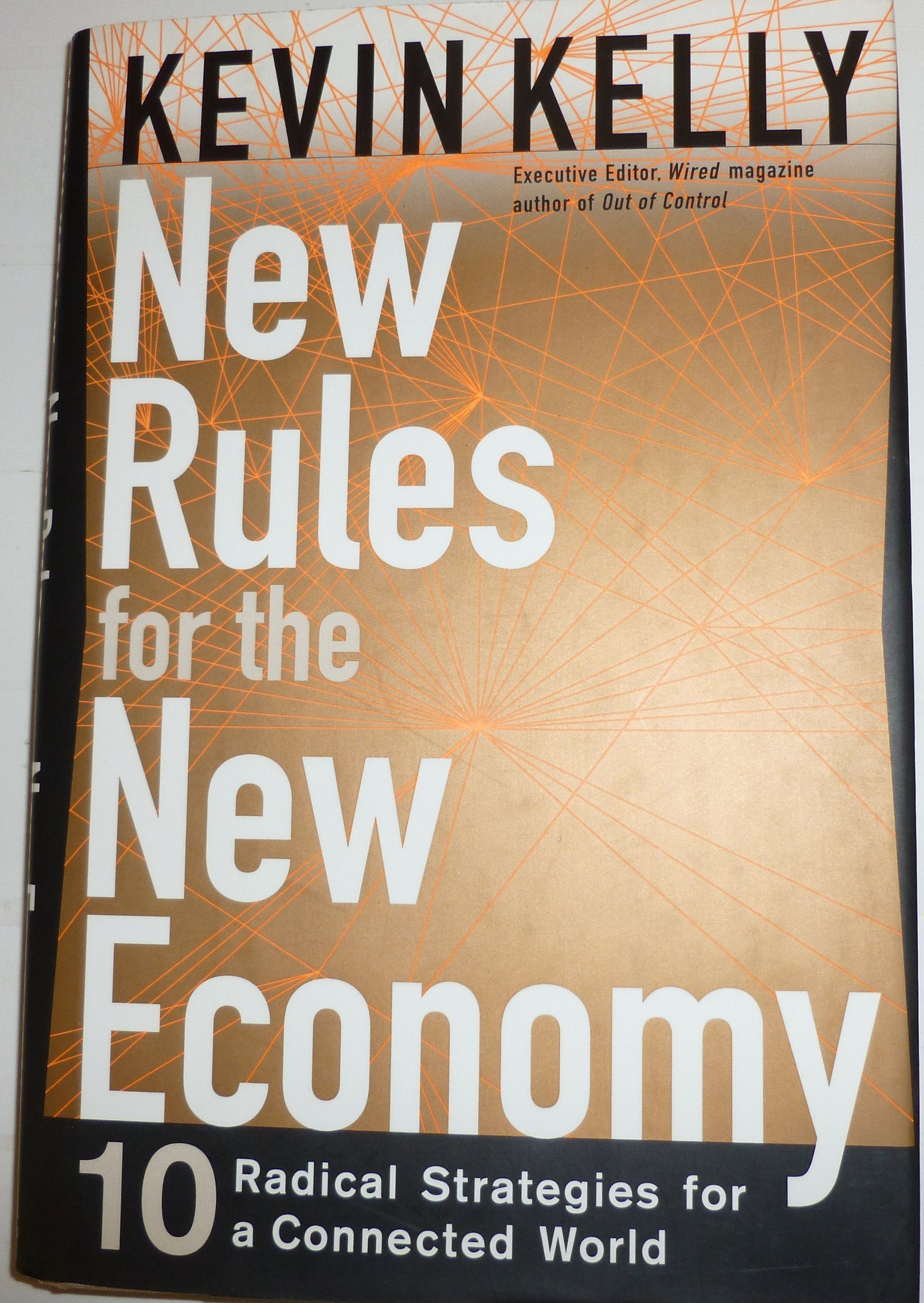
New Rules for the New Economy: 10 Radical Strategies for a Connected World
$20.11
by Kevin Kelly



The executive editor of Wired magazine outlines ten elements of today's global, computer-linked, decentralized business world and offers executives and entrepreneurs clear and specific strategies for succeeding in it. 50,000 first printing. There's hype and then there's the Internet. The widespread emergence of the World Wide Web and the idea of a network economy have set new records for excess in overheated marketing campaigns, breathless newspaper and magazine articles, and topsy-turvy financial markets. From his perch as founding editor of Wired magazine, Kevin Kelly has long been one of the new economy's chief hypesters. In New Rules for the New Economy , Kelly tries to encapsulate the characteristics of this emerging economic order by laying out 10 rules for how the wired world operates. The result is a dizzying, sometimes confusing, but always thought-provoking look at the behavior of networks and their effect on our economic lives. At the root of this network revolution is communication. As Kelly writes: Communication is the foundation of society, of our culture, of our humanity, of our own individual identity, and of all economic systems. This is why networks are such a big deal. Communication is so close to culture and society itself that the effects of technologizing it are beyond the scale of a mere industrial-sector cycle. Communication, and its ally computers, is a special case in economic history. Not because it happens to be the fashionable leading business sector of our day, but because its cultural, technological, and conceptual impacts reverberate at the root of our lives. Kelly's genius lies in synthesizing large amounts of information in unique and interesting ways. His ability to turn a phrase is reflected in the names he gives to his 10 rules, and it makes this book a pleasure to read. Some, for example, are: "Embrace the Swarm: The Power of Decentralization" (Rule 1); "No Harmony, All Flux: Seeking Sustainable Disequilibrium" (Rule 8); and "Let Go at the Top: After Success, Devolution" (Rule 6). A few of his ideas have a kind of Teflon quality that makes them elusive and difficult to evaluate. But that's OK. Like other prognosticators of the future-- Alvin Toffler and John Naisbitt come to mind--Kelly's job is to imagine a new world. Far from hype, New Rules for the New Economy is required reading for anyone pondering business in the not-too-distant future. --Harry C. Edwards The executive editor for Wired proposes ten new rules for getting by in business these days, e.g., "Embrace the Swarm: The Power of Decentralization." Copyright 1998 Reed Business Information, Inc. Kelly is a founding editor of Wired , the edgy magazine for those who are connected, and he continues to serve as its executive editor. Previously, he was an editor and publisher of the Whole Earth Review . He has also written Out of Control: The Rise of Neo-Biological Civilization (1994), in which he suggests that the same principles that govern biological systems can, should, and will be applied to technical systems and information networks. He now takes the next step to show how those networks will drive the economy. Kelly is full of bold new ideas, but they can be obscured by his exuberance. He is even more adept than management sloganeer Tom Peters at turning a hip-sounding but enigmatic phrase. To wit, 5 of his 10 strategies are embrace the swarm; follow the free; no harmony; all flux; and feed the Web. He does try to explicate, but often it is just more of the same. Readers of Wired will probably get it; others may find themselves looking for the proverbial emperor's clothes. David Rouse A look at the future through a rose-tinted crystal computer monitor. It's amazing how one person's nightmare can make someone else giddy. Kelly, executive editor of Wired magazine, gleefully looks forward to a ``new global economic culture'' that is characterized, ``most important[ly], by a widespread reliance on economic values as the basis for making decisions in all walks of life.'' Confronted with extensive alienation from noneconomic human life, Kelly advises us to accept the inevitable and join the electronically induced information age; only those failing to heed the siren call of cyberspace will encounter difficulties. Fortunately, Kelly provides ten rules to guide us on our way in the new economic order, essentially asserting that the entire world will soon look like the current World Wide Web - where power multiplies through connections, maintaining the network is crucial, change is constant, and even successful innovations are quickly left behind - and insisting that we must accept risk and act boldly. The possibilities are tremendous, for we are ``about to witness an explosion of entities built on relationships and technology that will rival the early days of life on Earth in their variety.'' It's also possible that Kelly is a bit overenthusiastic. He offers no guarantees, of course, but in the ne