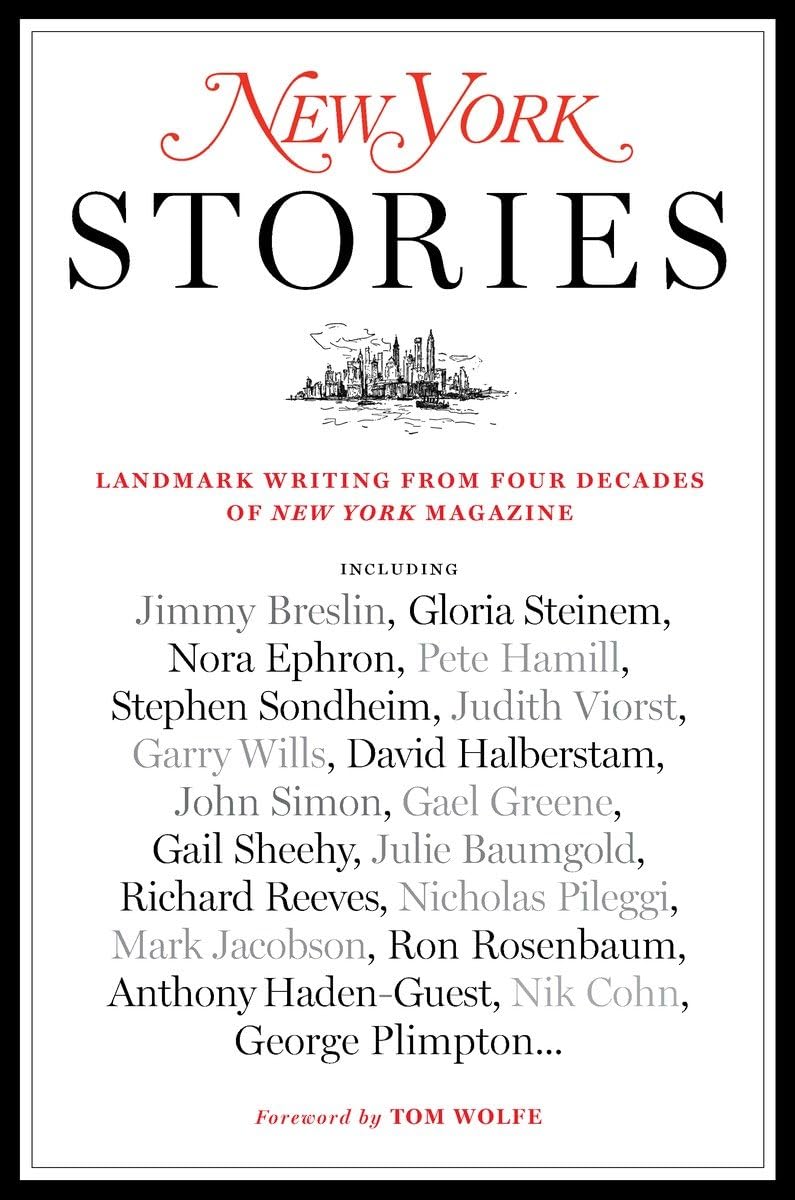
New York Stories: Landmark Writing from Four Decades of New York Magazine
$20.00
by Editors Of New York Magazine Editors Of New York Magazine



The magazine that is the city that is the world Just in time for its fortieth anniversary, New York magazine presents a stunning collection of some of its best and most influential articles, stories that captured the spectacle, the turbulence, and the cultural realignments of the past four decades. Covering subjects from “Radical Chic” to Gawker.com, written by some of the country’s most renowned authors, here are works that broke news, perfectly captured the moment, or set trends in motion. In New York Stories , Gloria Steinem (whose Ms. Magazine was introduced in New York ) broaches the subject of women’s liberation; Tom Wolfe coins “The Me Decade”; and Steve Fishman piercingly portrays the unwanted martyrdom of the 9/11 widows. Cutting edge features that invented terms like “brat pack” and “grup”; profiles of defining cultural figures including Joe Namath, Truman Capote, and long-shot presidential candidate Bill Clinton; and reports that inspired the acclaimed movies Saturday Night Fever, GoodFellas , and Grey Gardens –all are included in this one-of-a-kind compilation. The writers who chronicled the times that began with Nixon’s campaign and end with Obama’s are at their best in New York Stories . It’s an irresistible anthology from a magazine that, like the city itself, is still making stars, setting standards, and going strong. From its birth as a Sunday newspaper supplement, New York magazine has incubated many of the nation’s best writers, its influence on journalism and literature far exceeding its size and circulation. Virtually inventing the “new journalism” of the late twentieth century, New York has consistently courted both innovation and controversy and appeals to an audience well beyond its metropolitan base. This anthology brings together representative examples of the magazine’s prose. Cultural issues include Gael Greene on pretentious restaurants, Julie Baumgold on Truman Capote’s last days, and Vanessa Grigoriadis on bloggers. The magazine’s political pundits couldn’t be more stellar: Gloria Steinem, Garry Wills, David Halberstam, and Richard Reeves, profiling national leaders from Nixon through Obama. Tom Wolfe contributes a foreword that succinctly captures founding editor Clay Felker’s charisma and talent as well as his magazine’s perennial sniping feud with the New Yorker’s William Shawn. --Mark Knoblauch New York magazine began publishing in 1968. Tom Wolfe is the author of a dozen books, among them such contemporary classics as The Electric Kool-Aid Acid Test , The Right Stuff , and The Bonfire of the Vanities . A native of Richmond, Virginia, he earned his BA at Washington and Lee University and a PhD in American studies at Yale. He lives in New York City. Steve Fishman is a contributing writer who has written several of New York magazine's most notable stories. John Homans served as executive editor of New York magazine for nearly twenty years. Adam Moss has been New York magazine's editor in chief since 2004. RADICAL CHIC That Party at Lenny’s TOM WOLFE JUNE 8, 1970 In 1970, Leonard Bernstein, the composer and conductor, hosted a fund raiser for the Black Panther Party at his Park Avenue duplex. Tom Wolfe’s twenty-five-thousand-word piece on the party, which took up almost an entire issue of New York, was set in motion by an invitation—though not to him. He spotted it on the desk of David Halberstam, then a writer at Harper’s magazine, whose offices Wolfe was visiting. Wolfe called to say he’d be delighted to attend. Guests assumed anyone there shared their views. “I just thought it was a scream,” said Wolfe. “To think that somebody living in an absolutely stunning duplex could be having in all these guys who were saying, ‘We will take everything away from you if we get the chance,’ which is what their program spelled out, was the funniest thing I had ever witnessed. AT 2 OR 3 OR 4 A.M., somewhere along in there, on August 25, 1966, his forty-eighth birthday, in fact, Leonard Bernstein woke up in the dark in a state of wild alarm. That had happened before. It was one of the forms his insomnia took. So he did the usual. He got up and walked around a bit. He felt groggy. Suddenly he had a vision, an inspiration. He could see himself, Leonard Bernstein, the egregio maestro, walking out on stage in white tie and tails in front of a full orchestra. On one side of the conductor’s podium is a piano. On the other is a chair with a guitar leaning against it. He sits in the chair and picks up the guitar. A guitar! One of those half-witted instruments, like the accordion, that are made for the Learn-to-Play-in-Eight-Days E-Z-Diagram 110-IQ fourteen-year-olds of Levittown! But there’s a reason. He has an anti-war message to deliver to this great starched white-throated audience in the symphony hall. He announces to them: “I love.” Just that. The effect is mortifying. All at once a Negro rises up from out of the curve of the grand piano and