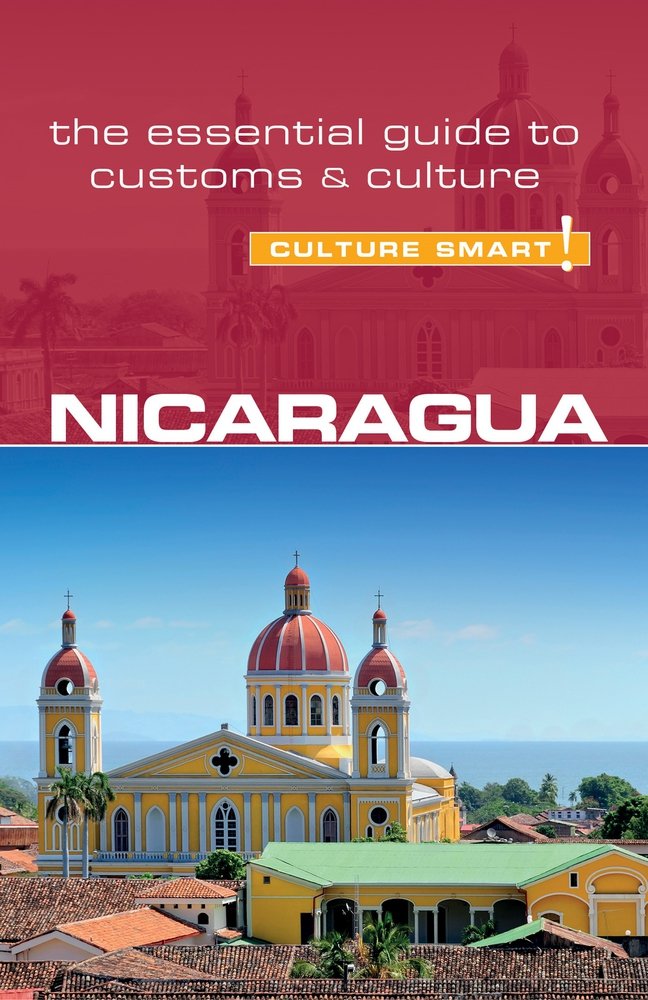
Nicaragua - Culture Smart!: The Essential Guide to Customs & Culture
$12.99
by Russell Maddicks



More and more travelers are discovering the delights of Nicaragua—a land of lakes and volcanoes. The image has persisted of a country racked by revolution and war, but the reality awaiting travelers couldn’t be more different. The largest country in Central America, Nicaragua is also one of the most diverse and least explored, with a chain of puffing volcanoes along the Pacific coast, two huge freshwater lakes, important rainforest reserves on the tropical Mosquito Coast, and tiny, picture-postcard Caribbean islands where English Creole is the lingua franca. Travelers' budgets will stretch further here than in other Latin American destinations, and around every corner, there are cobblestone streets, high-altitude coffee plantations, world-class bird-watching, perfect surf, and Flor de Caña, the smoothest rum that ever came out of an oak barrel. Culture Smart! Nicaragua offers readers an insider’s view of the country and its people. It explores Nicaragua’s national traditions, turbulent history, tasty local dishes, fun fiestas, and unique cultural expressions. It arms readers with key phrases in Nica-speak, or Nicañol, so you can break the ice, and provides insights into what the people of Nicaragua are like at home, at play, and in business. "Culture Smart has come to the rescue of hapless travellers." Sunday Times Travel "... the perfect introduction to the weird, wonderful and downright odd quirks and customs of various countries." Global Travel "...full of fascinating-as well as common-sense-tips to help you avoid embarrassing faux pas." Observer Russell Maddicks is a BBC-trained journalist. His book, Culture Smart! Ecuador, was awarded the Gold Prize at the Pearl of the Pacific International Travel Journalism Awards at the Ecuadorian International Tourism Fair (FITE) in Guayaquil. Nicaragua - Culture Smart! By Russell Maddicks Bravo Ltd Copyright © 2019 Russell Maddicks All rights reserved. ISBN: 978-1-85733-876-8 Contents Map of Nicaragua, Introduction, Key Facts, Chapter 1: LAND AND PEOPLE, Chapter 2: VALUES AND ATTITUDES, Chapter 3: CUSTOMS AND TRADITIONS, Chapter 4: MAKING FRIENDS, Chapter 5: THE NICARAGUANS AT HOME, Chapter 6: TIME OUT, Chapter 7: TRAVEL, HEALTH, AND SAFETY, Chapter 8: BUSINESS BRIEFING, Chapter 9: COMMUNICATING, Further Reading, Acknowledgments, CHAPTER 1 LAND & PEOPLE GEOGRAPHICAL SNAPSHOT Nicaragua is a triangular wedge between Honduras in the north and Costa Rica to the south, with the Pacific Ocean to the west and the Caribbean to the east. The largest country in Central America, it occupies an area of 50,336 square miles (130,370 sq. km) — slightly larger than the US state of Mississippi. The country can be divided into three broad geographical areas: the Pacific lowlands in the west, which consist of a broad and fertile plain that runs from the Golfo de Fonseca in the north to Costa Rica in the south; the central highlands, which sweep down from the forested uplands bordering Honduras through the middle of the country, effectively cutting it in half; and the Atlantic lowlands to the east, which take up almost 50 percent of the nation's territory, dominated by a long Caribbean coastline from Gracias a Dios in the north to San Juan de Nicaragua in the south, incorporating the lush Corn Islands and remote Pearl Cays. Pacific Lowlands You only have to glance at a topographical map of Nicaragua to see why it is known as the Land of Lakes and Volcanoes. The Pacific coast is dotted with an imposing string of twenty-five volcanoes, both active and dormant, that stretch from the huge crater lake of Cosigüina on the Golfo de Fonseca to the twin-volcano island of Ometepe in Lago Cocibolca (Lake Nicaragua), the largest freshwater lake in Central America and the ninth-largest in the world. The lake covers an area of 3,191 square miles (8,264 sq. km) and is so vast that when the Spanish conquistadors arrived on its shores in 1523 they thought they had reached an ocean. Only when their horses started to drink from it did they realize it was a freshwater lake — and so they named it the Mar Dulce (Sweet Sea). Connected to the Caribbean Sea via the Rio San Juan, Lago Cocibolca is home to bull sharks that have adapted to its low salinity, and encompasses several archipelagos, including Las Isletas, close to the colonial city of Granada, and Solentiname in the far south. Nicaragua's other large body of fresh water, Lago Xolotlán (Lake Managua), has been cleaned up in recent years, in particular the lakeside promenade in the capital, Managua, which now has a restaurant complex named after the deposed Chilean President Salvador Allende and a pier from which pleasure boats set off on short trips. The country's volcanoes are a huge magnet for tourists. Thrill-seekers climb to the summit of the still active Cerro Negro — the youngest volcano in Central America — and "volcano board" down the black ash slopes created by its last eruption in 1