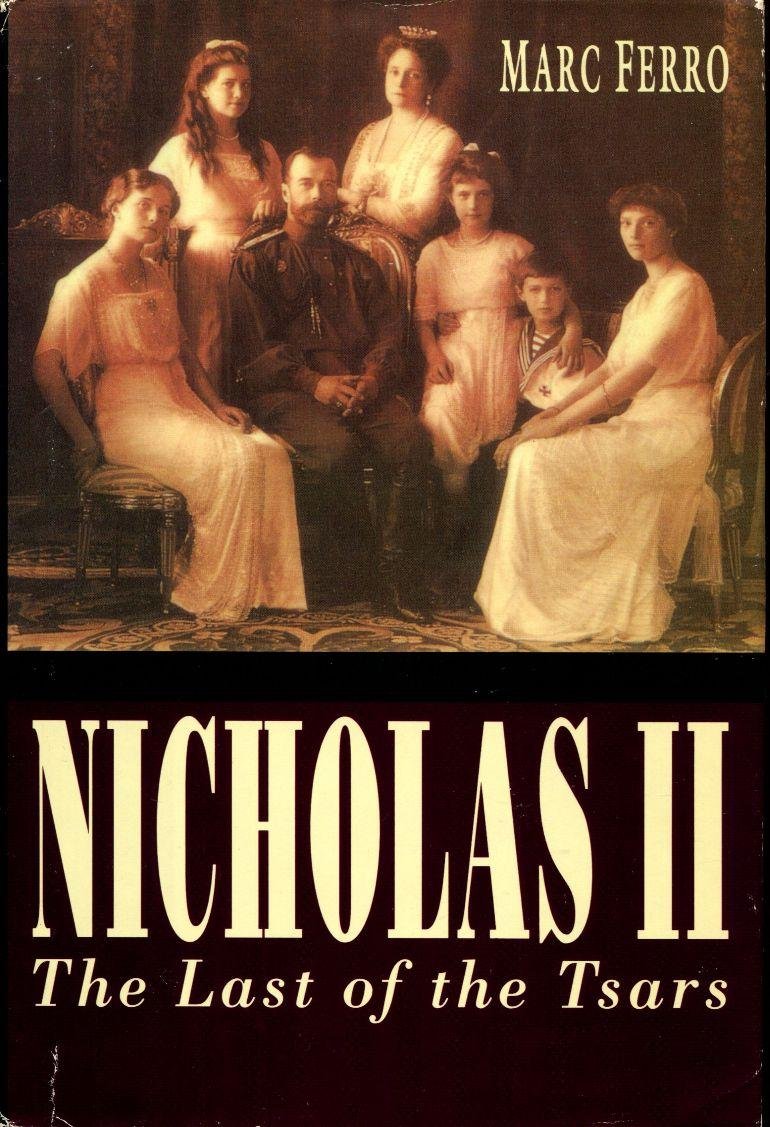



One of the world's preeminent historians, Marc Ferro is a leading member of the Annales School of France and a recognized authority on early twentieth-century European history. For well over two decades, in volumes such as The February Revolution of 1917 and October 1917 , he has demonstrated an unsurpassed skill in capturing the social and political forces that led to the Russian Revolution. Now Ferro turns his considerable talents to the biography of one of the pivotal figures of that era, Nicholas II, the last Tsar of Russia. For this important new biography, Ferro has searched extensively in Russian archives to illuminate Nicholas's character. What emerges is a vivid portrait of a reluctant leader, a young man forced by the death of his father into a role for which he was ill-equipped. A conformist and traditionalist, Nicholas admired the order, ritual, and ceremony identified with the intangible grandeur of autocracy, and he hated everything that might shake that autocracy--the intelligentsia, the Jews, the religious sects. His reign, as Ferro documents, was one of continual trouble: a humiliating war with Japan; the 1905 revolution that forced Nicholas to accept a constitutional assembly, the Duma; the international crisis of 1914, leading to World War I; and finally the Revolution of 1917, forcing his abdication. Throughout, we see a Tsar who was utterly opposed to change and to the ferment of ideas that stirred his country, who felt it was his duty to preserve intact the powers God had entrusted in him. Ferro also provides an intimate portrait of Nicholas's personal life: his wife Alexandra; his four daughters, Olga, Tatiana, Maria, and Anastasia, sisters so close they signed letters "OTMA," the initials of their Christian names; his son and heir Alexis, who suffered from hemophilia; and the various figures in the court, most notably Rasputin, whose ability to revive the frequently ailing Alexis made him indispensable to the Tsaritsa. (Ferro recounts that, when Alexandra heard of Rasputin's murder, she collapsed in anguish, certain her son was lost; but when Nicholas heard the news while with the army, he simply walked off whistling cheerfully.) Perhaps most intriguing is Ferro's chapter on the fate of the Tsar and his family, examining all the rumors and contradictory testimony that swirl around this still cloudy event. Ferro concludes that Alexandra and her daughters may have survived the revolution, and the woman who later surfaced in Europe claiming to be Anastasia may well have been so. This authoritative biography by one of the world's great historians shines a bright light on an ordinary man raised to an extraordinary station, who carried an unwanted burden, which crushed him. A highly regarded French historian, Ferro has written extensively on the Russian Revolution. He now focuses on Nicholas, the reactionary Romanov whose troubled reign (1894-1917) helped grease the skids for Soviet communism. Skillfully quoting from numerous letters and diaries, Ferro reconstructs the essential Nicholas: stubborn, shallow, and bound by tradition. Though absolutely mandatory, the accompanying social and political explication is awkwardly integrated into the biography. It's almost as if two distinct titles had been compressed into one. Robert Massie's Nicholas and Alexandra ( LJ 7/67) remains the volume of choice for a general audience, while Edvard Radzinsky's The Last Tsar: The Life and Death of Nicholas II ( LJ 7/92) harbors more interesting details concerning the Romanovs' final days. - Mark R. Yerburgh, Fern Ridge Community Lib., Veneta, Ore. Copyright 1993 Reed Business Information, Inc. Ferro (Social Sciences/cole des Hautes tudes, Paris; The Russian Revolution of February 1917, 1972), an expert on the political details of the Russian Revolution, claims to offer new information in this political biography of Tsar Nicholas II. But since its original appearance in England in 1991, Ferro's volume has been outdone and outdated by Edvard Radzinsky's magisterial The Last Tsar (1992). With long excerpts from letters and diaries, as well as with interviews with survivors and descendants, Radzinsky offered not only the harrowing life of Nicholas as tsar, father, and husband but also the terrible price of being part of Nicholas's family; he also wrote of his own odyssey in recovering the family's stories. Ferro, on the other hand--saying that the Soviet Union withheld necessary information and that the archives are closed--depicts a Nicholas who is variously an ``ordinary man'' and a ``victim of History,'' both brutal and feckless, a conformist and traditionalist--a man dominated by his wife and disdainful of intellectual and Jews. The author offers an inadequate analogy between Nicholas and Louis XVI, another pleasure-loving king confused by contemporary ideas, and baffled by the reformers, and acquiring only belatedly the political acumen that might have saved him. The execution of the tsar's famil