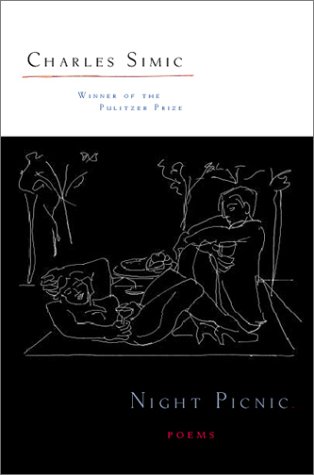



The author of Walking the Black Cat and the Pulitzer Prize-winning The World Doesn't End presents a new collection of poetry that evoke a rich variety of settings and images, from New York City's crowded sidewalks on a hot summer night to an abandoned old church in a small New England town. 15,000 first printing. This follow-up to the recent Jackstraws (LJ 3/1/99) finds Simic in a relatively benign and domestic frame of mind. While his predilection for dread and his predisposition toward surreal non sequiturs haven't entirely vanished, the poet more often turns his attention to the mundane: objects on a dresser, unmade beds, a gas station, strolling lovers ("I was warm, so I took my jacket off/ And put my arm around your waist/ and drew you to me"). Simic's tone is generally flat and matter-of-fact, and if evil intrudes, it barely ripples the easygoing delivery ("The devil's got his finger in every pie"). The poems are vignettes, ordinary or quirky scenes displayed at face value, vaguely inviting the reader to extend them beyond their uncertain borders via glancing references to churches, angels, and saints convenient ciphers meant to suggest a metaphysical dimension more easily implied than articulated. Like the "Tree of Subtleties" he describes, Simic intends to hint "at dark secrets still to be unveiled," but blanched of sharp linguistic edges or striking images, the hints just aren't compelling enough. Fred Muratori, Cornell Univ. Lib., Ithaca, NY Copyright 2001 Reed Business Information, Inc. Simic illuminates the shadow side of life in poems as perfectly formed and directed as the beam of a flashlight. He sees lovers in cemeteries after dark and ponders the secret lives of rats, crows, and worms, yet his noir outlook abates just enough to make room for a new strain of sardonic humor and a keen sense of the entanglement of the erotic and the doomed. Unexpected juxtapositions hit the brain like a whiff of smelling salts as he decodes the mixed messages of a street on a hot night--a thread of opera set against "the city boiling in its bloody stew," a couple French-kissing while the homeless lie in "dark doorways"--and considers various unlikely Christ figures, including a "Jesus lookalike / who won a pie-eating contest in Texas." Nabokovian in his caustic charm and sexy intelligence, Simic perceives the mythic in the mundane and pinpoints the perpetual suffering that infuses human life with both agony and bliss. Donna Seaman Copyright © American Library Association. All rights reserved Born in 1938 in Belgrade, Charles Simic is the recipient of many awards and honors, including a PEN International Award for translation, the Edgar Award, and the Harriet Monroe Award. He received the Pulitzer Prize for The World Doesn't End, and Walking the Black Cat was a finalist for the National Book Award for poetry in 1996. Simic teaches at the University of New Hampshire in Durham and writes regularly for the New York Review of Books and other publications.