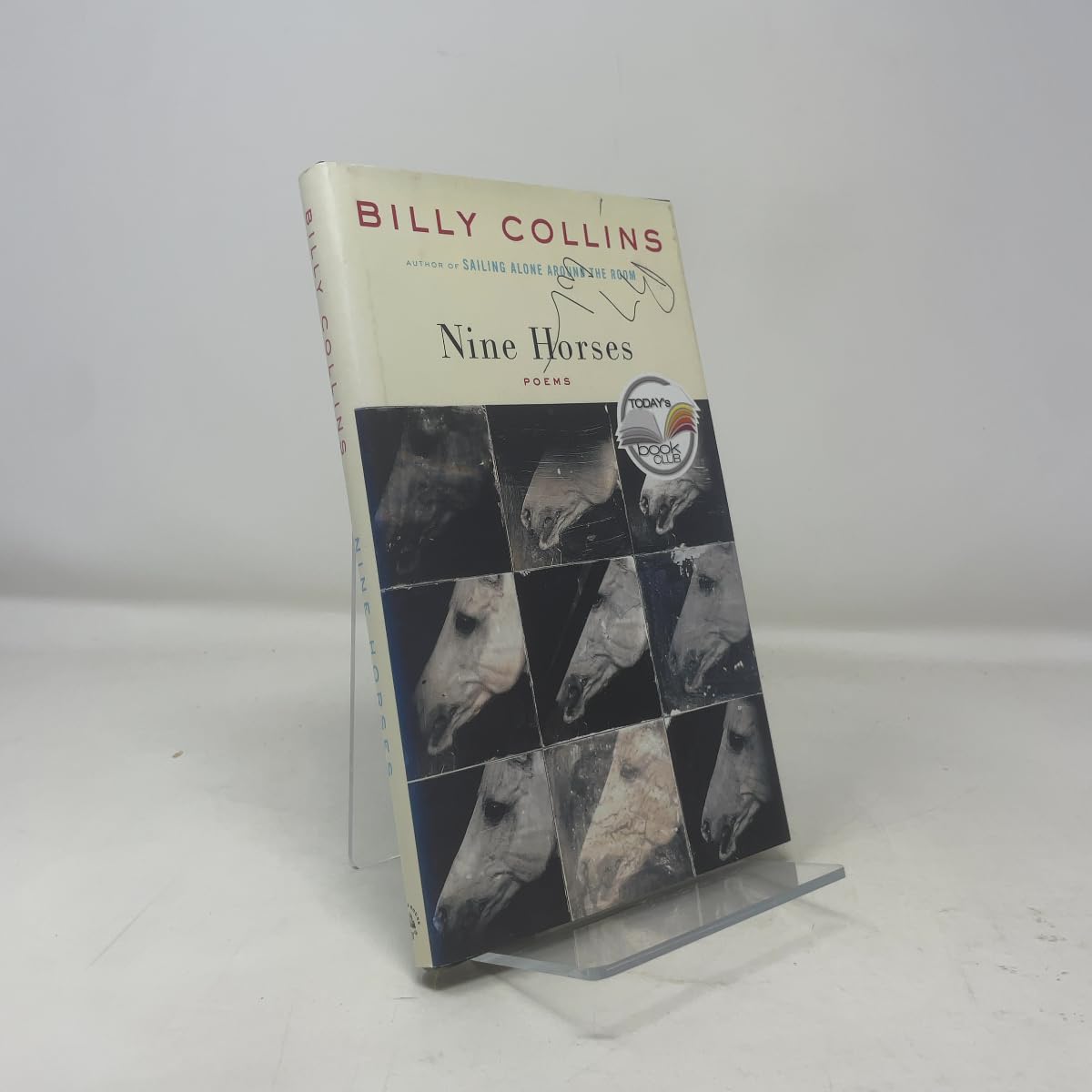



Nine Horses , Billy Collins’s first book of new poems since Picnic, Lightning in 1998, is the latest curve in the phenomenal trajectory of this poet’s career. Already in his forties when he debuted with a full-length book, The Apple That Astonished Paris, Collins has become the first poet since Robert Frost to combine high critical acclaim with broad popular appeal. And, as if to crown this success, he was appointed Poet Laureate of the United States for 2001–2002, and reappointed for 2002–2003. What accounts for this remarkable achievement is the poems themselves, quiet meditations grounded in everyday life that ascend effortlessly into eye-opening imaginative realms. These new poems, in which Collins continues his delicate negotiations between the clear and the mysterious, the comic and the elegiac, are sure to sustain and increase his audience of avid readers. Praise for Billy Collins and Sailing Alone Around the Room “He may be a sort of poet not seen since Robert Frost.” — The Boston Globe “It is difficult not to be charmed by Collins, and that in itself is a remarkable literary accomplishment.” — The New York Review of Books “There are brainy, observant, spit-shined moments on almost every page....You finish feeling pleased that such a sensible and gifted man is America’s Poet Laureate—young writers have plenty to learn from his clarity and apparent ease.” — The New York Times Book Review orses, Billy Collins s first book of new poems since Picnic, Lightning in 1998, is the latest curve in the phenomenal trajectory of this poet s career. Already in his forties when he debuted with a full-length book, The Apple That Astonished Paris, Collins has become the first poet since Robert Frost to combine high critical acclaim with broad popular appeal. And, as if to crown this success, he was appointed Poet Laureate of the United States for 2001 2002, and reappointed for 2002 2003. What accounts for this remarkable achievement is the poems themselves, quiet meditations grounded in everyday life that ascend effortlessly into eye-opening imaginative realms. These new poems, in which Collins continues his delicate negotiations between the clear and the mysterious, the comic and the elegiac, are sure to sustain and increase his audience of avid readers. Praise for Billy Collins and Sailing Alone Around the Room “He may be a sort of poet not seen since Robert Frost.” — The Boston Globe “It is difficult not to be charmed by Collins, and that in itself is a remarkable literary accomplishment.” — The New York Review of Books “There are brainy, observant, spit-shined moments on almost every page....You finish feeling pleased that such a sensible and gifted man is America’s Poet Laureate—young writers have plenty to learn from his clarity and apparent ease.” — The New York Times Book Review Billy Collins is the author of six collections of poetry, including Sailing Alone Around the Room ; Questions About Angels ; The Art of Drowning ; and Picnic, Lightning . He is a Distinguished Professor of English at Lehman College of the City University of New York. Collins is the Poet Laureate of the United States. i. The Country I wondered about you when you told me never to leave a box of wooden, strike-anywhere matches lying around the house because the mice might get into them and start a fire. But your face was absolutely straight when you twisted the lid down on the round tin where the matches, you said, are always stowed. Who could sleep that night? Who could whisk away the thought of the one unlikely mouse padding along a cold water pipe behind the floral wallpaper gripping a single wooden match between the needles of his teeth? Who could not see him rounding a corner, the blue tip scratching against a rough-hewn beam, the sudden flare, and the creature for one bright, shining moment suddenly thrust ahead of his time— now a fire-starter, now a torchbearer in a forgotten ritual, little brown druid illuminating some ancient night. Who could fail to notice, lit up in the blazing insulation, the tiny looks of wonderment on the faces of his fellow mice, onetime inhabitants of what once was your house in the country? Velocity In the club car that morning I had my notebook open on my lap and my pen uncapped, looking every inch the writer right down to the little writer’s frown on my face, but there was nothing to write about except life and death and the low warning sound of the train whistle. I did not want to write about the scenery that was flashing past, cows spread over a pasture, hay rolled up meticulously— things you see once and will never see again. But I kept my pen moving by drawing over and over again the face of a motorcyclist in profile— for no reason I can think of— a biker with sunglasses and a weak chin, leaning forward, helmetless, his long thin hair trailing behind him in the wind. I also drew many lines to indicate spee