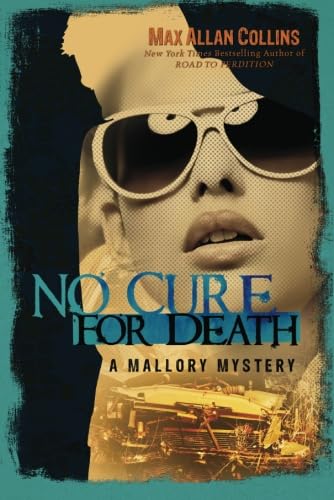



What kind of drama could happen in a small-town Iowa bus station? If you’re a guy like Mallory, it’s the kind that involves sidestepping trouble between a pretty, frightened blonde and a pretty frightening, two-fisted, one-eyed goon. With the help of a handy Pepsi bottle, Mallory saves the lady from the menacing lout, shares a heartfelt moment, and sees her safely off, wistfully wondering if they’ll ever meet again. End of story? Not a chance. Even though it’s Mallory’s best buddy, John, who’s visiting on leave from combat in Vietnam, it’s Mallory who has a nasty flashback―when that same sweet blonde drops back into his life after losing hers. But how did she go from a bus out of town to a car at the bottom of a cliff? Why is her “accident” a dead ringer for the one that killed a scandal-scarred senator? And is local lawman Sheriff Brennan helping to hush things up? The questions are good ones, and Mallory wants answers―bad. But if he crosses the wrong people, things could get ugly. A Q&A with Max Allan Collins Question: Where did Mallory begin? We understand that the first novel published, The Baby Blue Rip-Off , was actually the second Mallory novel. Max Allan Collins: That’s right. No Cure for the Death was written first, at the University of Iowa’s Writers Workshop. I probably began it around 1969, when I was studying with Richard Yates, the great mainstream novelist. I wrote three novels as my MFA thesis, Bait Money , No Cure for the Death , and Quarry , all sharing the same small Midwestern setting, Port City, but otherwise unrelated. The idea was to demonstrate that a mystery or crime novel could be written with a non-urban setting. Private eye-type stories were usually set in New York or Los Angeles, and I wanted to use a setting where I’d actually lived. Port City was Muscatine, Iowa, the small town where I still live. Q: But Mallory isn’t a private eye. MAC: Not technically, but the novels use the Raymond Chandler-style first- person technique, and the general investigative approach of a private eye novel, though these stories are probably more “medium-boiled” than “hardboiled.” Mallory is a mystery writer, which is the excuse for him getting involved in mysteries, but he was not intended to be a series character. Neither was the pro thief Nolan in Bait Money or my hitman Quarry. The three books in my MFA thesis were all designed to be standalones. Q: Why series then? MAC: Bait Money and No Cure for the Death both sold in late 1972 to Curtis Books, where the editor asked for sequels to both. Later, Quarry sold to Berkley Books, and that editor asked for a series, too. I was glad to comply in all three cases, but it caused me trouble. Nolan originally died at the end of Bait Money , Quarry was awaiting seemingly inevitable assassination, and Mallory, well...he was just a mystery writer. I’d have given him a better excuse to solve mysteries if I’d known he was going on to four more books! Q: No Cure for the Death , why was the first book published second? MAC: Curtis Books bought two Mallory novels, but the company was swallowed up by a bigger publisher, Popular Library, who consigned my novels to the purgatory known as inventory. For years, Popular Library’s editor assured me the books would be published, but before that ever happened, the rights reverted to me. No Cure for the Death had been very much of the late ‘60s/early ‘70s, with a strong Vietnam theme – some have called Mallory a hippie private eye. By the early ‘80s, the book seemed dated. The second novel, The Baby Blue Rip-Off , hadn’t dated at all. So it came up into the first slot. When No Cure for the Death was published next, I added an author’s note to label it a prequel. Q: What were the circumstances of Mallory finally finding his way into print? MAC: In the early ‘80s, I wrote an eco-thriller called Midnight Haul that I submitted to Walker Books. An editor there loved it and told me she was buying it, but then the top editor at Walker, Ruth Cavin, a very famous editor, called me to say that she liked Midnight Haul , but that it was too dark, and too much of a thriller, for the Walker line. If I ever did a mystery, though, she wanted to see it. As it happens, I had just gotten the rights back to the two Mallory novels, bundled The Baby Blue Rip-Off off to Ruth, who bought it in lightning speed. Shortly thereafter, Midnight Haul sold to Foul Play Press. The eco-thriller really is similar to the Mallorys, and if I had it to over, I’d probably rewrite Midnight Haul into a Mallory novel. Q: The smalltown setting does seem to be part of Mallory’s appeal, though you take him out of Port City in both Kill Your Darlings and Nice Weekend for a Murder . MAC: That indicates the autobiographical nature of the books. Kill Your Darlings is set in Chicago at a Bouchercon, the big mystery fan convetion, and Nice Weekend for a Murder is set at Mohonk Mountain House, in upstate New York, wher