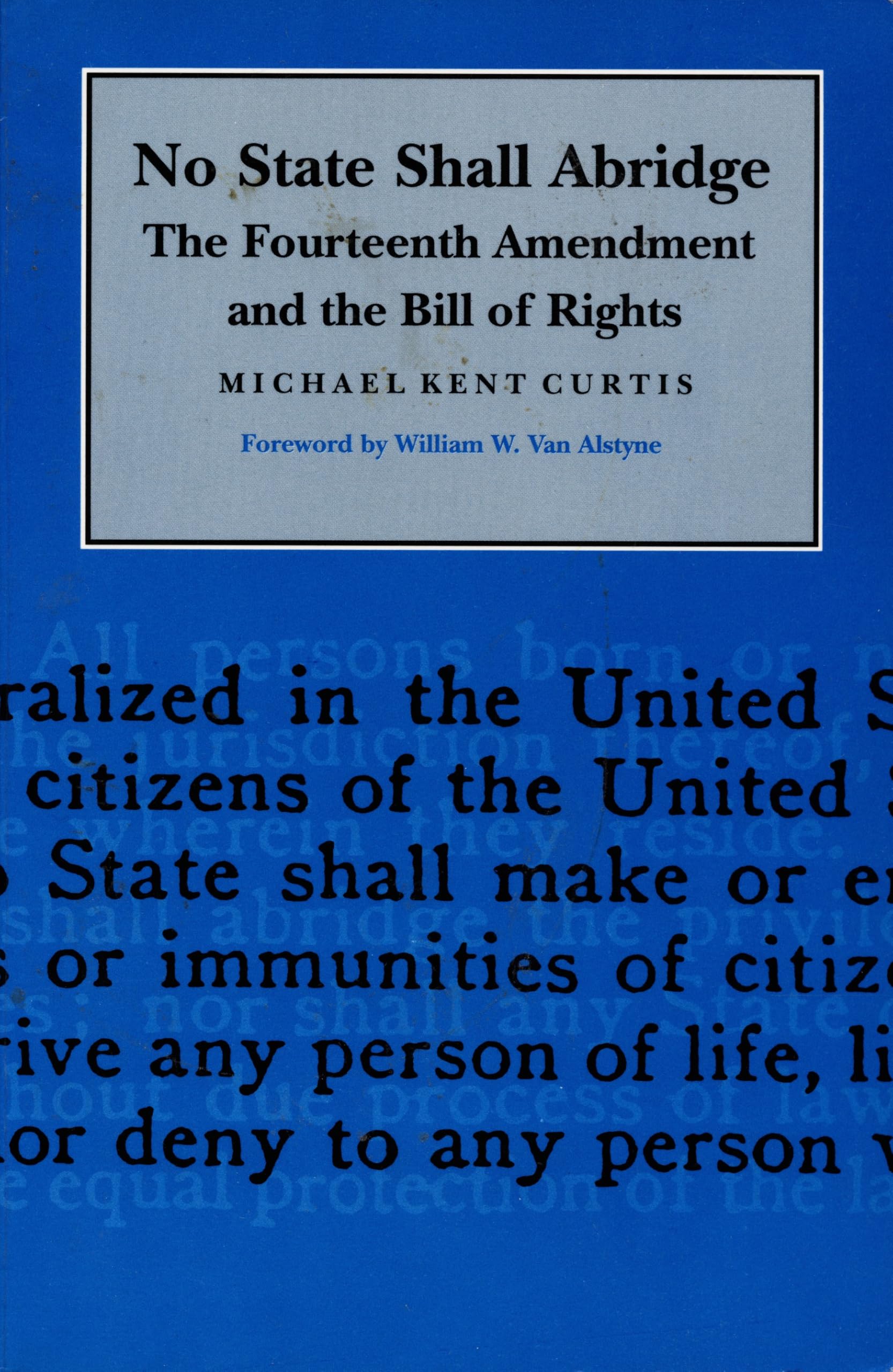
No State Shall Abridge: The Fourteenth Amendment and the Bill of Rights
$34.95
by Michael Kent Curtis



“The book is carefully organized and well written, and it deals with a question that is still of great importance—what is the relationship of the Bill of Rights to the states.”— Journal of American History “Curtis effectively settles a serious legal debate: whether the framers of the 14th Amendment intended to incorporate the Bill of Rights guarantees and thereby inhibit state action. Taking on a formidable array of constitutional scholars, . . . he rebuts their argument with vigor and effectiveness, conclusively demonstrating the legitimacy of the incorporation thesis. . . . A bold, forcefully argued, important study.”— Library Journal “The book is carefully organized and well written, and it deals with a question that is still of great importance—what is the relationship of the Bill of Rights to the states.” - Journal of American History “Curtis effectively settles a serious legal debate: whether the framers of the 14th Amendment intended to incorporate the Bill of Rights guarantees and thereby inhibit state action. Taking on a formidable array of constitutional scholars, . . . he rebuts their argument with vigor and effectiveness, conclusively demonstrating the legitimacy of the incorporation thesis. . . . A bold, forcefully argued, important study.” - Library Journal “Curtis effectively settles a serious legal debate: whether the framers of the 14th Amendment intended to incorporate the Bill of Rights guarantees and thereby inhibit state action. Taking on a formidable array of constitutional scholars, . . . he rebuts their argument with vigor and effectiveness, conclusively demonstrating the legitimacy of the incorporation thesis. . . . A bold, forcefully argued, important study.” ― Library Journal “The book is carefully organized and well written, and it deals with a question that is still of great importance—what is the relationship of the Bill of Rights to the states.” ― Journal of American History Michael Kent Curtis is Professor of Law at Wake Forest University School of Law. No State Shall Abridge The Fourteenth Amendment and the Bill of Rights By Michael Kent Curtis Duke University Press Copyright © 1986 Duke University Press All rights reserved. ISBN: 978-0-8223-1035-8 Contents Dedication, Foreword, Acknowledgments, Introduction, Chapter 1 From the Revolution to the Bill of Rights and Beyond, Chapter 2 The Historical Background of the Fourteenth Amendment, Chapter 3 The Framing of the Fourteenth Amendment, Chapter 4 In Which Some Arguments Against Application of the Bill of Rights to the States Are Analyzed, Chapter 5 The Amendment Before the States, Chapter 6 Congressional Interpretation, Chapter 7 The Amendment Before the Courts (Part One), Chapter 8 The Amendment Before the Courts (Part Two), Conclusion, Notes, Index, CHAPTER 1 From the Revolution to the Bill of Rights and Beyond From the Revolution to the Bill of Rights When the American colonies rebelled against Great Britain, the rebels gave their reasons in the Declaration of Independence: "We hold these truths to be self-evident: that all men are created equal; that they are endowed, by their Creator, with certain unalienable rights; that among these are life, liberty, and the pursuit of happiness. That to secure these rights, governments are instituted among men, deriving their just powers from the consent of the governed." The rhetoric, of course, was more advanced than the reality. Blacks were held as slaves in the colonies, not even all white males would get the vote for another sixty years or so, and all women were disfranchised and deprived of important liberties. Still, rhetoric has a way of shaping reality. By the twentieth century America was closer to the ideals of the Declaration than it was in 1776. The words of the Declaration itself were a factor in bringing about the change. According to the Declaration, people have unalienable rights to liberty. The ideology of the revolutionary generation shaped the later American Bill of Rights. This revolutionary ideology combined and wove together both the natural rights of man and the historic rights of Englishmen. The colonists emphasized natural rights and historic liberties as a result of their view of government. Government was potentially hostile to human liberty and happiness. Power was essentially aggressive. The Continental Congress in its Address to the Inhabitants of Quebec quoted Marquis Beccaria: "In every human society ... there is an effort, continually tending to confer on one part the heighth of power and happiness, and to reduce the other to the extreme of weakness and misery. The intent of good laws is to oppose this effort, and to diffuse their influence universally and equally." Rulers, stimulated by this pernicious "effort," and subjects animated by the just "intent of opposing good laws against it," have occasioned that vast variety of events, that fill the histories of so many nations. The rebellious co