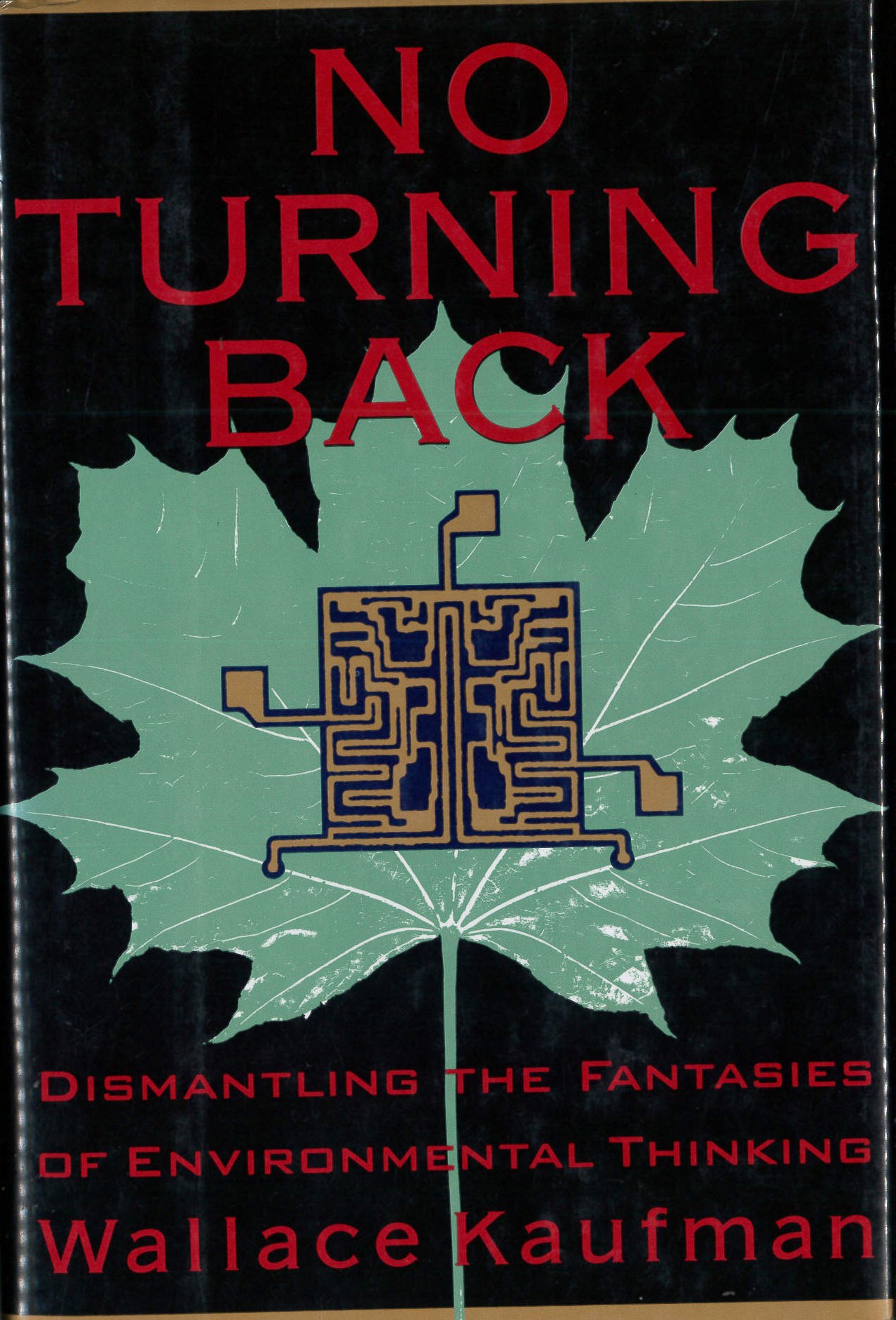
No Turning Back: Dismantling The Fantasies Of Environmental Thinking
$25.00
by Beverley Naidoo



Argues that environmentalists have ignored the fundamental principles of science, economics, and human nature while overlooking the world's real environmental problems Science writer Kaufman, who has served as president of two state-level environmental groups, purports that the environmental movement, like any large movement, has become a large machine, a large system of power with its own agenda, which includes controlling versions of the truth. The author identifies with other "recovering" environmentalists who report that internal politics has given those in the movement an irrational view of the world. Kaufman flails a lot in his writing and often doesn't lead the reader through his arguments, especially in the first part of the book. He generalizes too often for all environmentalists, and he could have used a good course in rhetoric. But the later chapters have less hyperbole and are more coherent and readable, and his thesis is one that should be debated. For larger environmental collections. Diane M. Fortner, Univ. of California Lib., Berkeley Copyright 1994 Reed Business Information, Inc. A renegade ex-leader of an environmental group (the Conservation Council of North Carolina) repents the errors of his ways as he examines how conservationism, with its emphasis on resource management, has been overtaken by environmentalism, with its emphasis on litigious vengeance in pursuit of utopian stasis. Kaufman's best crystallization of the Luddite attitude quotes one save-theearther (the New Yorker 's Alex Shoumatoff) saying numbers are a temperate zone precision trip and the idlest of superstitions. But in Kaufman's view, technology and market incentives, rather than more regulations, are the real route to the solution to pollution problems, and are not the problem itself. The difficulty in seeing the truth of this, he contends, is the sway held by the romanticism of Rousseau, Wordsworth, and above all Thoreau, as adhered to and interpreted by contemporary green authors (Commoner, Ehrlich, etc., critiqued in more detail in The Green Crusade by Charles Rubin ). A civil presentation of one side in the contentious conversation about ecology. Gilbert Taylor In classic jilted-lover style, former environmental activist Kaufman (The Beaches Are Moving, 1979) levels some sharp and deserving criticisms at the environmental movement, but loses credibility when he just can't find one good word for his former partner. Why is it, Kaufman wonders, that as the environmental movement in this country grows stronger, the quality of the environment keeps getting worse? Is it because that movement is run through with piners aching for a golden past and with baloney-filled doomsayers? Is the movement the purveyor of bad science and selective statistics, as Kaufman suggests? He is right in saying that environmentalism often bogs down in its Romantic vision of nature, but one of the movement's strengths has been its distrust of experts, all too often wrong in their forecasts; it welcomes the poet as well as the scientist, even if they do fiddle with the numbers. Kaufman seems to lose touch with reality when he claims that science (seen as a value-free wonderland) and capitalism (with its credo of self-interest) are all the tools we need for a better environmental future. Didn't those two bring us Bhopal, Three-Mile Island, Love Canal? No matter--we know what we want, nature doesn't care, so let's go get it, Kaufman says. Irradiate, it's good! Genetically engineer, it's new! Kaufman is capable of some of the most extraordinarily dingbat comments to come down the pike in a while: ``Science will provide,'' and, in reference to Beat poet Gary Snyder's Zen leanings, ``I wonder if [he] would mind being killed and eaten by a lion if it would say please and thank you.'' Clearly in Kaufman's brave new world there is no room for such namby-pambyness as intuition, doubt, wanting a second opinion, or concern for the consequences of rushing into the unknown. Kaufman comes across as a blend of science fetishist, free- market wonk, and immense sour grape--his good points sadly lost in the blather. -- Copyright ©1994, Kirkus Associates, LP. All rights reserved. Kaufman has written a book that deserves a widereadership among people who desire to deepen their understanding of theenvironmental movement. Ben W. Bolch, Rhodes College, in the Cato Journal. Kaufman is good at myth control. Among the myths he takeson: 1) recycling is always good, 2) forests are disappearing and development isthe bad guy, 3) global warming threatens life on earth, 4) greed causesenvironmental problems, 5) nature is always right, 6) "sustainabledevelopment" is a good thing, and 7) primitive people were smartermanagers of nature than we are. Alexander Volokh No Turning Back is the story of how the environmental movement displaced a conservation movements century of success with a crisis strategy to change not only government policy but also American culture.