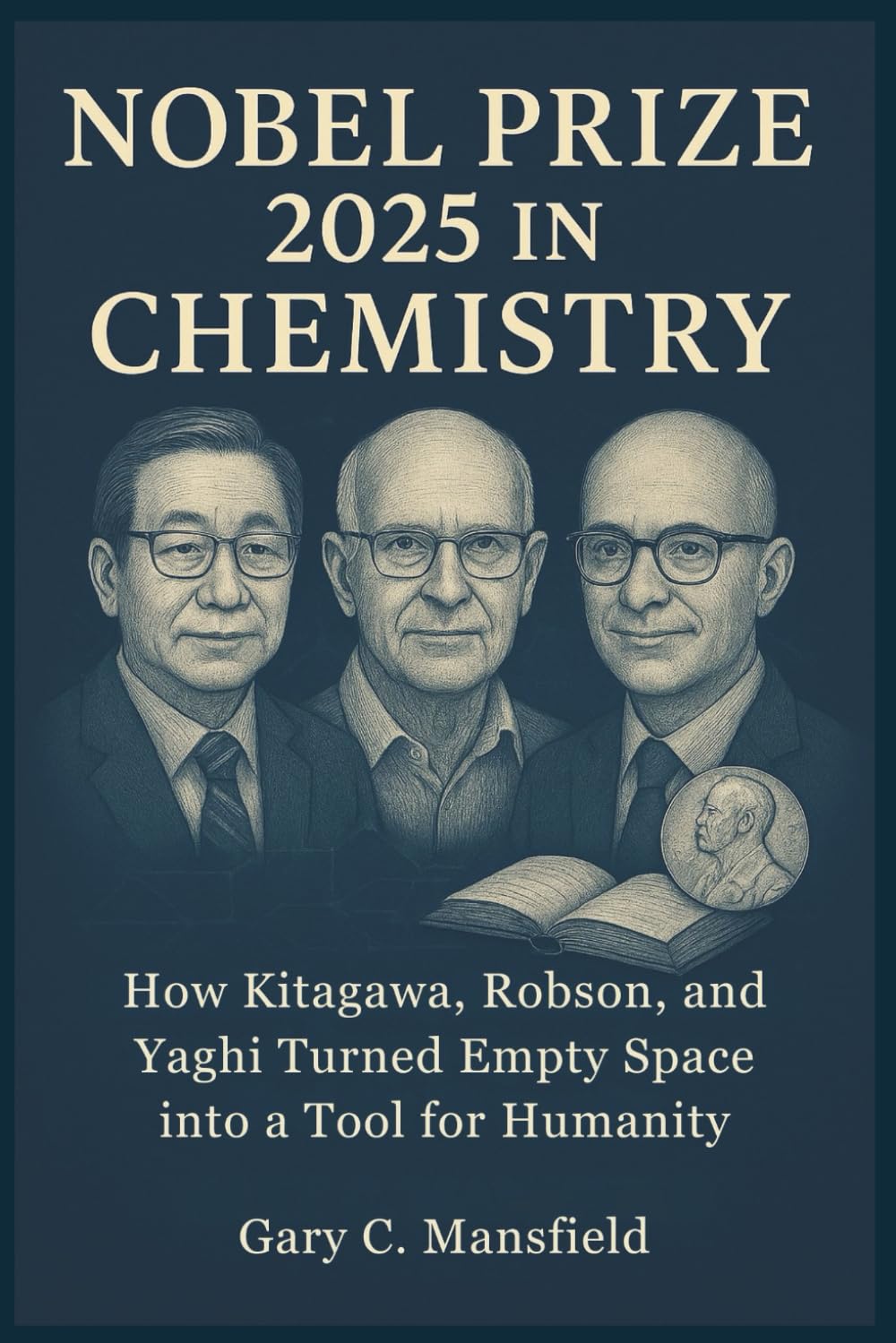
Nobel Prize 2025 in Chemistry: How Kitagawa, Robson, and Yaghi Turned Empty Space into a Tool for Humanity (Inside the Nobel Prizes 2025)
$15.99
by Gary C. Mansfield



The Nobel Prize 2025 in Chemistry celebrates a discovery that changed how science understands and uses matter. In this clear and insightful account, Gary C. Mansfield explains how Susumu Kitagawa , Richard Robson , and Omar M. Yaghi built the foundation of a new field— metal-organic frameworks (MOFs) —and showed that even empty space can become a working part of chemistry. Through engaging storytelling and accessible explanations, readers will see how these porous materials can capture carbon dioxide , harvest water from desert air , and store clean fuels such as hydrogen. The book explores how reticular chemistry connects atomic design to real-world problems, from climate change and water scarcity to pollution control and energy storage . More than a profile of three scientists, this is a story of global collaboration, perseverance, and imagination. From the laboratories of Kyoto , Melbourne , and Berkeley , these discoveries show how chemistry can move from theory to life-saving practice. Whether you are interested in environmental science , advanced materials , or simply want to understand why the Nobel Committee honored this work, Nobel Prize 2025 in Chemistry offers a detailed, readable look at the science shaping the twenty-first century.