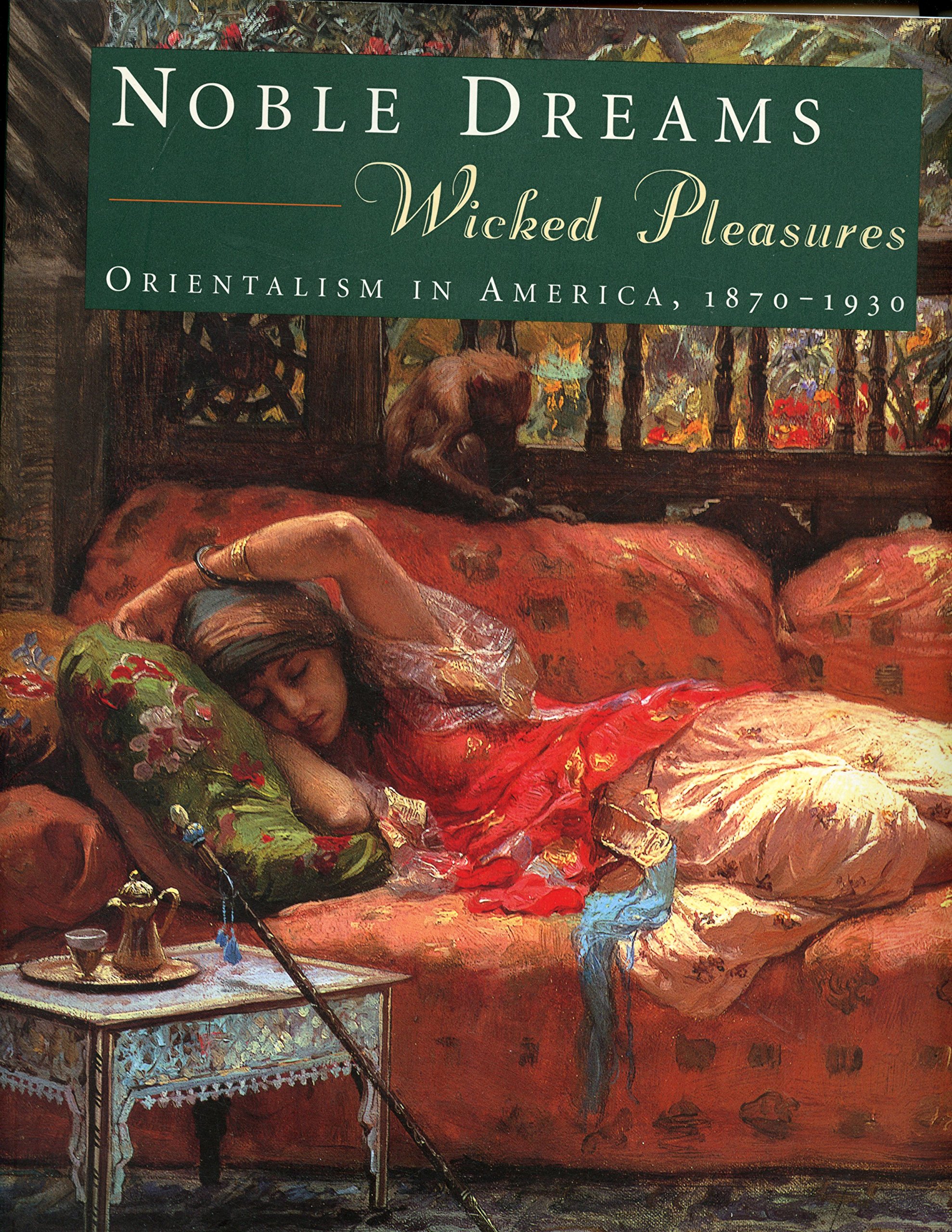



Noble Dreams, Wicked Pleasures explores complex American attitudes toward the Near East--as revealed in collected paintings, interior design, and multiple vernacular forms--at the formative moment of industrialization and the crystallization of a truly mass culture. Published to coincide with the multimedia exhibition that opens at the Sterling and Francine Clark Art Institute and travels to the Walters Art Gallery and the Mint Museum of Art, this catalogue considers how urban, mercantile, Protestant America represented the Islamic world of the Middle East and North Africa in ways that say more about itself than the foreign culture. This gorgeously illustrated volume first looks at the use of Orientalist stereotypes by some of the country's most important high art painters of the nineteenth century: Frederic Edwin Church's treatment of the exotic terrain through a lens of deep religiosity; a more cosmopolitan reading of the harem girl by John Singer Sargent; the perfumed alternative to industrial capitalism conjured in the landscapes and market scenes of Samuel Colman and Louis Comfort Tiffany; and interpretations of the Orient as emancipatory by Ella Pell, the only major woman Orientalist. The book next traces the popularization of Orientalism in the decorative arts (including a few treasures from Olana, Church's Moorish-style home on the Hudson), on Broadway, and in Hollywood, as well as through advertising that linked consumer products with visual suggestions of exotic sexuality and through cultural objects, such as the Shriners' fez. The generous color plates show both an innocent romanticization of the Orient and a darker, heavily eroticized version of Oriental "otherness." An excellent chronology and bibliography, in addition to expert essays by both Americanists and Islamicists, give context to absorbing images. Though a perfect companion for visitors to the exhibition, Noble Dreams, Wicked Pleasures is also for anyone seeking an uncommon take on the development of American self-understanding. Exhibition Schedule: ? The Sterling and Francine Clark Art Institute Williamstown, Massachusetts June 11-September 4, 2000 The Walters Art Gallery Baltimore, Maryland October 1-December 10, 2000 The Mint Museum of Art Charlotte, North Carolina February 3-April 22, 2001 Orientalism, the most interesting period in the Western world's long encounter with "the mysterious East," began in 18th-century Northern Europe and over the next several decades was exported to the United States in the able hands of avatars such as painters Jean-L on G r me and John Singer Sargent, architect Louis Sullivan, and even the dancer "Little Egypt." Although published alongside a traveling exhibition, this fascinating and very readable work is what a museum book ought to beDa well-illustrated, stand-alone study. Edwards has compiled a full examination of this branch of American exoticism and how it permeated the culture from high to low. The half comprising the exhibition catalog demonstrates its ecumenical approach. Included among exceptionally beautiful paintings by Sargent, Frederick Church, Henry O. Tanner, and others are more lowbrow examples of a broad-based cultural idea: heavily tasseled Shriner regalia, Fatima cigarette ads, and titillating clich s from the Ottoman Pavilion at Chicago's 1893 World Colombian Exposition. Edwards has included five interesting essays from contributors having both Islamic and American studies backgrounds. Although their accessibility is masked by preening, academic-sounding titles, behind this veil curious readers will find an exotic art-historical jewel. A terrific purchase for both public and academic libraries.DDouglas F. Smith, Oakland P.L., CA Copyright 2000 Reed Business Information, Inc. "Although published alongside a traveling exhibition, this fascinating and very readable work is what a museum book ought to be: a well-illustrated, stand-alone study. Edwards has compiled a full examination of this branch of American exoticism and how it permeated the culture from high to low. . . .An exotic, art-historical jewel." ― Library Journal "An intellectually stimulating, much-needed catalogue for an important exhibition of American material culture." ― CAA.reviews "A valuable tool for American historians interested in material culture." ― The Historian "Edwards has drawn together a superb cohort of American and Islamic art historians to describe the curious mix of high and low cultural interests. . . . One great contribution of this [book] is that it situates Orientalism within diverse visual cultures, including architecture, advertising, design, book illustration, dance, and film." ---Michael Davidson, Modernism/Modernity Holly Edwards is an independent scholar and specialist on Islamic art. She is the author of The Genesis of Islamic Architecture . Contributors to the catalogue include Brian Allen, Assistant Director for Curatorial Programs at the Clar