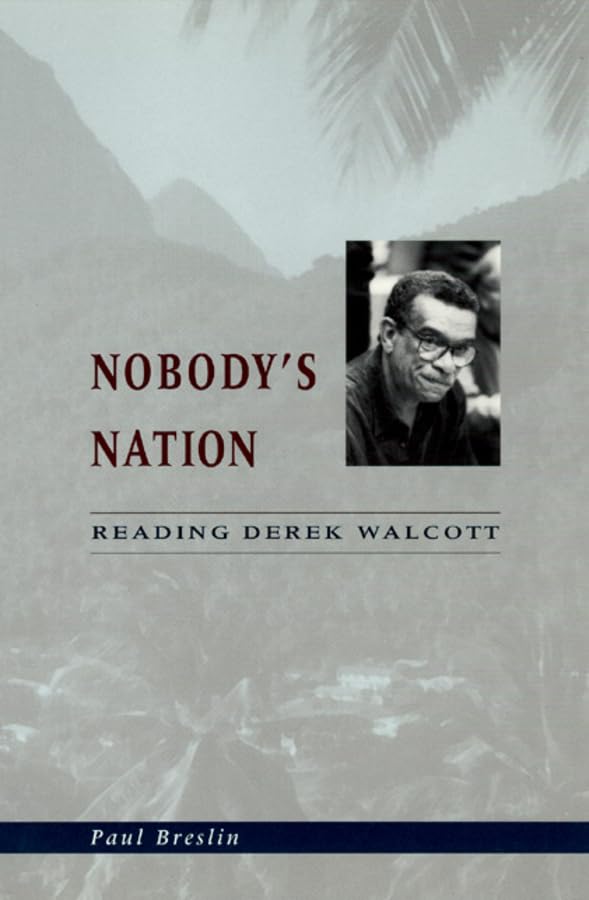



Nobody's Nation offers an illuminating look at the St. Lucian, Nobel-Prize-winning writer, Derek Walcott, and grounds his work firmly in the context of West Indian history. Paul Breslin argues that Walcott's poems and plays are bound up with an effort to re-imagine West Indian society since its emergence from colonial rule, its ill-fated attempt at political unity, and its subsequent dispersal into tiny nation-states. According to Breslin, Walcott's work is centrally concerned with the West Indies' imputed absence from history and lack of cohesive national identity or cultural tradition. Walcott sees this lack not as impoverishment but as an open space for creation. In his poems and plays, West Indian history becomes a realm of necessity, something to be confronted, contested, and remade through literature. What is most vexed and inspired in Walcott's work can be traced to this quixotic struggle. Linking extensive archival research and new interviews with Walcott himself to detailed critical readings of major works, Nobody's Nation will take its place as the definitive study of the poet. Nobody's Nation offers an illuminating look at the St. Lucian, Nobel-Prize-winning writer, Derek Walcott, and grounds his work firmly in the context of West Indian history. Paul Breslin argues that Walcott's poems and plays are bound up with an effort to re-imagine West Indian society since its emergence from colonial rule, its ill-fated attempt at political unity, and its subsequent dispersal into tiny nation-states. According to Breslin, Walcott's work is centrally concerned with the West Indies' imputed absence from history and lack of cohesive national identity or cultural tradition. Walcott sees this lack not as impoverishment but as an open space for creation. In his poems and plays, West Indian history becomes a realm of necessity, something to be confronted, contested, and remade through literature. What is most vexed and inspired in Walcott's work can be traced to this quixotic struggle. Linking extensive archival research and new interviews with Walcott himself to detailed critical readings of major works, Nobody's Nation will take its place as the definitive study of the poet. Nobody's Nation offers an illuminating look at the St. Lucian, Nobel-Prize-winning writer, Derek Walcott, and grounds his work firmly in the context of West Indian history. Paul Breslin argues that Walcott's poems and plays are bound up with an effort to re-imagine West Indian society since its emergence from colonial rule, its ill-fated attempt at political unity, and its subsequent dispersal into tiny nation-states. According to Breslin, Walcott's work is centrally concerned with the West Indies' imputed absence from history and lack of cohesive national identity or cultural tradition. Walcott sees this lack not as impoverishment but as an open space for creation. In his poems and plays, West Indian history becomes a realm of necessity, something to be confronted, contested, and remade through literature. What is most vexed and inspired in Walcott's work can be traced to this quixotic struggle. Linking extensive archival research and new interviews with Walcott himself to detailed critical readings of major works, Nobody's Nation will take its place as the definitive study of the poet. Paul Breslin is a professor of English at Northwestern University. He is the author of The Psycho-Political Muse: American Poetry since the Fifties , published by the University of Chicago Press, and You Are Here , a collection of poems. Nobody's Nation Reading Derek Walcott By Paul Breslin University of Chicago Press Copyright © 2001 Paul Breslin All right reserved. ISBN: 0226074269 1 - Biographical Sketch It takes a West Indian a long time to say who he is. Derek Walcott Derek Alton Walcott was born in Castries on January 23, 1930, and grew up just a few blocks from the home of St. Lucias other Nobel laureate, the economist Sir W. Arthur Lewis, born on the same date in 1915. His parents, Warwick and Alix Walcott, welcomed two children into the world that day: Derek and his fraternal twin, the late Roderick Aldon. A daughter, Pamela, had been born two years earlier. Walcotts immediate grandfathersa Dutchman from Saint Martin on his mothers side and an Englishman from Barbados on his fatherswere white and relatively wealthy, and his immediate grandmothers primarily of African descent and poor. He was, as he would later put it in his most famous early poem, racially divided to the vein . Warwick Walcott died on April 23, 1931, after surgery for a mastoid infection. Although the future poet, only a year old at the time, could have no direct memory of him, the fathers presence remained in the house. His paintings he had been a skillful amateur watercoloristand other revered, silent objects ( Another Life, in CP, 153 ) hung on the walls and stood on the shelves, meticulously cared for by his widow. He a