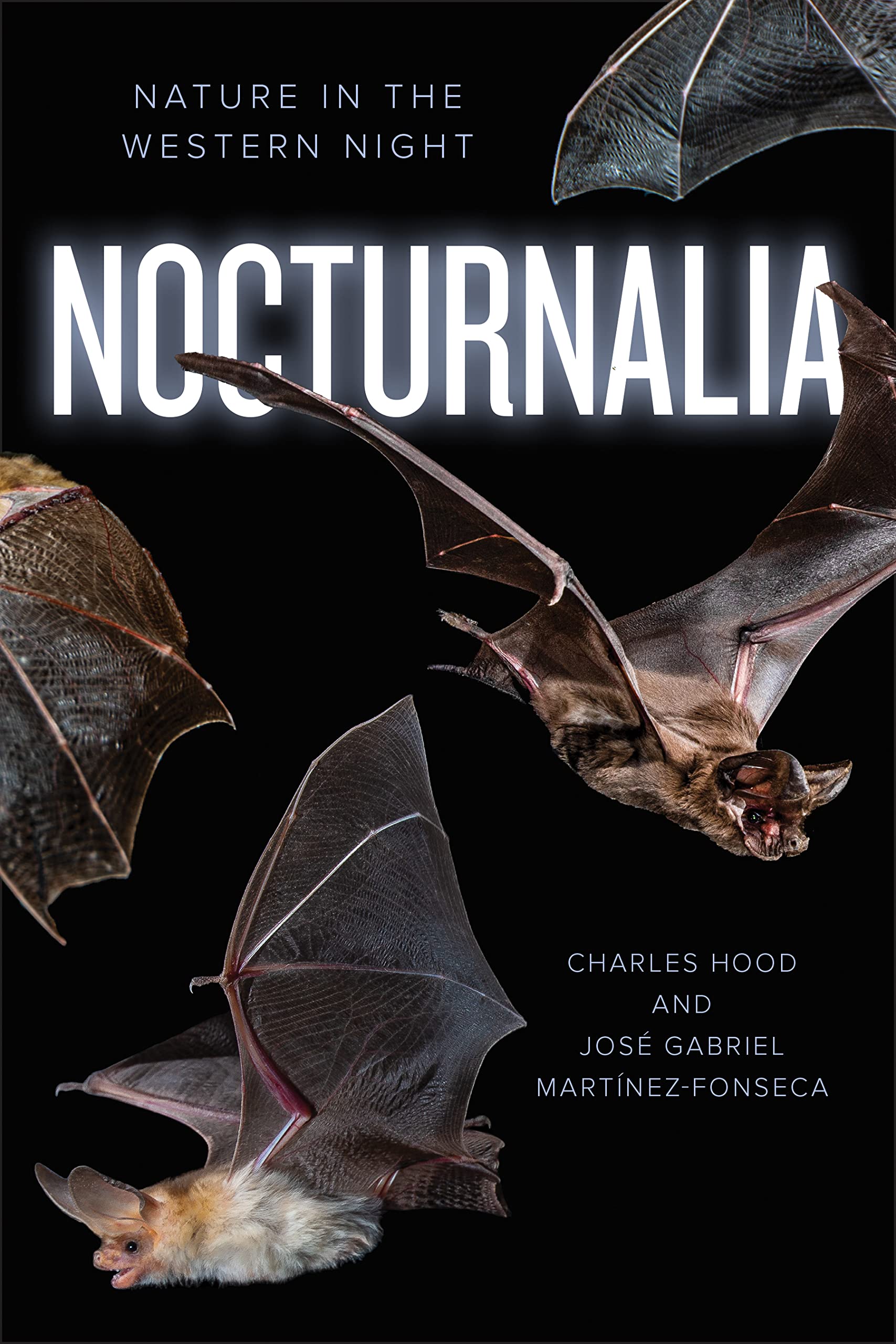



Don’t be afraid of the dark: grab a flashlight and rediscover your sense of adventure! Darkness is something humans strive to keep at bay, but under the glow of twilight a nocturnal universe stirs to life. Nightshade blossoms bloom, javelinas parade down city streets, fox eyes gleam under the cover of the forest, and tiny sparrows fly incredible distances, guided by the stars. Naturalist Charles Hood and bat biologist José Gabriel Martínez-Fonseca unravel these enigmas in Nocturnalia, inviting readers on an environmental romp through the wonders of the Wild West. Their sundown dispatches, featuring over 100 photographs from California and the American Southwest, take us from the astronomical canopy overhead, to the flora that unfurl under moonshine, to the creatures that go bump in the night. With practical tips for the budding nighttime naturalist, the authors invite citizen scientists of all stripes to expand our knowledge of this final frontier and our understanding of life on Earth. Exploring the evolutionary adaptations of owls, bats, and other nightlife animals; the natural history of nighttime plants; and the celestial patterns that regulate this after-dark kingdom, Hood and Martínez-Fonseca lift their lanterns to illuminate the exquisite and intricate inner workings of nature after nightfall. Charles Hood is a poet and naturalist who lives in the Mojave Desert. His previous books with Heyday include Wild Sonoma: Exploring Nature in Wine Country and A Salad Only the Devil Would Eat: The Joys of Ugly Nature . Always ready for the next excursion, he owns three bat detectors, nine headlamps and flashlights, and a hardcopy world atlas. José Gabriel Martínez-Fonseca divides his time between Nicaragua and Arizona, where he recently completed a PhD in bat ecology at Northern Arizona University. He owns almost as many headlamps and cameras as Charles does and has contributed images to wildlife publications worldwide. He is also very adroit at catching bats and tarantulas, among other creatures. Martínez-Fonseca is the coauthor, along with Charles Hood and Erin Westeen, of Sea Turtles to Sidewinders: A Guide to the Most Fascinating Reptiles and Amphibians of the West. EXCERPT FROM THE INTRODUCTION So you’ve gotten a good headlamp and a backup flashlight. You’ve found a buddy and packed your best field guides. Now, join Charles and José on one of our favorite night hikes, something suitable for kids and newbies and old hands alike, so we can give you a sense of what you might expect when you set off on your own nature adventures. Our starting point is the Palm Canyon trailhead, Kofa Wildlife Refuge, western Arizona. The refuge name comes from a mine (“King of Arizona”), and the preserve was initially created to protect desert bighorn sheep. They are still here, but so are owls and foxes and many other delightful creatures. One approaches this “sky island” from a saguaro-studded gravel plain, turning off the paved road and heading east toward the obvious mountain range of red rock. It looks like a fortress of stone, imposing and yet hauntingly beautiful. It is April, late in the afternoon. The immediate landscape is rocky and cholla filled, with the stone face of the mountain rising ahead of us. Waterfall streaks on now-dry cliffs are the fingerprints of a hundred centuries of thunderstorms. As soon as we get out of the car, we can hear the welcome greeting of a cactus wren— cha cha chug chug chug . Wind is from the west, steady enough to lift the sweat away instantly, and it’s about 95 degrees Fahrenheit, with 9 percent humidity. As the day darkens toward dusk, space and texture are each more distinct as shadows crenellate the cliffs, delineating each spall and spike. Seven o’clock—we have not started hiking yet, but now we see the first canyon bat, and Charles has a bat detector out, a little red box plugged into an iPhone to make the bats’ echolocation clicks audible to our dull human ears. More and more bats zip past—the phone lights up with seismograph patterns of transcribed calls. What are they hunting? A micromoth, the first official bug of the night and maybe what the bats are after too, perches on the tip of a creosote branch. We can hear but not see two distant great horned owls. Crickets: food for the ear, food for night’s smallest snakes. And now here is a mystery bat—the detector shrugs, unable to confirm identification, so maybe it’s one of the myotis bats, such as cave myotis, a species whose calls are not archived in our ID app. Technology can bring us closer to nature, if used judiciously; there does not ever need to be a sharp divide between human and nonhuman, or “nature” and the tools that enhance our understanding of nature. The authors have fancy cameras (probably too many fancy cameras), and we find that a smartphone is a great tool too. So is a good journal and sturdy boots and an insulated canteen. Low tech, high tech, and no tech: it all works together. On a night hike, you get