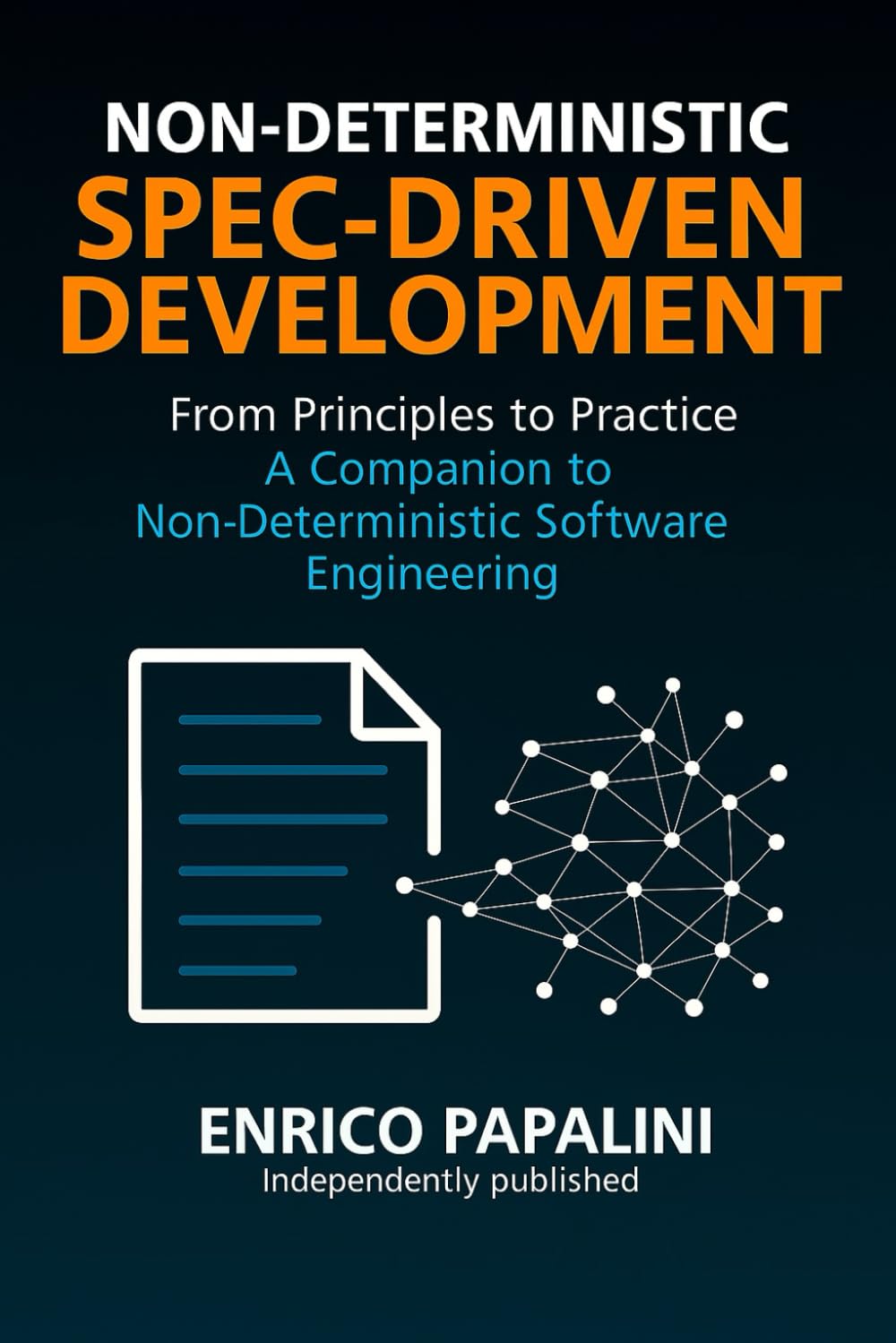
Non-Deterministic Spec-Driven Development: From Principles to Practice --- A Companion to Non-Deterministic Software Engineering
$15.99
by Enrico Papalini



Stop telling AI what to code. Start specifying what you need. This companion guide transforms how you work with AI coding assistants—from frustrating prompt engineering to systematic specification-driven development. Learn the methodology that turns vague requirements into precise, executable specifications that AI can actually implement correctly. The AI coding revolution has a problem: most developers are using it wrong. You've tried the AI assistants. You've written the prompts. And you've experienced the frustration: code that almost works, implementations that miss the point, and hours spent fixing what the AI got wrong. The problem isn't the AI—it's how we communicate with it. Spec-Driven Development (SDD) changes everything. This companion book to Non-Deterministic Software Engineering provides a complete, practical methodology for working with AI coding assistants like Claude Code, GitHub Copilot, Cursor, and others. Instead of hoping your prompts are clear enough, you'll learn to create specifications that eliminate ambiguity and produce correct implementations—consistently. What You'll Learn: • The paradigm shift from prompt engineering to specification engineering—why "intent is the source of truth" transforms AI collaboration • A four-phase process with explicit gates: Specification → Planning → Tasks → Implementation—no skipping ahead • GitHub Spec Kit mastery —the open-source toolkit that structures your specifications and integrates with 15+ AI assistants • Six battle-tested playbooks for every scenario: Greenfield projects (start right from day one) - N+1 features (leverage existing patterns) - Legacy integration (adopt SDD pragmatically) - Emergency hotfixes (when production is down) - Spike/exploration (structured learning) - Multi-role teams (PO, FA, Dev, QA coordination) • Seven advanced patterns including the Constitution Pattern, Clarification Cascade, and Research-Before-Commit • When NOT to use SDD —critical guidance on scenarios where this approach doesn't fit Practical, Ready-to-Use Resources: Templates for every artifact type (constitution, clarification log, consistency report, research artifact) - Two complete end-to-end examples : A notification feature (18 tasks) and Sprintify, a full enterprise application with Java, Spring Boot, Kafka, and OpenShift (24 tasks) - Implementation scripts you can copy into your projects tomorrow - Multi-role handoff checklists for team coordination Who This Book Is For: Developers frustrated with inconsistent AI outputs who want a systematic approach - Tech leads building team workflows around AI-assisted development - Architects designing specification patterns for enterprise adoption - Engineering managers evaluating when and how to introduce SDD The Bottom Line: Six months from now, when someone asks "why does this feature work this way?"—the answer will be in your specification, not lost in chat history. Transform your AI collaboration from chaotic prompting to systematic engineering. About the Author Enrico Papalini brings extensive experience in software engineering and AI-assisted development to this practical guide. His focus on bridging theory and practice makes complex methodologies accessible to working developers.