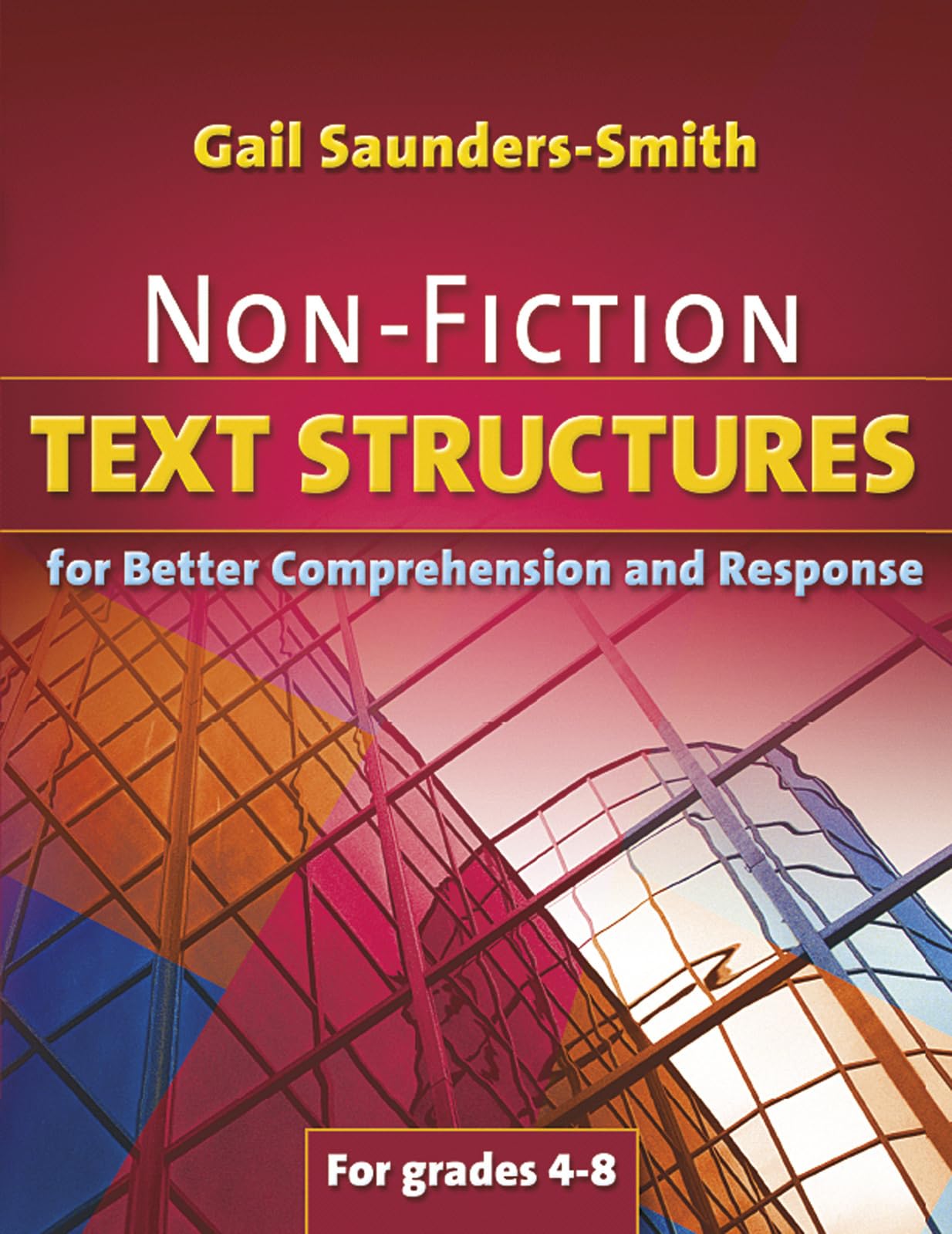
Non-Fiction Text Structures for Better Comprehension and Response (Maupin House)
$23.95
by Gail Saunders-Smith



Non-fiction text structures organize information into comprehensible patterns. Knowing how to recognize and use these structures to navigate non-fiction text greatly improves students understanding of what they read. Gail Saunders-Smith simplifies the process by providing teachers of grades 4-8 with: -strategies for teaching each of the five non-fiction text structures: compare/contrast, cause/effect, sequence/procedure, question/answer, and exemplification -engaging whole-class and small-group mini-lessons and activities using written, verbal, image, three-dimensional, and technology responses -study skills for locating, recording, and using information -tools for assessing student understanding, and explanations of the text features that organize information within the text structures. Examples, photographs, student samples, and graphic organizers support your teaching, and a bibliography of professional books and resources for locating leveled non-fiction texts make this a complete, ready-to-use guide for improving student comprehension. Communicating through writing is one of the key lessons that must be learned througout a child's school years. Non-fiction Text Structures for Better Comprehension and Response is a teacher's aide for teaching students in the later elementary through middle school grades. With quick reference to the non-fiction text structures and ideas for activities and combining problems, Non-fiction Text Structures is an English teacher's best friend for the subject and should be strongly considered. -"Wisconsin Book Watch," The Midwest Book Review, November 2009-- "The Midwest Book Review" Gail Saunders-Smith is an assistant education professor at Youngstown State University in Ohio. She is also an independent staff developer, writer, and editor. She presents nationally at conferences on literacy development and instruction and has written numerous articles, children s non-fiction books, and professional resources. Gail holds a B.S. and M.A. in Early Childhood Education from Kent State University and a M.S. in Administration and Supervision from Youngstown State University. She completed post-graduate work at The Ohio State University and earned a Ph.D. in curriculum and instruction from The University of Akron. Gail is a former classroom teacher, Reading Recovery Teacher Leader, and Reading/Language Arts K-12 Supervisor and Coordinator of State and Federal Programs for the Summit County ESC.