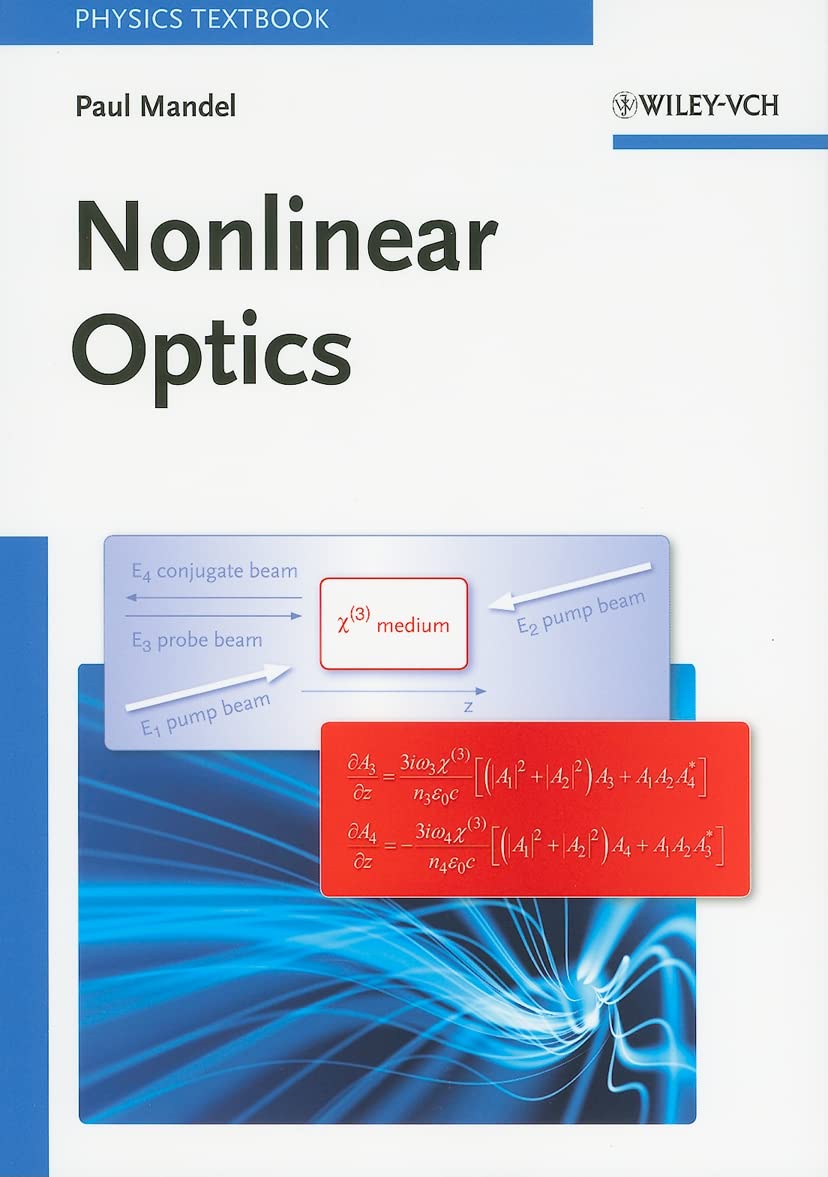



Based on the author's extensive teaching experience and lecture notes, this textbook provides a substantially analytical rather than descriptive presentation of nonlinear optics. Divided into five parts, with most chapters corresponding to a two-hour lecture, the book begins with a unique account of the historical development from Kirchhoff's law for the black-body radiation to Planck's quantum hypothesis and Einstein's discovery of spontaneous emission - providing all the explicit proofs. The subsequent sections deal with matter quantization, ultrashort pulse propagation in 2-level media, cavity nonlinear optics, chi(2) and chi(3) media. For graduate and PhD students in nonlinear optics or photonics, while also representing a valuable reference for researchers in these fields. Based on the author‘s extensive teaching experience and lecture notes, this textbook provides a substantially analytical rather than descriptive presentation of nonlinear optics. Divided into five parts, with most chapters corresponding to a two hour lecture, the book begins with a unique account of the historical development from Kirchhoff‘s law for the black-body radiation to Planck‘s quantum hypothesis and Einstein‘s discovery of spontaneous emission – providing all the explicit proofs. The subsequent sections deal with matter quantization, ultrashort pulse propagation in 2-level media, cavity nonlinear optics, ?Ê(2) and ?Ê(3) media. For graduate and PhD students in nonlinear optics or photonics, while also representing a valuable reference for researchers in these fields. Part I: Quantized matter _ 2- and 3-level media _ atomic interference _ electromagnetically induced transparency _ slow light Part II: Sine-Gordon solitons _ Self-induced transparency _ Sine-Gordon equation – derivation and solutions Part III: Cavity nonlinear optics _ lasers _ optical bistability Part IV: Χ(2) media _ second harmonic generation _ sum and difference frequency generation _ optical parametric oscillators Part V: Χ(3) media _ multiwave mixing _ optical phase conjugation _ nonlinear Schrödinger equation – derivation and solutions Based on the author‘s extensive teaching experience and lecture notes, this textbook provides a substantially analytical rather than descriptive presentation of nonlinear optics. Divided into five parts, with most chapters corresponding to a two hour lecture, the book begins with a unique account of the historical development from Kirchhoff‘s law for the black-body radiation to Planck‘s quantum hypothesis and Einstein‘s discovery of spontaneous emission – providing all the explicit proofs. The subsequent sections deal with matter quantization, ultrashort pulse propagation in 2-level media, cavity nonlinear optics, ?Ê(2) and ?Ê(3) media. For graduate and PhD students in nonlinear optics or photonics, while also representing a valuable reference for researchers in these fields. Part I: Quantized matter _ 2- and 3-level media _ atomic interference _ electromagnetically induced transparency _ slow light Part II: Sine-Gordon solitons _ Self-induced transparency _ Sine-Gordon equation – derivation and solutions Part III: Cavity nonlinear optics _ lasers _ optical bistability Part IV: Χ(2) media _ second harmonic generation _ sum and difference frequency generation _ optical parametric oscillators Part V: Χ(3) media _ multiwave mixing _ optical phase conjugation _ nonlinear Schrödinger equation – derivation and solutions Paul Mandel is the founder and was Head of the Theoretical Nonlinear Optics group at the Universite Libre de Bruxelles (ULB) until his retirement in 2008. He obtained his academic degrees at the ULB under Professor I. Prigogine. His career was spent with the National Science Foundation of Belgium with full-time research positions. He has been working in quantum and semi-classical optics since 1971, managing national and European research contracts, and has chaired research conferences in the EU and the USA. Lately, he has been a part-time Professor of Optics at the ULB. He has published over 250 research papers in refereed journals and a book with Cambridge University Press.