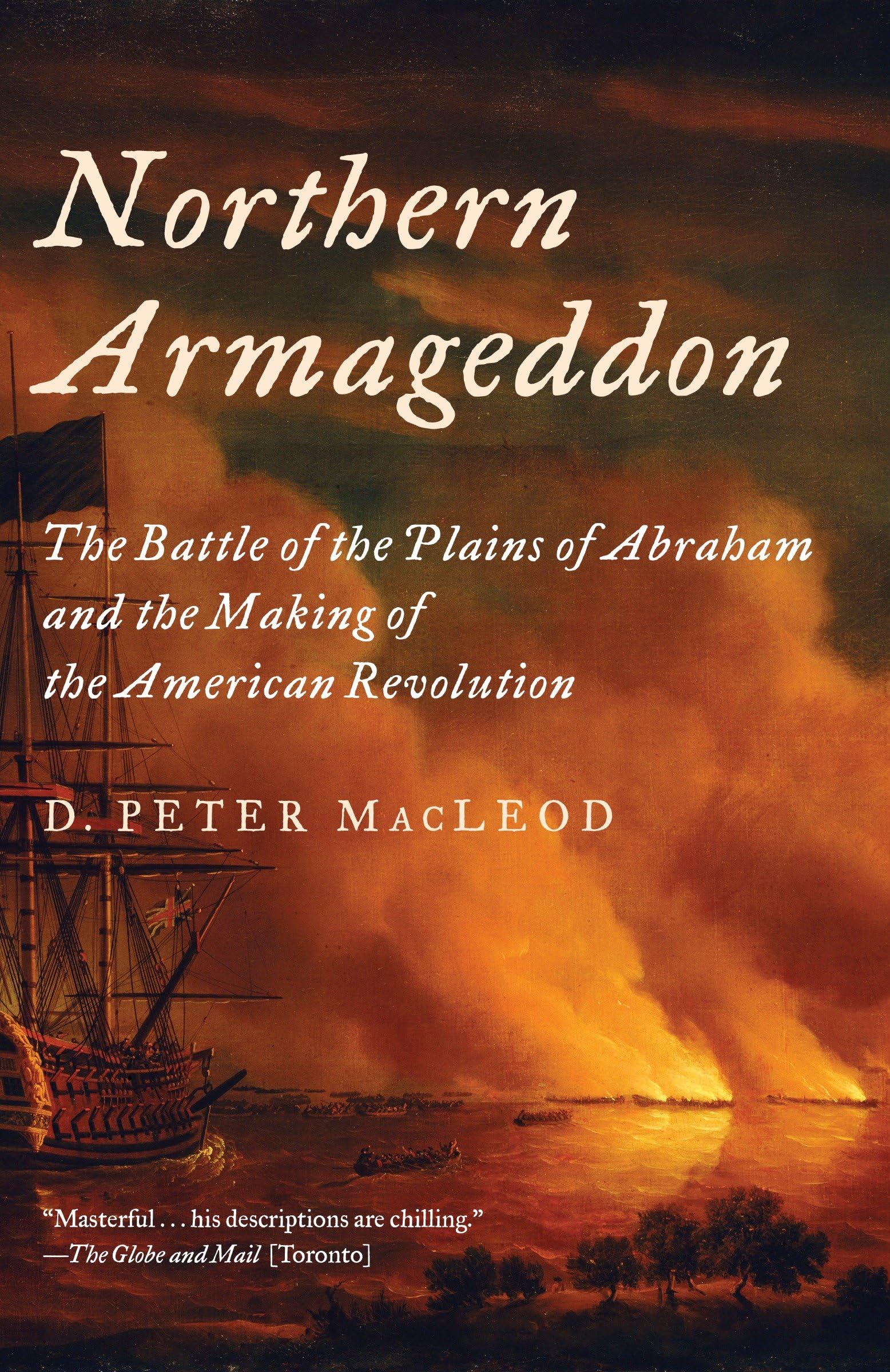
Northern Armageddon: The Battle of the Plains of Abraham and the Making of the American Revolution
$18.00
by D. Peter MacLeod



The battle on the Plains of Abraham lasted twenty minutes, and at its finish the course of a continent was changed forever: New military tactics were used for the first time against standard European formations; Generals Wolfe and Montcalm each died of gunshot wounds; France surrendered Quebec to the British, setting the course for the future of Canada; and British control of North America east of the Mississippi was assured. Also American participation in ousting the French spurred the confidence of the people of New York, Pennsylvania, and Massachusetts, who began to agitate for independence from Great Britain. In Northern Armageddon , Peter MacLeod, uses original research—diaries, journals, letters, and firsthand accounts—and all of his extensive knowledge and grasp of warfare and colonial North American history, to tell this epic story on a human scale. A huge, ambitious re-creation, MacLeod gives us the large-scale ramifications of this clash of armies, not only on the shape of North America, but on the history of Europe itself. “Significantly advances our understanding of the naval role in the battle of the Plains of Abraham and excels all previous studies. . . . A vibrant portrait. . . . A visceral narrative. . . . Persuasive.” —David Preston, The Wall Street Journal “Even-handed. . . . Vivid. . . . MacLeod has crafted a serious work of history that reads like an adventure novel. He skillfully illuminates the many ways Americans fit into the big picture of the continent’s conflicts, in which two big nations emerged out of a patchwork of contending powers.” —Clarke Crutchfield, Richmond Times-Dispatch “Writing with a keen eye for the dramatic, MacLeod tells this story in a big way, giving equal parts to each side. . . . The events of the battle are finely rendered, and MacLeod makes a strong case for their importance as a precursor to the American Revolution.” — Publishers Weekly “MacLeod explores the extent of Quebec’s insurmountable natural defenses and Wolfe’s inability to overcome them. . . . The author’s strong knowledge of every aspect of the fight prevails to produce an intricate, enlightening account. . . . Students of American history will appreciate the detail and the thoroughness of this account of what Churchill called the ‘first world war.’ ” — Kirkus “Definitive . . . superb in its combination of individual perspective and strategic narrative. Americans (who composed roughly a third of the conquering army) did not realize at the time that as Montcalm’s men surrendered they had taken the first steps on their own country’s path to independence. This book tells us—brilliantly—both how the battle was fought, and what it meant.” —Eliot A. Cohen, author of Conquered into Liberty: Two Centuries of Battles Along the Great Warpath that Made the American Way of War “Masterful . . . his descriptions are chilling.” — Toronto Globe and Mail D. Peter MacLeod is Director of Research at the Canadian War Museum. He is the author of The Canadian Iroquois and the Seven Years’ War . He lives in Ottawa, Ontario. Chapter 1 500,000 Years of History Humans Make War; Geography Shapes the Battlefield The history of the Battle of the Plains of Abraham began with a gentle rain of sediment floating down to the floor of the proto–Atlantic Ocean during the late Precambrian era. Time passed; minute grains of sand and clay settled, accumulated, and hardened into gigantic blocks of sedimentary rock. When tectonic shifts slammed them together, closing the proto-Atlantic and creating the Appalachian Mountains, some of these blocks shifted westward. One massive chunk of folded and faulted limestone, sandstone, and shale, six miles long, half a mile wide, and known to geologists as the Quebec Promontory, came to rest against the future Canadian Shield. Half a billion years later, the fate of Canada, the future United States, and the French and British Empires in North America turned on possession of this block of sedimentary rock. By September 1759, the Seven Years’ War, the titanic struggle for empire between France and Britain that Winston Churchill called “the first world war,” had been under way for just over five years. During those five years, British goals in North America had changed from the occupation of the Ohio valley to the conquest of Canada. Yet although the British enjoyed comfortable margins of naval and military superiority in the region, they had spent most of those years reeling from defeat after defeat at the hands of Pierre de Rigaud de Vaudreuil, governor-general of New France and commander in chief of the French armed forces in North America. Year after year, the British in North America contemplated or attempted the conquest of part or all of New France. Vaudreuil responded by sending Louis-Joseph de Montcalm, his senior field commander, to capture British outposts and smash British offensives before they could threaten Canada. Sheer force of number