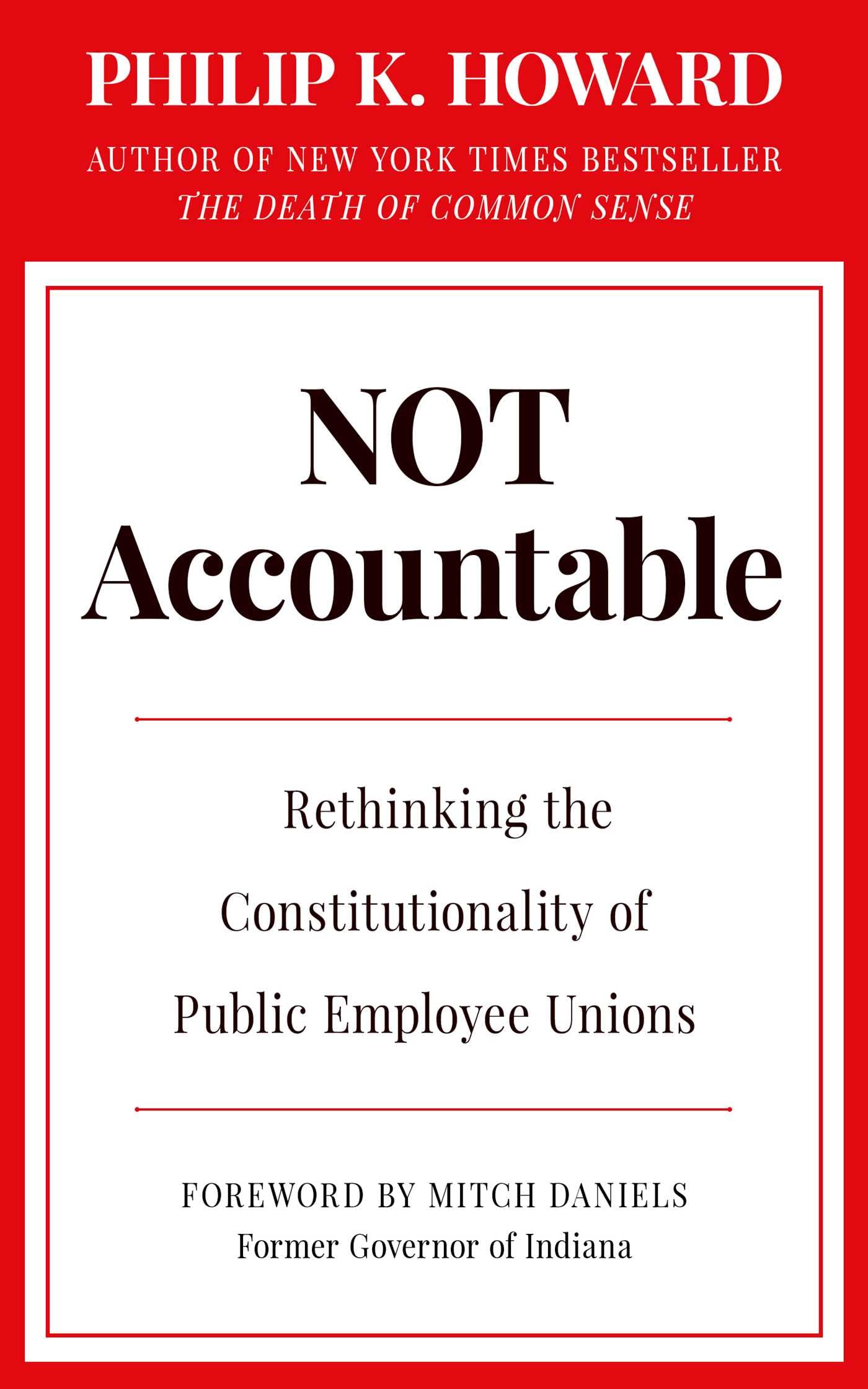
Not Accountable: Rethinking the Constitutionality of Public Employee Unions
$9.96
by Philip K. Howard



“Elected leaders come and go, but public unions just say no.” Hiding in plain sight is a fatal defect of modern democracy. Public employee unions have a death grip on the operating machinery of government. Schools can’t work, bad cops can’t be fired, and politicians sell their souls for union support. With this searing five-point indictment, Philip K. Howard argues that union controls have disempowered elected executives and should be unconstitutional. Union power in government happened almost by accident in the 1960s, ostensibly to give public unions the same bargaining rights as trade unions. But government bargaining is not about dividing profits, but making political choices about public priorities. Moreover, the political nature of decision-making allowed unions to provide campaign support to friendly officials. Public bargaining became collusive. The unions brag about it: “We elect our own bosses.” Sitting on both sides of the bargaining table has allowed public unions to turn the democratic hierarchy upside down. Elected officials answer to public employees. Basic tools of good government have been eliminated. There’s no accountability, detailed union entitlements make government largely unmanageable and unaffordable, and public policies are driven by what is good for public employees, not what is good for the public. Public unions keep it that way by brute political force—harnessing the huge cohort of public employees into a political force dedicated to preventing the reform of government. The solution, Howard argues, is not political but constitutional. America’s republican form of government requires an executive branch that is empowered to implement public policies, not one shackled to union controls. Public employees have a fiduciary duty to serve the public and should not be allowed to organize politically to harm the public. This short book could unlock a door to fixing a broken democracy. Common Good (www.commongood.org) is a nonpartisan reform coalition to simplify government and restore common sense in daily decisions. It proposes a new governing vision: replace red tape with individual accountability. Its Founder and Chair is lawyer and author Philip K. Howard. "Philip K. Howard has written a short, important book on an urgently needed reform that gets only more urgent with every new labor contract negotiated by governments and public-sector unions. For, as the late economist Herbert Stein noted in his famous 'Stein's Law,' 'if something cannot go on forever, it will stop.'" — John Steele Gordon, The New Criterion "A courageous book that respects no sacred cows." — Michael T. Hartney, Clarem ont Review of Books "Longtime centrist reformer Philip K. Howard argues persuasively that public-sector unions are inherently both unconstitutional and disruptive to proper functioning of a representative democracy." — Washington Examiner "Mr. Howard's civic-minded zeal for a well-functioning democracy—not to mention the appeal of his brisk, clear prose—should focus our attention on a vexing public problem and even inspire us to wrest back control of our government." — John Ketcham, The Wall Street Journal "Howard's book is ... a potent summons to politics, which can still bring such unions to heel." — George Will, The Washington Post "Howard's thoughtful perspective and well-deserved reputation for dispensing non-wonkish common sense make it likely that his message and proposed reforms will not be ignored. ... One hopes that Philip Howard's Not Accountable will motivate Americans to pay closer attention and heed his sensible recommendations." — Mark Pulliam, Law & Liberty "Howard not only catalogs the many dreadful consequences of the rising power of government-employee unions ... but also offers his own startling solution to the problem, arguing that public unions should be considered unconstitutional because they have thoroughly undermined our democratic form of government." — Steven Malanga, City Journal "The clearest case against [public unions'] flagrant distortion of American democracy is made in a new book Not Accountable by Philip K. Howard, a lawyer who has been a lonely voice for common sense governance since his brilliant book, The Death of Common Sense , in 1994. I consider him a charter member of the Sanity Caucus. If you are interested in your progeny not having their intellects stunted by mediocre martinets, you should read this book." — Joe Klein, Sanity Clause "Howard ... hopes Not Accountable, like Upton Sinclair's The Jungle, will spark demands for reform." — Michael Barone, Washington Examiner "Howard was bound at some point to home in on collective bargaining. He began to see it as one of the biggest impediments to productivity and reform. 'The abuse of power by public employee unions is the main story of public failure in America,' he writes in Not Accountable ." — Mary Williams Walsh, Political News Items "