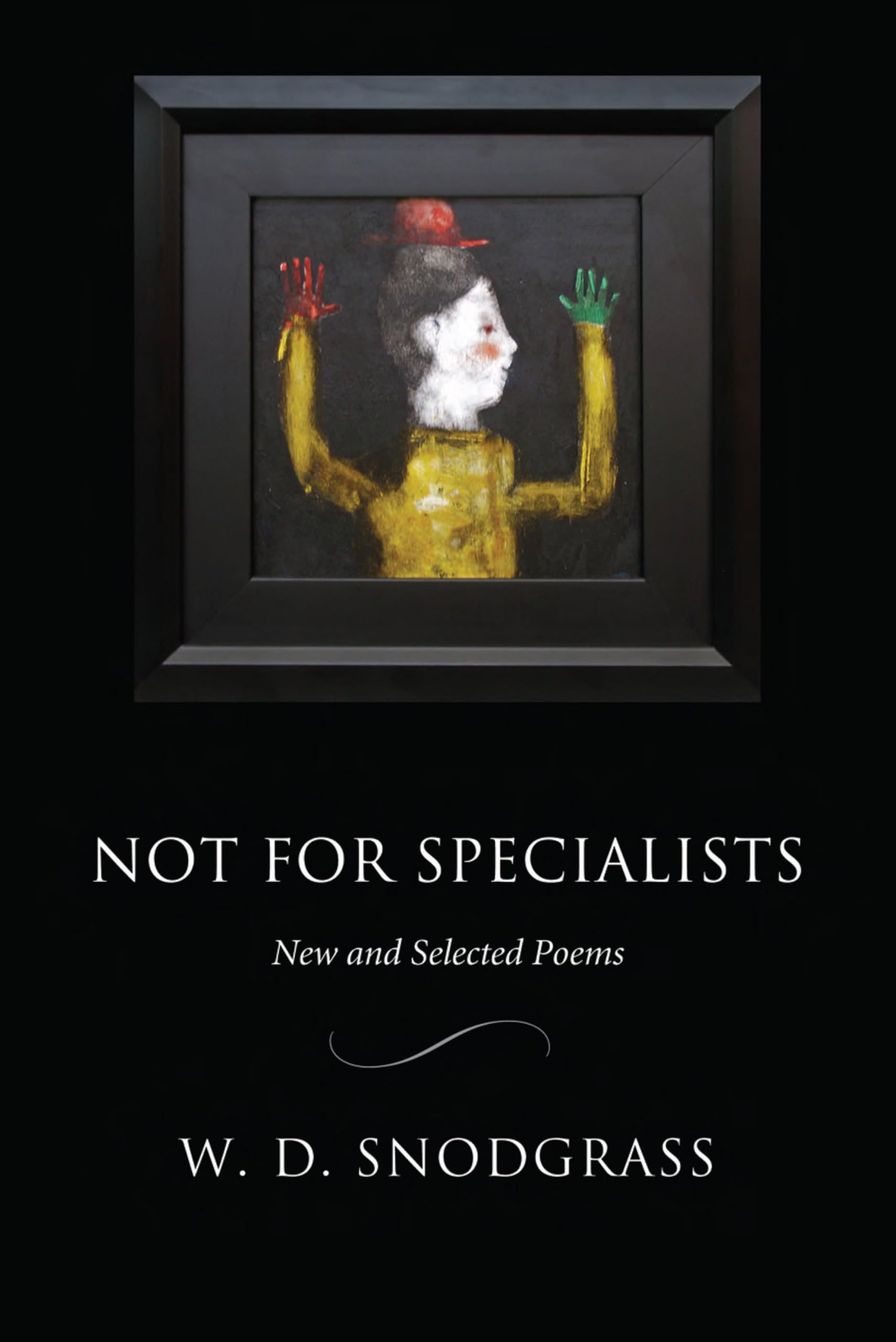
Not for Specialists: New and Selected Poems (American Poets Continuum)
$11.38
by W.D. Snodgrass



Until the late 1970s, W. D. Snodgrass was known primarily as a confessional poet and a key player in the emergence of that mode of poetry in the late 1950s and early 1960s. Snodgrass makes poetry out of the daily neuroses and everyday failures of a man—a husband, father, and teacher. This domestic suffering occurs against a backdrop of more universal suffering which Snodgrass believes is inherent in the human experience. Not for Specialists includes 35 new poems complemented by the superb work he wrote in the Pulitzer Prize winning collection, Heart’s Needle , along with poetry from seven other distinguished collections. from “Nocturnes” Seen from higher up, it makes its first move in the low creekbed, the marshlands down the valley, spreading across the open hayfields, the hedgerows with their tops still lit, laps the roadbed, flows over lawns and gardens, past the house and up the wooded hillside back behind us till only some few rays still scythe between the treetrunks from the far horizon and are gone. W. D. Snodgrass , born in Pennsylvania in 1926, is the author of more than 20 books of poetry, including The Fuehrer Bunker: The Complete Cycle (BOA, 1995); Each in His Season (BOA, 1993); and Heart's Needle (1959), which won the Pulitzer Prize for Poetry. His other books include To Sound Like Yourself: Essays on Poetr y (BOA, 2002), After-Images: Autobiographical Sketches (BOA, 1999) and six volumes of translation, including Selected Translations (BOA Editions, 1998), which won the Harold Morton Landon Translation Award. From Publishers Weekly Snodgrass made his splash with Heart's Needle (1959), a careful sequence of rhymed poems about his marital troubles and his daughter: the volume helped create so-called "confessional poetry" and won a Pulitzer Prize. Snodgrass gave his later allegiance not to autobiography, but to technique, pursuing, on the one hand, sad, clear, lyrical poems and rueful epigrams, and on the other, ambitious if not quixotic multipoem projects. Among the former, most of the best are brand new: they take on subjects as disparate as twilight fireflies, the war in Iraq, hip replacements and the man who stole Snodgrass's credit card, in styles indebted to poets as different as Andrew Marvell and A.R. Ammons. One Ammons-like work is "The Führer Bunker," a cycle of poems about, and spoken by, Joseph Goebbels, Hermann Goering, Adolf Hitler and other members of Hitler's inner circle, completed in 1995. As if in reaction to that grim, ambitious achievement, other pieces here feature graceful measures and a light touch: a quartet of seasonal odes breathes new life into very old topics. This is a judicious selection from a significant oeuvre. (Apr.) Copyright © Reed Business Information, a division of Reed Elsevier Inc. All rights reserved. --This text refers to an out of print or unavailable edition of this title. From Booklist If you think that writing primarily in rhyme and meter bespeaks equanimity, or sweetness of character, read Snodgrass. Oh, he mellows out in the face of nature, but he's prickly. But if it weren't for whatever propelled him out of three marriages, he wouldn't have written his extraordinary record of noncustodial fatherhood, "Heart's Needle," the title piece in his Pulitzer Prize-winning first collection, which retains undiminished its ring of truth and its emotional power. By the same token, though at some temporal remove, he couldn't have written the new poem about his first wife's latest marriage, conducted by the beloved daughter of his early masterpiece, who has since become an Episcopal priest. His many profoundly bemused and persuasive poems of love's tougher moments, his marvelous angry and denunciatory poems, and the chilling Fuehrer Bunker poems in the voices of the major Nazis during the war's last month--all these might have been impossible if Snodgrass was a nice, easygoing guy. He's not that sort, and his best work seems permanent because he isn't. Ray Olson Copyright © American Library Association. All rights reserved --This text refers to an out of print or unavailable edition of this title. W. D. Snodgrass is author of over twenty books of poetry, two books of literary criticism, and six volumes of translation. Honors include an Ingram Merrill Foundation award, Harold Morton Landon Translation Award, and fellowships from The Academy of American Poets, Ford Foundation, Guggenheim Foundation, and National Endownment for the Arts. He retired from teaching in 1994. Used Book in Good Condition