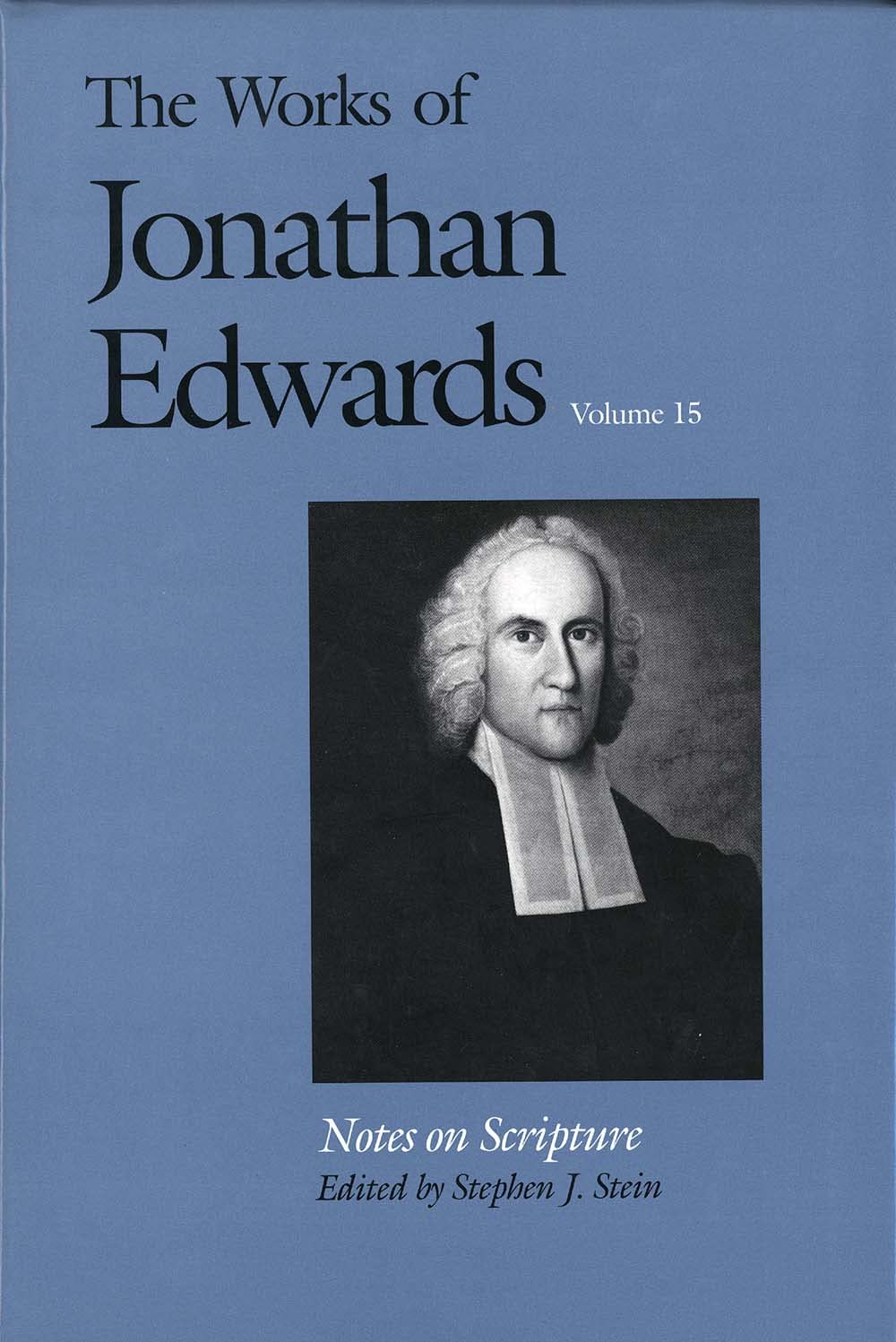
Notes on Scripture (The Works of Jonathan Edwards Series, Volume 15)
$138.00
by Jonathan Edwards



This is the first complete edition of the private biblical notebook that Jonathan Edwards compiled over a period of nearly thirty-five years. Edwards’ "Notes on Scripture" confirms the centrality of the Bible in his thought and provides more balance to earlier depictions of his writings that emphasized the scientific and philosophical while overlooking the biblical dimension. In this critical edition the entries appear in the order in which Edwards wrote them, beginning with a short commentary on Genesis 2:10-14 that he penned in 1724, and ending with his last entry, Number 507 on the Book of Solomon's Song, written two years before his death. This volume provides direct access to one of America’s most influential religious thinkers. Edwards’ entries range across the entire scriptural canon and reveal his creativity in the interpretation of particular biblical texts and his fascination with typology. The notebook also documents Edwards’ engagement with the intellectual currents of his day, in particular his response to the challenge associated with the Enlightenment critique of biblical revelation. Stephen J. Stein’s introduction situates Edwards as an exegete in the larger tradition of biblical commentary and in the intellectual world of eighteenth-century Western thought. Stephen J. Stein is Chancellors’ Professor of Religious Studies and chair of the Department of Religious Studies at Indiana University. He is the author of The Shaker Experience in America and editor of Edwards’ Apocalyptic Writings , both published by Yale University Press. The Works of Jonathan Edwards Notes on Scripture By Jonathan Edwards Yale University Press Copyright © 1998 Jonathan Edwards All right reserved. ISBN: 9780300071986 Chapter One DISCOURSE ON THE TRINITY According to Thomas A. Schafer, Edwards began the manuscript of what he called the "Discourse on the Trinity" (otherwise known as "Essay on the Trinity") in early 1730, when he wrote eight folio pages in a short time. He was able to write at such a pace because he could draw upon numerous "Miscellanies" entries on the topic written up to that time. He later went back over these eight pages, making some changes, soon after their original composition, struggling to improve the language and clarify the thought. Edwards' intention for the composition is unclear; he put it aside for some time, apparently several years. When in the mid- or late 1730s he took up the manuscript again, he added another folio signature (pp. 9-12), as well as an additional leaf or signature that is now missing. The additions are of two kinds and perhaps reflect Edwards' changing perception of the piece as a whole. At first he tried to improve the original portion of the essay by signaling additions, via cue marks, to particular passages. Probably in the early to mid-1740s, however, he simply started appending discrete entries without connecting them to earlier passages. This latter phase suggests that Edwards came to view the manuscript as a source book rather than as an autonomous statement, a speculation borne out by his willingness to cannibalize it for other works such as A Divine and Supernatural Light, Treatise on Grace, and Religious Affections . All the same, there are no use marks. The first part of the "Discourse" is taken up with describing the persons of the Trinity, particularly the Son and the Holy Spirit. God, Edwards begins, is infinitely happy in the enjoyment and contemplation of himself, which engenders a "perfect idea of himself." Thus the Deity is "repeated." God's idea of himself is "the express and perfect image of himself" and is a "spiritual idea," or the repetition of all of God's memories, exercises, and powers-that is, a replication of God, or God himself again. This is confirmed by scriptural descriptions of the Second Person, where the Son is the "image" and "face" of God, the "brightness, effulgence and shining forth of God's glory," the "wisdom," "logos," and "Amen" of God. Between the Father and Son exists a mutual love, joy, and delight, a "pure act," or the "Deity in act," which is the Holy Spirit. The Holy Spirit is the love of the Father and Son for each other, the love that "quickens and enlivens" creation and created spirits, and comforts God's people. Again, Scripture confirms this definition by describing the Holy Spirit as a dove, a symbol of love; scriptural types and similitudes of the Holy Spirit are oil, water, fire, breath, and wind, all of which connote a "flowing out." So the saints' communion with God consists in partaking of the Holy Spirit, or God's love. This is why, in the New Testament, Paul's greetings always mention the love and grace of the Father and Son, and the communion of the Holy Ghost. In the next section, Edwards moves on from a discussion of the persons in themselves to a consideration of their shared qualities. He reiterates that the Deity can be understood as God, understanding,