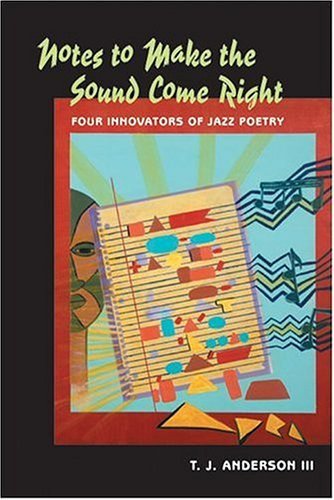
Notes to Make the Sound Come Right: Four Innovators of Jazz Poetry
$19.00
by T.J. Anderson III



In “When Malindy Sings” the great African American poet Paul Laurence Dunbar writes about the power of African American music, the “notes to make the sound come right.” In this book T. J. Anderson III, son of the brilliant composer, Thomas Anderson Jr., asserts that jazz became in the twentieth century not only a way of revising old musical forms, such as the spiritual and work song, but also a way of examining the African American social and cultural experience. He traces the growing history of jazz poetry and examines the work of four innovative and critically acclaimed African American poets whose work is informed by a jazz aesthetic: Stephen Jonas (1925?–1970) and the unjustly overlooked Bob Kaufman (1925–1986), who have affinities with Beat poetry; Jayne Cortez (1936– ), whose work is rooted in surrealism; and the difficult and demanding Nathaniel Mackey (1947– ), who has links to the language writers. Each fashioned a significant and vibrant body of work that employs several of the key elements of jazz. Anderson shows that through their use of complex musical and narrative weaves these poets incorporate both the tonal and performative structures of jazz and create work that articulates the African journey. From improvisation to polyrhythm, they crafted a unique poetics that expresses a profound debt to African American culture, one that highlights the crucial connection between music and literary production and links them to such contemporary writers as Michael Harper, Amiri Baraka, and Yusef Komunyakaa, as well as young recording artists―United Future Organization, Us3, and Groove Collection―who have successfully merged hip-hop poetry and jazz. “How often does one find a scholar with almost equal passion for poetry and for jazz? T. J. Anderson is as much a discerning scholar as he is a sensitive poet, and has been able to articulate the power and pertinence of jazz poetry in American culture with tremendous facility and insight. This book will command attention in the field for a long time to come.” —Isidore Okpewho, professor of Africana studies at Binghamton University and author of Once upon a Kingdom: Myth, Hegemony, and Identity “Anderson reads with a composer’s ear, writes with an improviser’s instincts, keeping a scholar’s eye trained on the emergence of jazz forms on the page and stage.” —Aldon L. Nielson, Kelly Professor of American Literature at Pennsylvania State University and author of Integral Music: Languages of African American Innovation “T. J. Anderson has a deep and abiding understanding of the connections between jazz and poetry—and of their intricacy. He offers a highly lucid overview of jazz poetry, as well as searching examinations of the connections between jazz and the work of such unjustly neglected poets as Bob Kaufman and Stephen Jonas. At its best, Anderson’s writing has the fluency and impassioned intelligence of a Miles Davis solo.” —David Wojahn, professor of English at Virginia Commonwealth University and author of Strange Good Fortune and The Falling Hour Traces the jazz impulse in contemporary African American poetry In ?When Malindy Sings the great African American poet Paul Laurence Dunbar writes about the power of African American music, the ?notes to make the sound come right. In this book T. J. Anderson III, son of the brilliant composer, Thomas Anderson Jr., asserts that jazz became in the twentieth century not only a way of revising old musical forms, such as the spiritual and work song, but also a way of examining the African American social and cultural experience. He traces the growing history of jazz poetry and examines the work of four innovative and critically acclaimed African American poets whose work is informed by a jazz aesthetic: Stephen Jonas (1925??1970) and the unjustly overlooked Bob Kaufman (1925?1986), who have affinities with Beat poetry; Jayne Cortez (1936? ), whose work is rooted in surrealism; and the difficult and demanding Nathaniel Mackey (1947? ), who has links to the language writers. Each fashioned a significant and vibrant body of work that employs several of the key elements of jazz. Anderson shows that through their use of complex musical and narrative weaves these poets incorporate both the tonal and performative structures of jazz and create work that articulates the African journey. From improvisation to polyrhythm, they crafted a unique poetics that expresses a profound debt to African American culture, one that highlights the crucial connection between music and literary production and links them to such contemporary writers as Michael Harper, Amiri Baraka, and Yusef Komunyakaa, as well as young recording artists?United Future Organization, Us3, and Groove Collection?who have successfully merged hip-hop poetry and jazz. In ?When Malindy Sings” the great African American poet Paul Laurence Dunbar writes about the power of African American music, the ?notes to make the sound come right.” In this book T. J. Anders