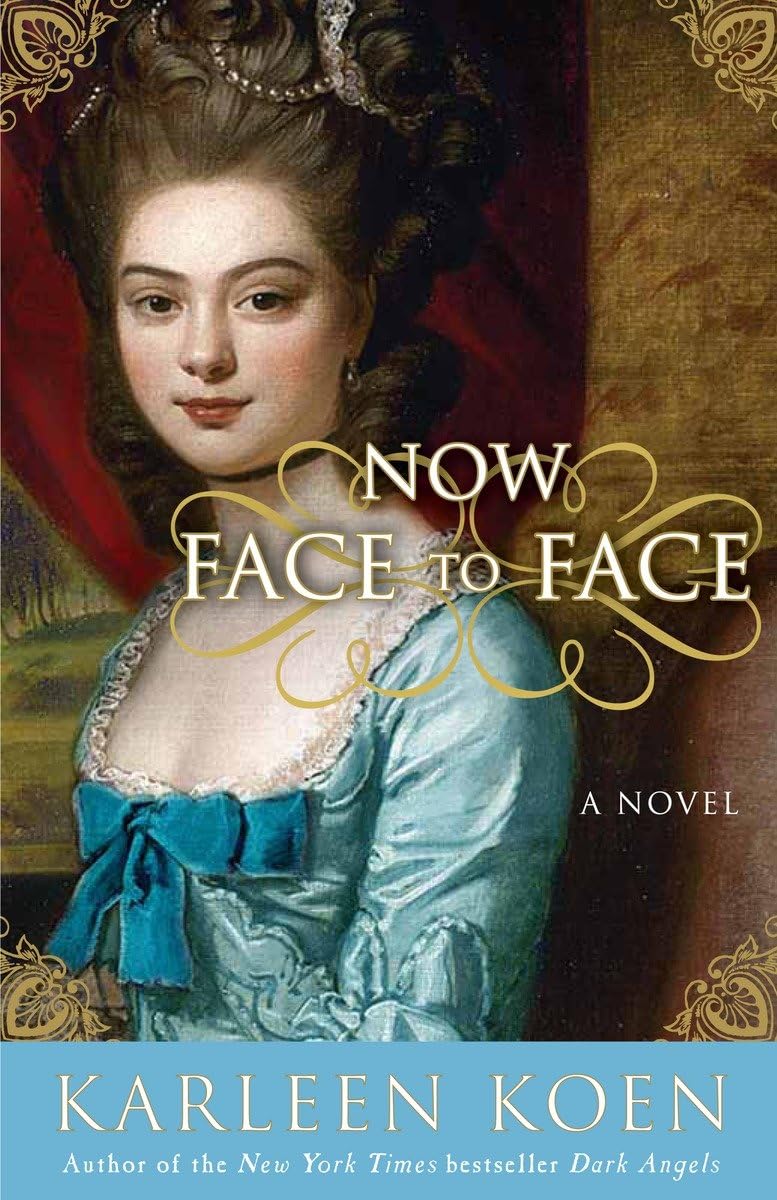



The unforgettable sequel to Karleen Koen’s beloved debut, Through a Glass Darkly A Book-of-the-Month Club main selection A bride at fifteen, widowed at the tender age of twenty, Barbara, Countess Devane, embarks for colonial Virginia financially ruined by the death of her husband in scandalous circumstances. Dressed in mourning as is proper for a woman, she is patronizingly described as a “fragile black butterfly,” but the fragility is deceiving. She makes a place for herself in the new world, takes lovers and friends across political divides, and questions the established traditions of slavery. Facing enemies she never suspected, she must return to England and deal face to face with the problems created by her husband, who haunts her even in death. Back in London, she quickly finds herself pulled into Jacobite plotting, and the treachery of powerful men suddenly threatens her family, her friends—and a new love. Now Face to Face sweeps readers from eighteenth-century America to London and brings both worlds to vivid life. It is a magnificent evocation of an era, from the plantations of Virginia to Hanoverian England. “Intrigue, adventure, suspense and love . . . a beautifully written, completely satisfying saga.” —Jean M. Auel, New York Times bestselling author Karleen Koen is the New York Times bestselling author of the historical fiction novels Through a Glass Darkly , Now Face to Face , Dark Angels, and Before Versailles . Koen lives in Texas. Chapter One On the first day of September in the year of 1721, a galley with a center mast and one sail glided through the waters of the James River in His Majesty King George I’s Royal Colony of Virginia. It was manned by slaves on oars, and in its middle, as if to emphasize her importance, sat its principal passenger, Barbara Montgeoffry, widow to an earl, and therefore a countess: the Countess Devane. She was young to be widowed already, only one-and-twenty, like the century. She sat small, exquisite yet fragile-looking in her widow’s weeds—clothes solidly black as the manners of the time demanded. Other passengers included the Deputy Governor of the colony and the Countess’s servants, a young French maid and a page boy, a slave himself. Two pug dogs, a cow, and six willow baskets with chickens inside were wedged in and around trunks, wooden boxes, barrels, and furniture wrapped in oilcloth. The river was wide, the sky blue-white. Birds chirped in trees that stood like ancient sentinels on the banks. For some time now, from the east, from the direction of Williamsburg—the principal town and capital of the colony—clouds had been gathering, rolling over and into each other. At this bend in the river, there were no houses, only fields and trees, a forest of trees, huge trees, primeval trees, as old possibly as the land itself, certainly older than the colony, which had existed upon the shores of this river and three others to the north only since 1607. “Governor Spotswood, how much farther?” asked Barbara impatiently. She was the reason the Governor had taken time from his duties to man a galley up the James River. “We are not half the way yet. Are you unwell again? Shall we land? Perry’s Grove is an hour or so ahead,” Sir Alexander Spotswood answered. An older man, in his fifties, he was deputy governor of the colony. As he spoke, a sudden wind came up to shake the fringe on his buckskin coat and pull at the sides of his wig, a full, formal, dark wig, in the style that the late king of France, Louis XIV, had made fashionable. It was parted in the middle to hang down majestically around the face. “I’m quite well, just impatient to reach First Curle.” She’d come to Virginia from England to look over her grandmother’s plantation, but there had been a delay of a week while she recovered from a fever. Her arrival was completely unexpected, as was her fever; to the Governor, it was as if a shimmering butterfly had landed unexpectedly in his colony, a butterfly with the most impressive of ancestors. The Countess’s grandfather Richard Saylor had been a renowned and beloved general in the long war with France that had taken up the Governor’s young manhood—and that of so many others—in the 1680s and 1690s and into the beginning of this century. Richard Saylor’s military exploits had earned him a dukedom. The Governor had served under him once upon a time. Is there going to be rain? thought the Governor, staring at the sky. The clouds were suddenly closer; he’d swear they had moved at least a mile since the last time he checked them. He looked at the shore, estimating where they were, where to take shelter should it begin to rain. He looked over to the young Countess, his fragile black butterfly. He did not imagine her responding kindly to a storm of rain, though she had displayed nothing but beautiful manners so far, beautiful manners that matched a beautiful face the precise shape of a heart, a fair and sweet face. The Lionheart’s granddaughter, th