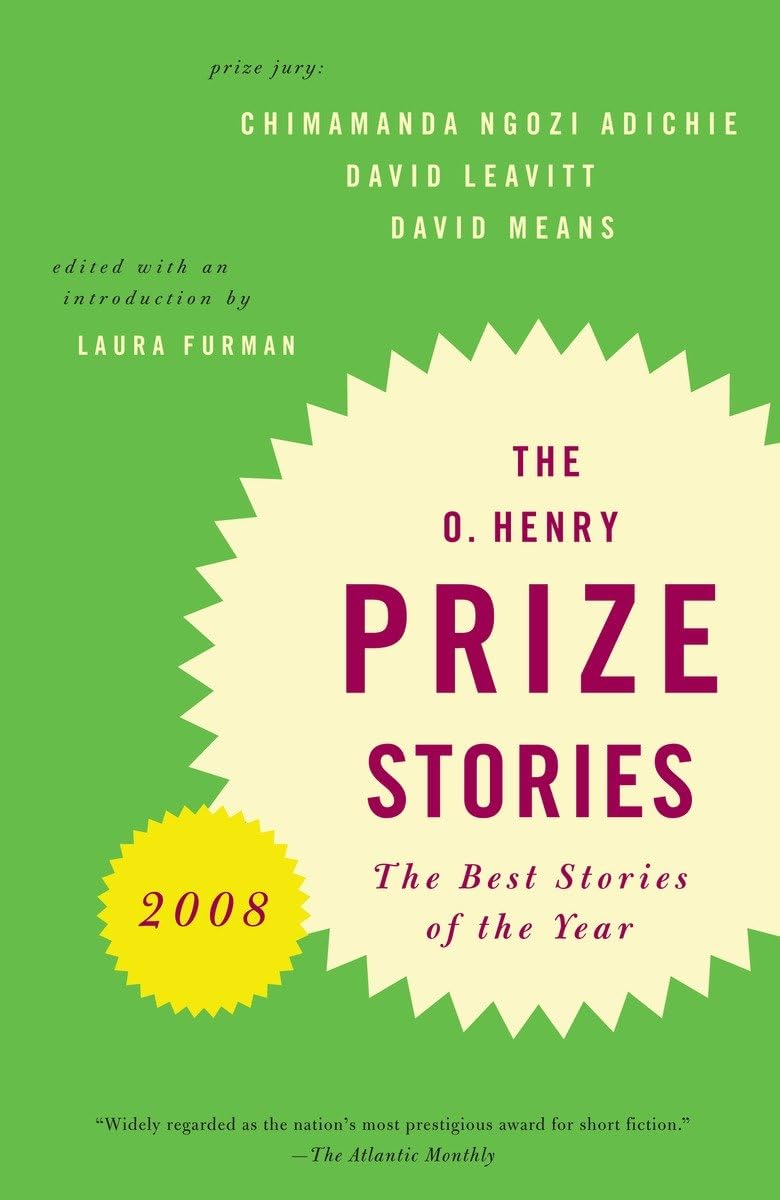



An annual collection of the twenty best contemporary short stories selected by series editor Laura Furman from hundreds of literary magazines, The O. Henry Prize Stories 2008 is studded with extraordinary settings and characters: a teenager in survivalist Alaska, the seed keeper of a doomed Chinese village, a young woman trying to save her life in a Ukrainian internet café. Also included are the winning writers' comments on what inspired them, a short essay from each of the three eminent jurors, and an extensive resource list of literary magazines. “Widely regarded as the nation's most prestigious awards for short fiction.” — The Atlantic Monthly Laura Furman's work has appeared in The New Yorker, Vanity Fair, Ploughshares, The Yale Review, and other magazines. She is the founding editor of the highly regarded American Short Fiction (three time finalist for the American Magazine Award). A professor of English at the University of Texas at Austin, she teaches in the graduate James A. Michener Center for writers. She lives in Austin. Introduction The O. Henry Prize Stories 2008 includes acknowledged masters, such as William H. Gass and William Trevor, along with talented beginners, such as Shannon Cain, Brittani Sonnenberg, Tony Tulathimutte, and Alexi Zentner. Though the twenty authors differ in age, nationality, gender, and style, it is a happy accident that their work consistently demonstrates the liveliness of the short story form. Another happy accident-the invention of academic graduate programs in creative writing-contributes to the number of stories being written by young people. The benefit is accidental because the proliferation of short stories in writing workshops might be attributed to the practical demands of the average sixteen-week semester; the student can work on several drafts of a story in the course of a term with an intensity not possible for drafts of novels or even novellas. (There are exceptions to this, no doubt.) The existence of graduate programs in creative writing is now an ordinary fact of literary life, though as recently as the 1940s it wasn't. The phenomenon often puzzles those who are neither teachers nor students, for what can be taught in any writing program? Talent can't be, nor can taste. Intelligence is there or not. Awareness of what is honest and what is false can be encouraged but must be innate also. Students can be educated as readers, as can anybody, and they can be introduced to the work of wonderful writers and be helped to understand what makes the work so good; educating readers is one of the higher callings of writing classes, if not the highest. The most valuable contributions to a writer's education aren't insightful pronouncements or didactic urgings of method or subject matter from the teacher, or even the indispensable-the detailed consideration of the student's own efforts. The best learning, like the best writing, comes from instinct, never from logic. The most valuable and lasting gift is the unspoken example of the teacher's own integrity, devotion to literature, and passion for the work of writing. In the presence of the right teacher, the student is momentarily part of literature too. A first reading of William Gass's “A Little History of Modern Music” is delightful for the situational humor of the classroom in which the teacher is free to say what he pleases and the students are under constraint. Subsequent readings show that there is more to the professor than a cranky fellow at the end of the term and perhaps his rope. The professor's history of modern music is also a guide to the role of the audience in the development of art. He teaches that new art creates its own new audience. “Home” to Mr. Gass's professor is the old music. A willingness to hear new music signals the courage to have new experiences and to leave home. “A Little History of Modern Music” is a portrait of the dissemination of knowledge, the encouragement of instinct, and the excitement of the intellectual adventure of connection and articulation. Another teacher-student relationship, this one burdened by the giving and taking of grades and sex, is the spark for Sheila Kohler's “The Transitional Object,” an age-old story of manipulation. Claire, a foreign student in Paris, learns what it is not to belong. The lessons she learns from her professor bring into question her own morality and acquaint her all too well with the power to be gained from being unscrupulous. As you read Kohler's story, consider, if you will, who is the transitional object, where Claire has been, and where she is going. In Edward P. Jones's carefully calibrated story of social snobbery, “Bad Neighbors,” the reader can decide just who the bad neighbors are. Are they the respectable and reprehensible residents of the 1400 block of Eighth Street NW, or the Bennington family, whose furniture is half broken and whose children can't quite be numbered by the street's established families? J