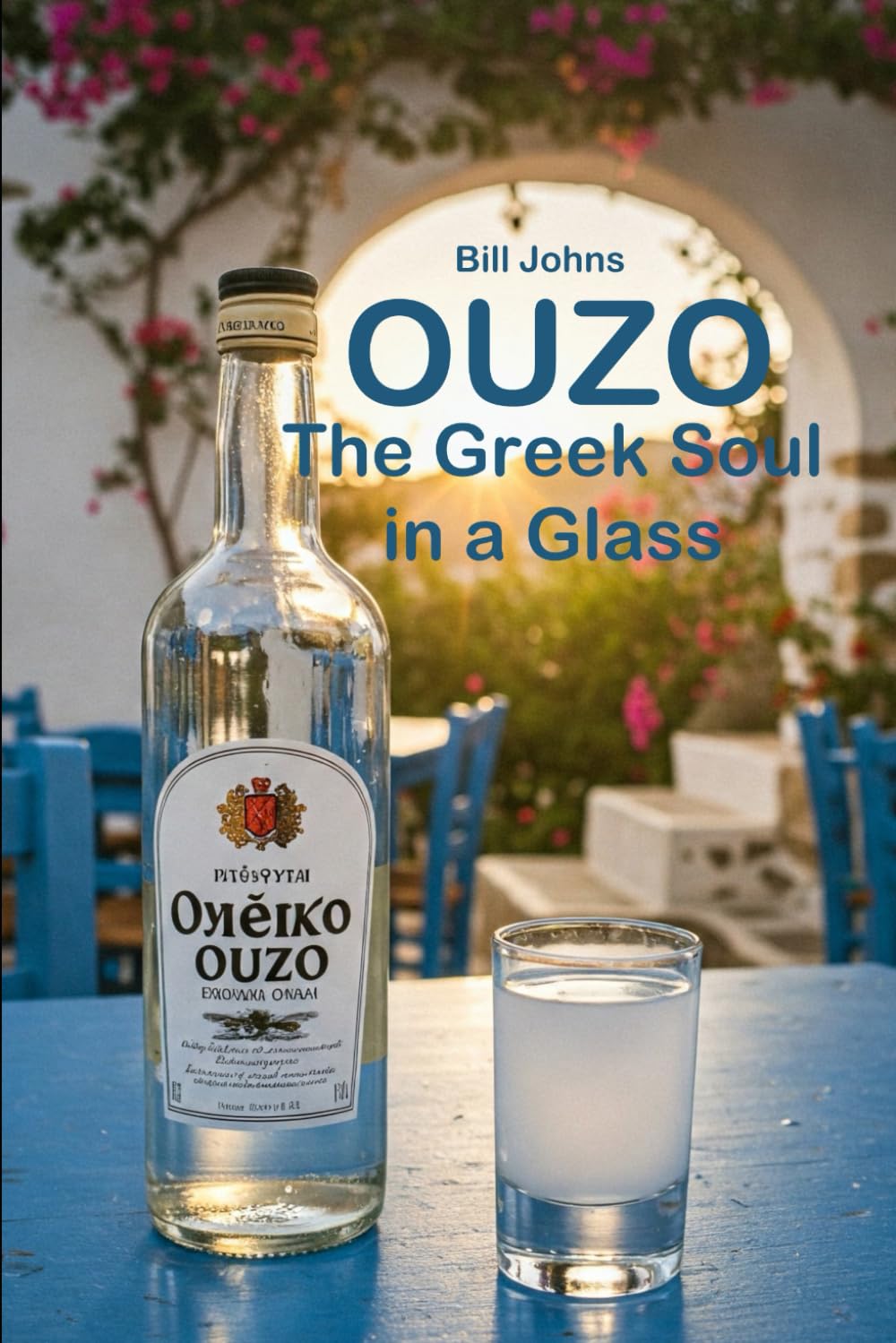



Pour a glass. Add water. Watch the cloud bloom. Ouzo: The Greek Soul in a Glass is not just a history—it is a return. In a world that moves too fast to remember, this book offers something rarer than nostalgia: a ritual of presence. From the first swirl of the louche to the scent of anise lingering in a quiet kitchen, ouzo calls its drinkers not to novelty, but to recognition. Whether you grew up with the red eggs of Greek Easter or first tasted ouzo on a sunlit balcony in Lesbos, this is a book that meets you at the intersection of memory and taste—and invites you to stay. Written with forensic depth and cultural sensitivity by Bill Johns, author of Gin: The World in a Glass and Bourbon: A History Aged in Charred Oak , this volume explores ouzo not as a commodity but as a carrier of continuity. It is a spirit that has survived war, migration, censorship, and reinvention—not because it demanded attention, but because it accompanied life with quiet persistence. From the stills of Mount Athos to the meze tables of Thessaloniki, from diaspora kitchens in Melbourne to shaded cafés in Plomari, ouzo is more than a drink. It is a signal. A language. A way of attending to the moment that defies the rush of the modern world. Through sixteen chapters and a deeply reflective epilogue, Johns traces ouzo’s lineage across empires, rituals, and recipes. He brings alive the forgotten labor of women who flavored the spirit in kitchens and fields, the contradictions of monks who distilled beneath rules that forbade intoxication, and the diaspora generations who found home not in geography, but in the moment the glass clouded. With chapters like “The Blue Table: Ouzo and the Ritual of the Meze,” “Clouded Rights: The Legal and Economic Battle for Ouzo,” and “Diaspora and the Glass from Home,” the book braids together the chemical, the cultural, and the deeply personal into a sustained meditation on taste, time, and belonging. Ouzo refuses to flatten its subject into a tourism trope or national branding exercise. It honors complexity. The drink’s defining transformation—its louche, that swirling bloom of translucent cloudiness when water is added—is not just a chemical phenomenon but a metaphor for the entire narrative. What was invisible becomes visible, not through distillation alone, but through context. Memory, like ouzo, is clearest when it clouds. For readers of cultural food history, diaspora studies, and those who have ever poured a glass to remember someone no longer there, this is a book that resonates long after the last page. It is for the elder who never explained why the drink mattered, only that it did. For the child who did not yet know the taste but recognized the ritual. For anyone who has watched a glass of ouzo cloud and felt time pause around it. You do not drink ouzo to escape. You drink it to remain. This book does the same.