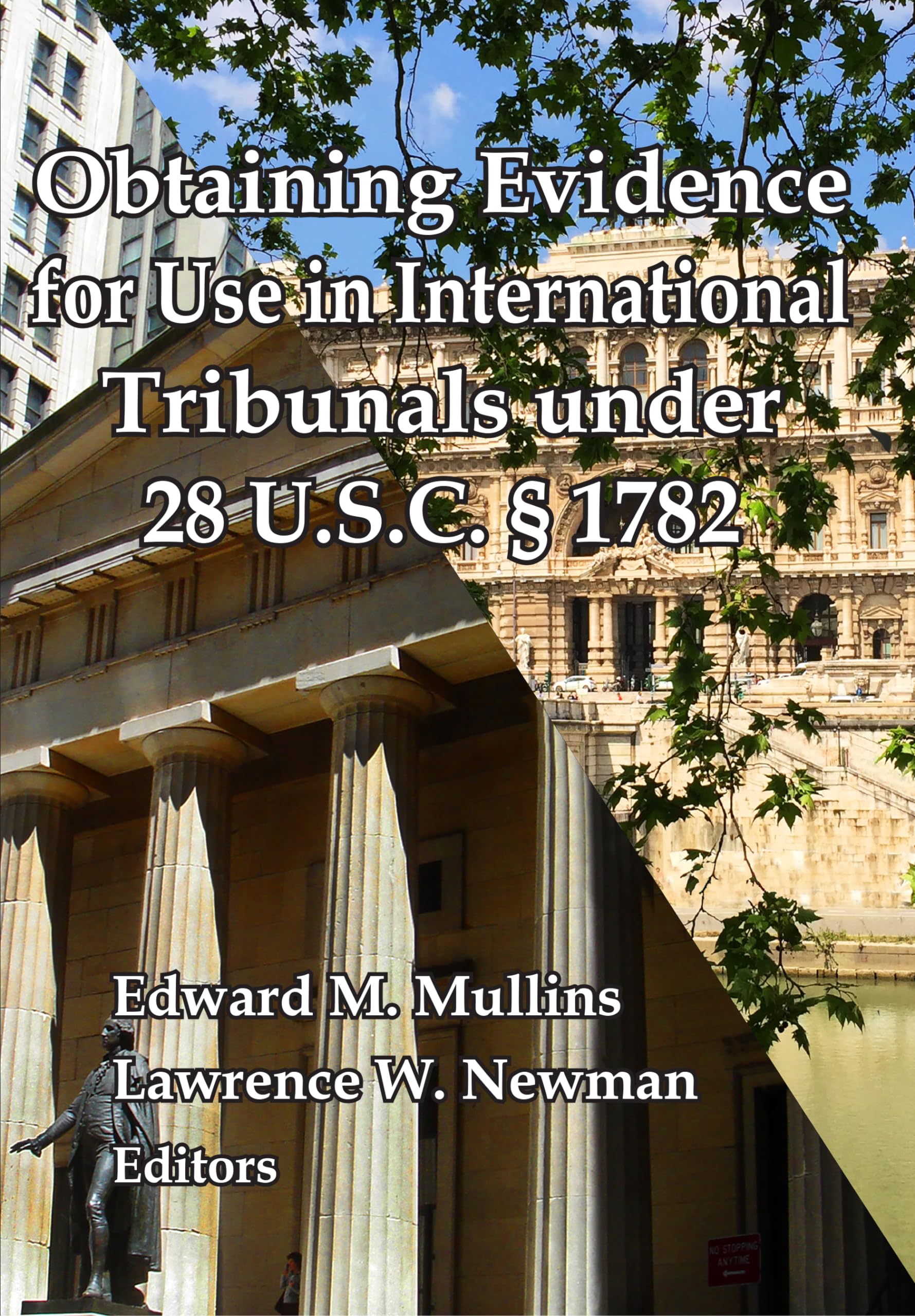
Obtaining Evidence for Use in International Tribunals under U.S.C. Sec. 1782
$150.00
by Edward M. Mullins



Transnational discovery is a vitally important part of international litigation. An increasingly important role has been discovery in the United States of information that can be used in international and foreign tribunals. That discovery has been done through the use of section 1782 of the federal judicial code, title 28, under which US courts have the discretion to permit interested persons to obtain documents and take depositions under the Federal Rules of Civil Procedure for use in foreign and international tribunals. As applications to federal courts have multiplied in recent years, courts have dealt with them in varying ways and on various legal bases, not all of them consistent with one another. This book discusses in detail the various ways in which courts have interpreted and applied various elements contained in section 1782. The book is the only one written for practitioners by practitioners with experience and expertise in litigation involving section 1782. CHAPTER 1 The History of 28 U.S.C. Section 1782 CHAPTER 2 Comparing Section 1782 with Other Cross-Border Discovery Methods―Letters Rogatory, Diplomatic/Consular Channels and Other Avenues CHAPTER 3 Section 1782’s “For Use” Statutory Requirement CHAPTER 4 What Are Section 1782 Foreign or International Tribunals Outside the Arbitral Setting? CHAPTER 5 Found in the District: Statutory Requirement Rooted in Personal Jurisdiction CHAPTER 6 Possession and Control under the Federal Rules of Civil Procedure CHAPTER 7 Discretionary Factors under Intel CHAPTER 8 Use of Section 1782 in Aid of Arbitration CHAPTER 9 Application of the Federal Rules of Civil Procedure to Section 1782 Discovery APPENDIX A 28 U.S.C. § 1782 Assistance to Foreign and International Tribunals and to Litigants Before Such Tribunals APPENDIX B Intel Corp. v. Advanced Micro Devices, Inc. Index This is an essential work for anyone practicing international litigation or arbitration in the United States (and elsewhere). Its contributions are timely, thoughtful and eminently practical. --- Gary Born, Partner, WilmerHale Section 1782 is a critical tool for cross-border dispute resolution practitioners, regardless of the dispute venue. This book is an indispensable instruction manual on how to effectively use that tool or deal with its intricacies when it is used against you. --- Glenn P. Hendrix, Arnall Golden Gregory LLP “This is an insightful and extremely useful analysis of the key issues in Section 1782 proceedings. Invaluable.” --- Gregory P. Joseph, Joseph Hage Aaronson LLC, Past President, American College of Trial Lawyers Edward M. Mullins is a Partner in the Miami office of Reed Smith. Throughout his distinguished career, Mr. Mullins has represented clients in their most challenging commercial litigation and arbitration matters. He is Florida Bar Board Certified for International Arbitration and Litigation for which he served as inaugural chair of the certification committee. He was a member consultant for the American Law Institute Restatement of the US Law of International Commercial and Investor- State Arbitration. His experience includes handling disputes involving various issues addressing distribution agreements, joint venture agreements, and energy and construction disputes, as well as investor-state arbitral disputes. He has worked extensively with clients in Section 1782 applications for discovery in the aid of foreign proceedings including at the trial and federal levels. In addition, Mr. Mullins is a member of the Executive Committee of the ABA Section of International Law and is a Fellow of the Chartered Institute of Arbitrators. Lawrence W. Newman has spent 5 decades with the gloabl law firm of Baker & McKenzie. Mr. Newman was Chairman for four years of the International Disputes Committee of the New York City Bar, and thereafter the Chairman of the Arbitration Committee of the International Institute for Conflict Prevention and Resolution (CPR) and is a member of the Advisory Committee of the Restatement of International Arbitration of the American Law Institute. Mr. Newman is a Fellow of the College of Commercial Arbitrators and a Fellow of the Chartered Institute of Arbitrators, where he is a member of its Practice and Standards Committee and Chairman of its Arbitration Subcommittee. He was an Adjunct Associate Professor at Fordham Law School, teaching a course on International Arbitration. He has been, since 2000, the Chairman of the International Arbitration Club of New York.