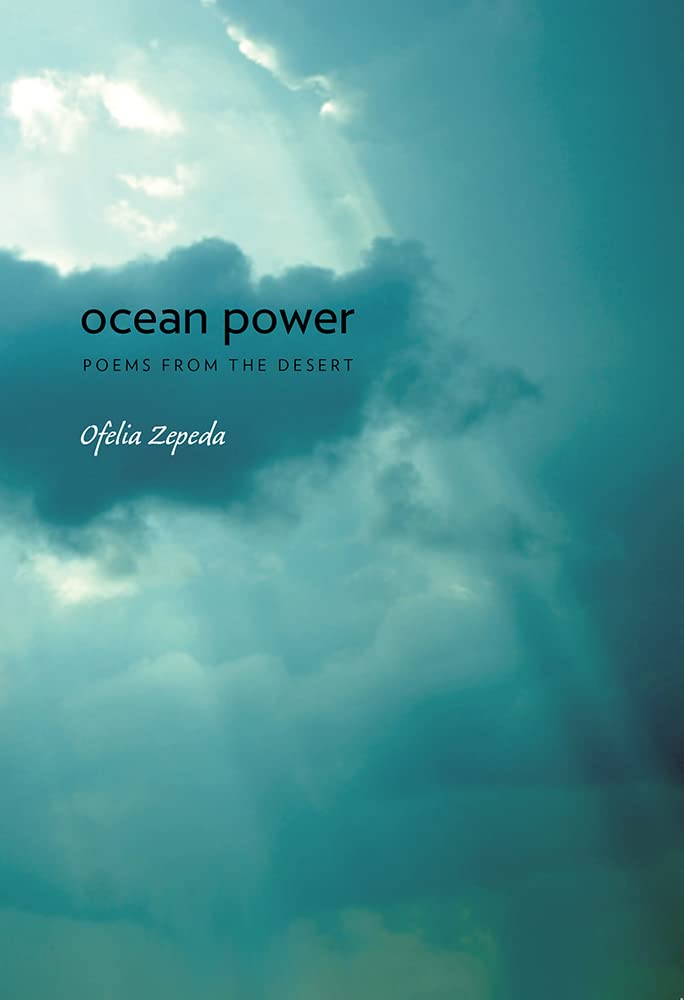



The annual seasons and rhythms of the desert are a dance of clouds, wind, rain, and flood—water in it roles from bringer of food to destroyer of life. The critical importance of weather and climate to native desert peoples is reflected with grace and power in this personal collection of poems, the first written creative work by an individual in O'odham and a landmark in Native American literature. Poet Ofelia Zepeda centers these poems on her own experiences growing up in a Tohono O'odham family, where desert climate profoundly influenced daily life, and on her perceptions as a contemporary Tohono O'odham woman. One section of poems deals with contemporary life, personal history, and the meeting of old and new ways. Another section deals with winter and human responses to light and air. The final group of poems focuses on the nature of women, the ocean, and the way the past relationship of the O'odham with the ocean may still inform present day experience. These fine poems will give the outside reader a rich insight into the daily life of the Tohono O'odham people. "Listen./You can hear it./The stones in the earth rattling together." Simon J. Ortiz is just one of the Native Americans included in Home Places who takes us beyond the stereotypes and cliches we may have come to expect. Chosen from 25 years of Sun Tracks, the literary magazine published from the American Indian Studies Program at the University of Arizona, these poems, stories, and songs are rich in tradition, ancestry, and the wonders and beauty of the natural world. As these paths go out into the world, however, they travel inward as well: the women and men writing become real, their hearts and souls stripped bare. "My house is the red earth: it could be the center of the world," says Joy Harjo. As real as her place is to Harjo, this world has many centers. As the editors point out in their introduction, "nearly as many Indian tribes exist in the 20th Century as when Europeans first encountered them in the 1600s." It is only fitting, then, that this is a multilingual text, incorporating as many as five Native languages. Both new and established writers represent the more than 300 tribes who still inhabit home place in North America. Zepeda is a Tohono O'odham woman, a mother, a daughter, and a poet. Her tribe, Desert People of the Southwest, are steeped in traditional values and cultural ways. Ocean Power (a bilingual volume) depicts the respect and even reverence she was raised to feel in the presence of nature. Her relationship to the world is more, though; it is sisterly, motherly. The respect is mutual, as she understands it, and that makes reverence possible: "Grown men with dry fear in their throats/watch the water come closer and closer." Blaeser comes from much of the same tradition, though her home place is more to the north. A Chippewa from the Minnesota lake region, she writes poems informed by the natural world as well, but she acknowledges more openly the outside world, full of its own ritual and tradition. She opens her mail with an allusion to million-dollar sweepstakes, notices Wrigley Field on a trip to "the Chicago Pow Wow," and sees the dichotomy in her hands: "One wears silver and tourquoise, a Zuni bracelet and a Navaho ring./One wears gold and diamonds, an Elgin watch and a Simonson's half-carat." Blaeser's place includes the rivers and trees and wondrous wildlife but also Barbie dolls, the 4-H, and awareness of the bomb. There are still many people who imagine the indigenous people of North America in flashes of John Ford films and memories of the novels of Louis L'Amour. Their ideas are crusted with cliches from another time, wrong even then but certainly outdated. More reading of work like this?the writings of contemporary Native Americans?could go a long way toward dispelling the myths. Recommended for any large collection, but especially any with a special interest in Native Americans.?Louis McKee, Painted Bride Arts Ctr., Philadelphia Copyright 1995 Reed Business Information, Inc. "A fine first volume of quietly powerful poems that reflect the oral traditions of her Tohono O'odham people." — Western American Literature "A fresh look at the desert from the perspective of people that adapted to that land over many centuries . . . Zepeda frequently constructs evocative images of life in the desert that are seldom seen." — Visions Magazine "Zepeda's imagery captures the most subtle perceptions of the natural world-the smell of coming rain, the taste of dust-and her poems, deriving from tribal, family, and personal memories, reveal an intense and characteristically Tohono consciousness of weather, sky, earth, and water, of the landmarks which measure the passage of the seasons, and of nature in both its positive and negative manifestations." — World Literature Today "Her poems let us glimpse the Pimería Alta from an O'odham point of view. The desert is achingly palpable here." — Southwest Mission Research Ce