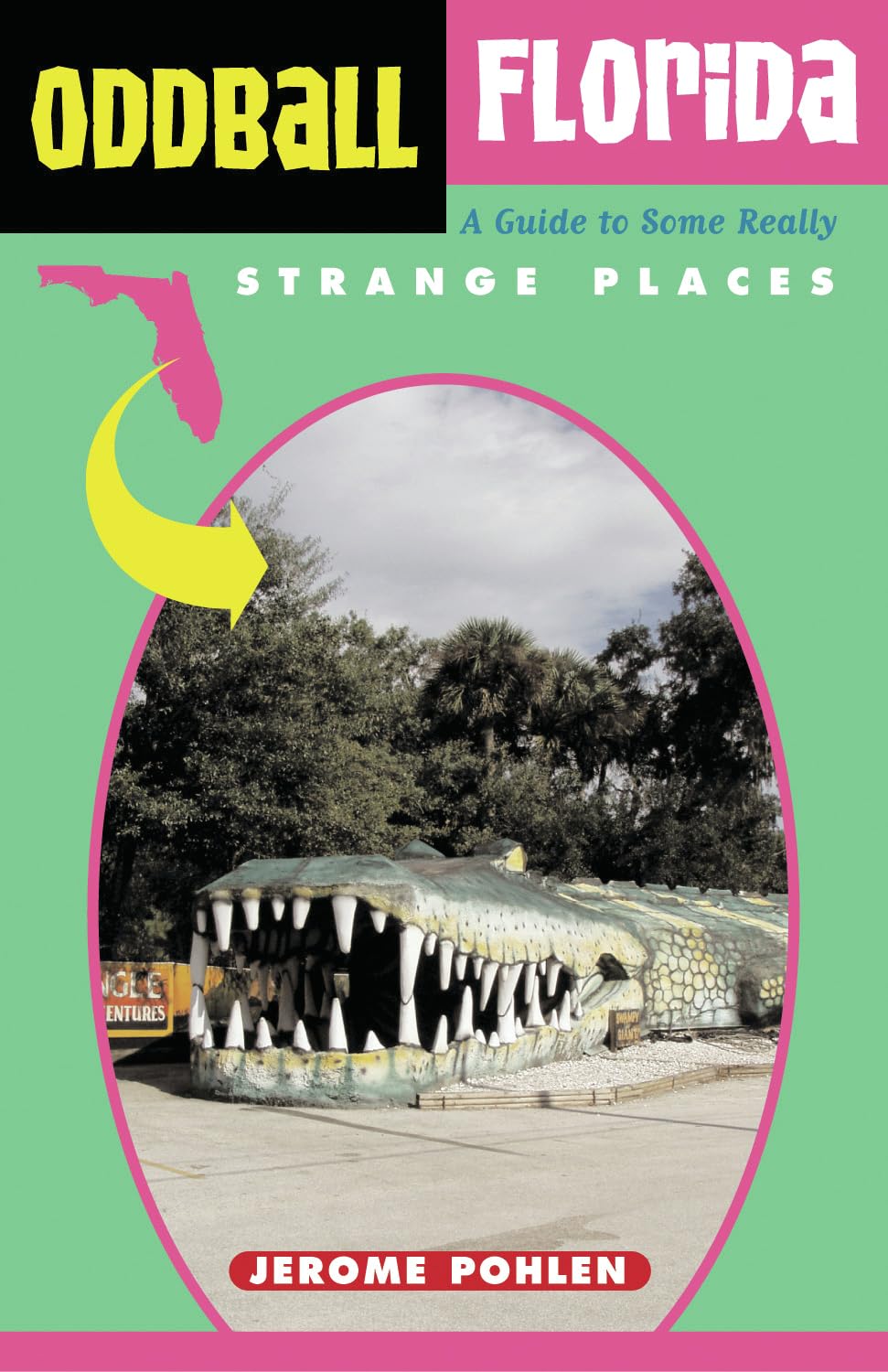
Oddball Florida: A Guide to Some Really Strange Places (Oddball series)
$9.98
by Jerome Pohlen



This entertaining guide directs travelers to the off-the-wall and offbeat destinations in Florida, home of gator wrestlers, school bus demolition derbies, Hemingway wannabes, the Fountain of Youth, the Nudist Hall of Fame, and a utopian community based on the premise that the earth is not round, but concave. Additional oddball attractions include a graveyard for roosters, the world’s largest strawberry, the world’s smallest police station, and museums dedicated to seashells, hamburgers, oranges, teddy bears, sponges, air conditioning, and one very old petrified cat. Documenting local oddities and forgotten history, this travel guide covers Florida in six regions with maps and detailed directions for each site as well as phone numbers, hours, websites, and various photographs. “A travel guide with a twist, providing plenty of opportunities to revel in the strangeness on public display.” — The Bloomsbury Review on Oddball Indiana “This is not your parents' travel book, but in the new millennium, all travel guides will be written like this.” —Chuck Shepard, author of the column “News of the Weird,” on Oddball Illinois “One irresistible guidebook.” — Chicago Tribune on Oddball Illinois Jerome Pohlen is the author of Oddball Minnesota , Oddball Colorado , Oddball Indiana , Oddball Illinois , and Oddball Wisconsin . He is a regular travel commentator for 848 on WBEZ, the Chicago affiliate of National Public Radio. He lives in Chicago. Oddball Florida A Guide to Some Really Strange Places By Jerome Pohlen Chicago Review Press Incorporated Copyright © 2004 Jerome Pohlen All rights reserved. ISBN: 978-1-55652-503-2 Contents INTRODUCTION, 1. THE PANHANDLE, Map of the Panhandle, 2. THE NORTH, Map of the North, 3. THE GULF COAST, Map of the Gulf Coast, 4. TAMPA/ST. PETERSBURG AREA, 5. ORLANDO AREA, 6. THE ATLANTIC COAST, Map of the Atlantic Coast, 7. THE SOUTH, Map of the South, 8. MIAMI AREA, 9. THE KEYS, Map of the Keys, 10. BUSTED TOUR, EPILOGUE, ACKNOWLEDGMENTS, RECOMMENDED SOURCES, INDEX BY CITY NAME, INDEX BY SITE NAME, CHAPTER 1 THE PANHANDLE Just after the Civil War, Florida came up with a great idea to raise some badly needed cash: sell the Panhandle to neighboring Alabama. The far western region had long been the state's stepchild, geographically speaking, and a majority of voters in the area approved the proposed sale. But Alabama wasn't any more solvent than Florida and had to take a pass. Well, it was Alabama's loss. Though often dismissed as the Redneck Riviera by Disney-bound tourists, the Panhandle can hold its own against overpopulated tourist traps like Orlando and Miami. Not only are Panhandle beaches cleaner and less crowded than those farther south, the region can also boast the state's highest peak and the only Florida cave system open to the public. That's right, you can climb to the 345-foot summit of Britton Hill simply by stepping out of your car in Lakewood, and just a short time later explore the depths of Florida Caverns to see stalagmites, stalactites, and lots of bat guano. Is Britton Hill not uplifting enough? Head on over to Bristol, where you can stroll through what some believe to be the original Garden of Eden, a true heaven on earth. Or do you expect to be headed someplace a little lower, and warmer? Well then, step through the grinning mouth of Lucifer into Dante's Inferno at a Panama City Beach amusement park. Heaven or hell, the Panhandle has them both. Orlando? It's just got hell. Apalachicola God Bless John Gorrie! First things first. The only reason you've even considered vacationing in Florida (or living here) is due to both the ignorance and the genius of Dr. John Gorrie. What did he do? Believing that malaria and yellow fever were caused by hot, swampy air — as opposed to the real culprit, mosquitoes — he developed a method of making ice using compressed air. He built his first working prototype around 1847, but it wasn't until 1851 that he was issued U.S. Patent Number 8080. A year later he modified his invention to produce cold air. Air conditioning was born. Though ice had to be shipped from the north during those days, Gorrie was never able to spur enough investor interest to finance mass production of his new machine. This was due in part to bad press from reporters who had been encouraged by northern ice-shipping conglomerates to badmouth his invention. He eventually abandoned the device others dismissed as "too fantastic." Cold air or not, Gorrie contracted yellow fever in 1855 and perished a poor, unrecognized hero. Not until 1911 did Florida properly honor this hero, sending a statue of the doctor to the U.S. Capitol's Statuary Hall. Five years later, Frenchman Ferdinand Carre developed a closed-loop, ammonia-based cooler, the final major improvement toward today's air conditioning. Gorrie's original machine ended up in the hands of the Smithsonian, but you can see a scale model in