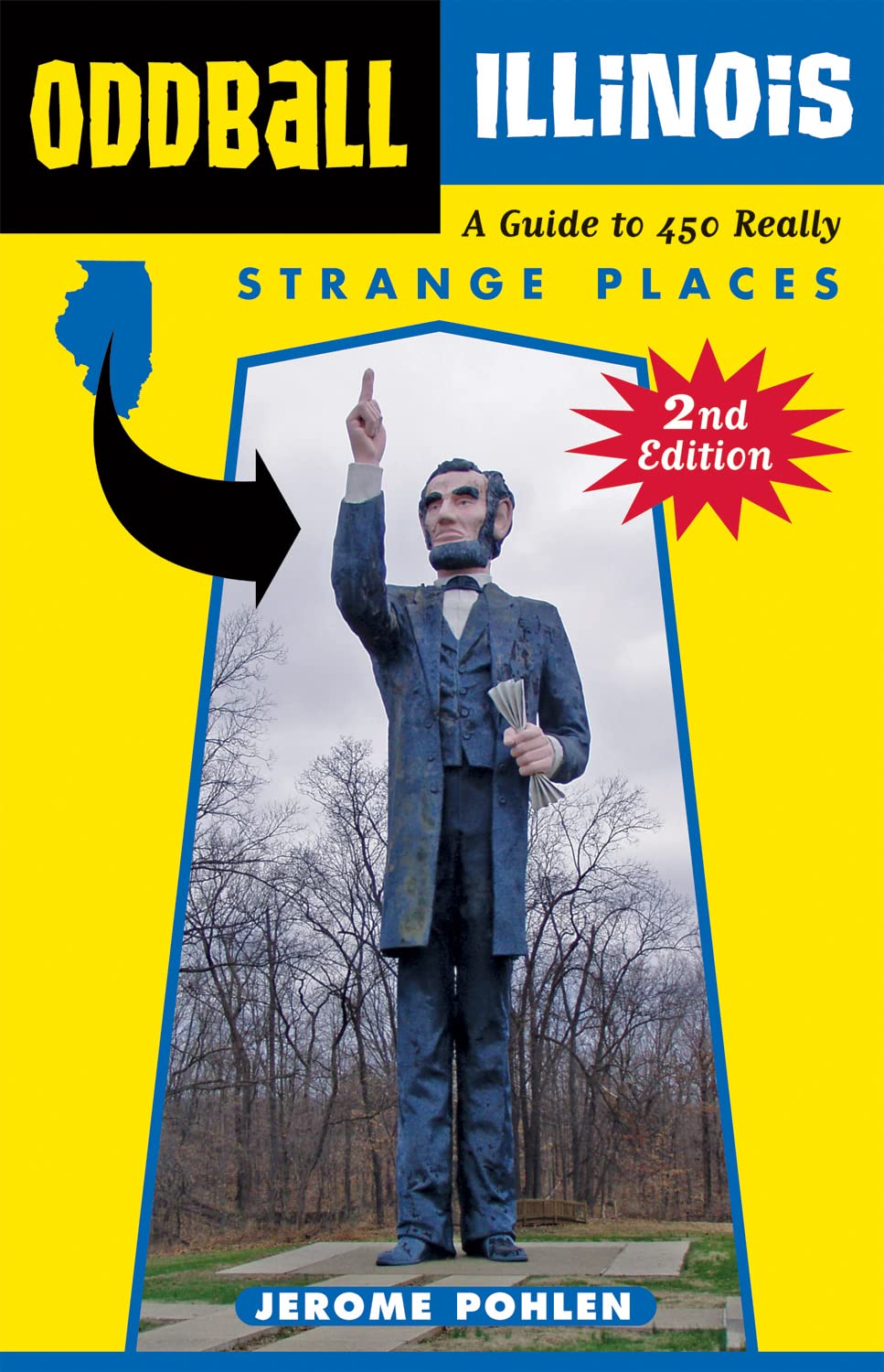
Oddball Illinois: A Guide to 450 Really Strange Places (Oddball series)
$16.95
by Jerome Pohlen



There is more to Illinois than cornfields, corrupt politicians, and the Cubs! The Land of Lincoln is filled with fascinating people, one-of-a-kind places, and things with unique and bizarre histories. Forget about quaint small town bed-and-breakfasts and crowded Chicago nightclubs— Oddball Illinois , now fully updated and expanded, takes you to the places you really want to go. See: Henry’s Rabbit Ranch - America’s One and Only Hippie Memorial - World’s First Jungle Gym - Popeye’s Hometown - The Leather Archives and Museum - General Santa Ana’s two wooden legs - World’s Largest Sock Monkey - Scarlett O’Hara’s green drapes - The Friendship Shoe Fence - And many, many more sites This book belongs in your glove box—you never know when you’ll be in range of an oddball adventure! “One irresistible guidebook.” — Chicago Tribune “This Bible of cultural attractions is essential for any travelers who want to know (almost) everything about the Land of Lincoln . . . Oddball Illinois is an amazing historical/topographical document.” — West Chicago Press “For those who are up to an adventure, but don’t like to venture too far from home.” — Tri-County News-Williamsfield Times Edition “Interesting and unusual.” — Chicago Parent “A view of quirky and under-appreciated destinations in Illinois and Chicago.” — Kane County Chronicle Jerome Pohlen is an editor and educational writer who has written 10 travel guides, including Oddball Wisconsin , Oddball Iowa , Oddball Indiana , and Progressive Nation . His travel writing has appeared in the Chicago Reader , Reader’s Digest , and Time Out Chicago . He has been a regular contributor on travel and culture for Eight Forty-Eight , which airs on WBEZ, Chicago’s NPR affliate. Oddball Illinois A Guide to 450 Really Strange Places By Jerome Pohlen Chicago Review Press Incorporated Copyright © 2012 Jerome Pohlen All rights reserved. ISBN: 978-1-61374-032-3 Contents INTRODUCTION, 1. CHICAGO! CHICAGO!, 2. CHICAGO SUBURBS, 3. NORTHERN ILLINOIS, 4. CENTRAL ILLINOIS, 5. SOUTHERN ILLINOIS, 6. THEME TOURS, 7. EPILOGUE, ACKNOWLEDGMENTS., RECOMMENDED SOURCES, INDEX BY CITY NAME, INDEX BY SITE NAME, CHAPTER 1 CHICAGO! CHICAGO! Chicago has been called many things, so it's odd that it has adopted "The Windy City" and "The Second City" as its nicknames. Both were originally intended as put-downs. Contrary to popular belief, Chicago is not exceptionally windy. The average wind speed is 10.4 mph, much calmer than in many towns. "The Windy City" is instead a nickname coined by Charles Dana of the New York Sun, who was criticizing city boosters as loudmouthed windbags. When Chicago and New York were bidding on the 1893 Columbian Exposition, he advised his readers to "pay no attention to the nonsensical claims of that Windy City. Its people could not hold a World's Fair, even if they won it." Well, Chicago did both, but still the name stuck. "The Second City" was the title of a derisive piece about Chicago in The New Yorker in 1951. It was written by reporter A. J. Liebling, who accused Windy City folk of always wanting to be everything New York already was. Again, rather than taking it as an insult, Chicago's citizenry adopted it. These nicknames are much better than titles like "Hog Butcher Capital of the World" or "Porkopolis" and much preferred to "The Stinky Onion." The word Chicago is a bastardization of Checagou, meaning "wild onion" or "stinky onion," a common plant in the swamps along the river. Early settlers spelled the Native American term Schuerkaigo, Shikkago, Ztschaggo, Stachango, and Psce-shaggo, among others, according to Bill Bryson's Made in America (1994). Thank goodness they settled on Chicago. What Goes Up What They Rarely Tell You on the Architecture Tour Chicago has a lot to be proud of when it comes to architecture. It invented the skyscraper. It has North America's tallest building. And when Frank Lloyd Wright designed a mile-tall, sunshine-blocking superscraper with atomic-powered elevators, did he propose it be built in New York? Absolutely not! It was Chicago where his massive ego felt at home. There are some, however, who don't see tall buildings as architectural advancements. They block the light, diminish the humans who live and work in them, and invite a messy form of suicide. Well, the war's over, gang, and the skyscrapers won. Here are a few you should check out on any Chicago visit. Site of the World's First Skyscraper Most architectural historians now agree that the 10-story Home Insurance Building, designed in 1884 by William LeBaron Jenney and completed in 1885, was the world's first skyscraper. A skyscraper is defined as a tall building supported by an interior steel structure where the exterior walls bear no weight. Jenney never lived to receive his due, nor did the Home Insurance Building. His groundbreaking accomplishment was not ackno