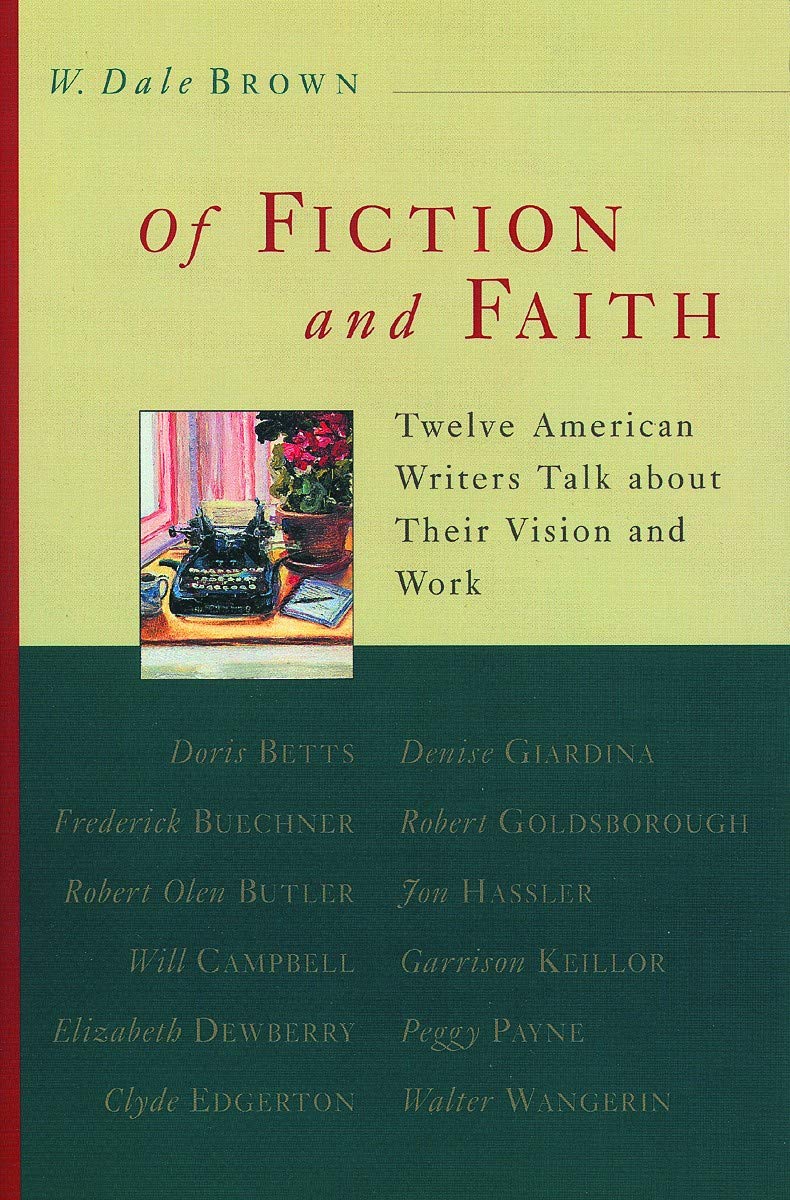
Of Fiction and Faith: Twelve American Writers Talk about Their Vision and Work
$18.00
by Dale Brown



Of Fiction and Faith features personal interviews with twelve of America's most significant writers: Doris Betts, Frederick Buechner, Robert Olen Butler, Will Campbell, Elizabeth Dewberry, Clyde Edgerton, Denise Giardina, Robert Goldsborough, Jon Hassler, Garrison Keillor, Peggy Payne, and Walter Wangerin. Conducted over a five-year period, these interviews provide a window into the personal and literary lives of a company of writers whose work continues to defy categorization. These writers talk candidly about their careers, their audiences, their approaches to writing, and their attitudes toward issues of faith. Taken together, the interviews provide a perceptive analysis of contemporary literature and a challenge to the practice of labeling books as "Christian" or "secular." The volume also includes photographs, a brief introduction to each of the writers, and a chronological listing of their work. In addition to serving those who are fans of one or more of these writers, this book is also an excellent resource for those interested in finding quality fiction for personal reading. Cozy fireside conversations with a dozen contemporary writers on their faith, carefully arranged and thoughtfully conceived. Brown (English/Calvin Coll.) has gathered together conversations with 12 Christian writers, most of whom say they are uncomfortable with that term. The authors range from those renowned in Christian circles (Frederick Buechner and Walter Wangerin) to the more widely famous (Garrison Keillor, who is very provocative and outspoken about his vision for the church, and southern hellion Will Campbell). Brown also includes writers who are not yet household names, like newcomer Elizabeth Dewberry and longtime novelist Doris Betts, and popular authors most readers probably don't think of as Christian, like mystery writer Robert Goldsborough. Compiler Brown is fully engaged in these conversations, but allows the writers to speak for themselves (his introduction is less than three pages long, a refreshing brevity). Implicitly, his subtext seems to be that for these writers, there are a dozen different ways of manifesting their faith in their work. Brown is very critical of the throw-away fiction found in most Christian bookstores, and is intrigued by the fact that some of these bookstores won't even stock meaty novelists such as Campbell or Buechner. The writers discuss their stylistic and theological influences (Graham Greene, Annie Dillard, and Walker Percy win high marks from many). They reflect upon their perceived audiences, occasional hate mail, and stinging reviews; it is difficult, it seems, to write fiction with a Christian message when many Christian readers seem to prefer simplistic morality tales with squeaky-clean language, and when ``secular'' readers are often turned off by theology. Brown has included a useful bibliography for each writer, pointing to further pleasures. The book's only real flaw is its fairly narrow perspective: All but one of the subjects are mainline Protestant (the exception being Jon Hassler, who is Catholic), most are male, and all are white. (12 b&w photos, not seen) -- Copyright ©1997, Kirkus Associates, LP. All rights reserved. Booklist "All twelve engage in riveting conversation that is less concerned with the writing biz or highfalutin aesthetics than with the human elements that go into writing fiction and the human effects that writing has upon readers and the writers themselves." Kirkus Reviews "Cozy fireside conversations with a dozen contemporary writers on their faith, carefully arranged and thoughtfully conceived." Presbyterian Record "An excellent book for anyone who is a writer or wants to be a writer. . . An excellent introduction to a new writer you may not have considered before. . . If you like to read fiction writers who explore great biblical themes honestly, but who don't like being called 'Christian writers' . . . you will enjoy these interviews." Christian Scholar's Review "While the intersection of faith and writing is an important element of the book, it also examines many other fascinating aspects of the writing life, from the habits and techniques that make a good writer to careful discussions of individual works by these novelists. Brown shows an impressive and detailed knowledge of the books his subjects have written, and he engages them in ways that bring out thought-provoking and sometimes surprising ideas. The book is worthwhile not only for readers who care about faith in fiction, but also for those who care about the art of fiction. . . . In Of Fiction and Faith , W. Dale Brown engages his subjects with all the right questions, and the insights that emerge in these discussions will be rewarding and helpful to anyone interested in reading or writing good literature." Dale Brown (1949-2014) was director of the BuechnerInstitute at King University, Bristol, Tennessee. Formerly hewas professor of English and director of the Festiv