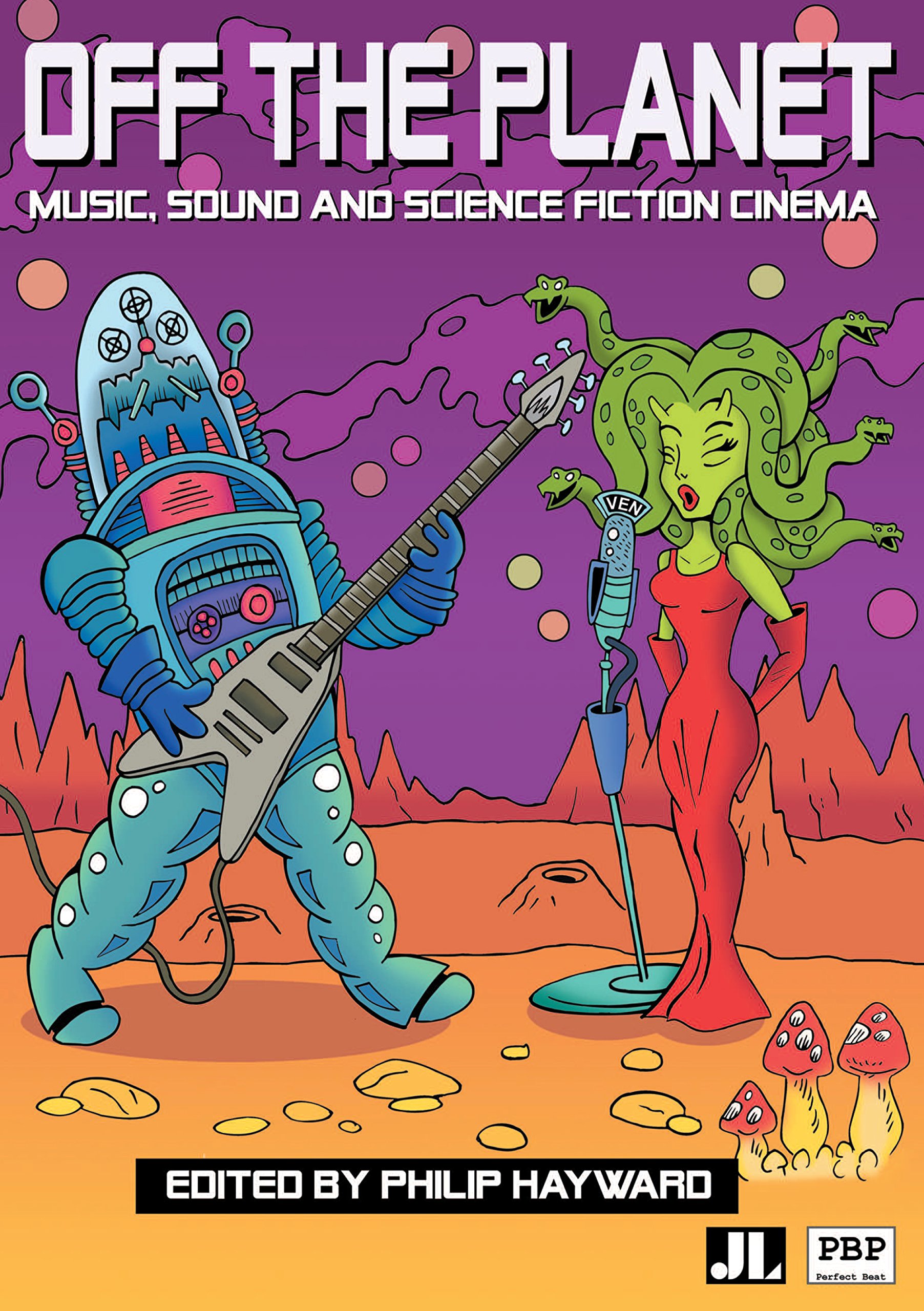



Over the last decade, music and sound have been increasingly recognized as an important―if often neglected―aspect of film production and film studies. Off the Planet comprises a lively, stimulating, and diverse collection of essays on aspects of music, sound, and Science Fiction cinema. Following a detailed historical introduction to the development of sound and music in the genre, individual chapters analyze key films, film series, composers, and directors in the postwar era. The first part of the anthology profiles seminal 1950s productions such as The Day the Earth Stood Still, the first Godzilla film, and Forbidden Planet. Later chapters analyze the work of composer John Williams, the career of director David Cronenberg, the Mad Max series, James Cameron's Terminators, and other notable SF films such as Space Is the Place, Blade Runner, Mars Attacks!, and The Matrix. Off the Planet is an important contribution to the emerging body of work in music and film. Contributors include leading film experts from Australia, Canada, Japan, New Zealand, the United Kingdom, and the United States. Distributed for John Libbey Publishing Philip Hayward is Professor of Contemporary Music Studies at Macquarie University, Sydney, and co-editor of Perfect Beat―The Pacific Journal of Research into Contemporary Music and Popular Culture. He has written and edited several other books, including Widening the Horizon: Exoticism in Post-War Popular Music (John Libbey, 1999). Off the Planet Music, Sound and Science Fiction Cinema By Philip Hayward Indiana University Press Copyright © 2004 Copyright the authors All rights reserved. ISBN: 978-0-86196-644-8 Contents Introduction Sci Fidelity – Music, Sound and Genre History Philip Hayward, 1, Chapter 1 Hooked on Aetherophonics: The Day The Earth Stood Still Rebecca Leydon, 30, Chapter 2 Atomic Overtones and Primitive Undertones: Akira Ifukube's Sound Design for Godzilla Shuhei Hosokawa, 42, Chapter 3 Forbidden Planet: Effects and Affects in the Electro Avant Garde Rebecca Leydon, 61, Chapter 4 The Transmolecularisation of [Black] Folk: Space is the Place, Sun Ra and Afrofuturism Nabeel Zuberi, 77, Chapter 5 Nostalgia, Masculinist Discourse, and Authoritarianism in John Williams' Scores for Star Wars and Close Encounters of the Third Kind Neil Lerner, 96, Chapter 6 Sound and Music in the Mad Max trilogy Rebecca Coyle, 109, Chapter 7 "These are my nightmares": Music and Sound in the films of David Cronenberg Paul Theberge, 129, Chapter 8 Ambient Soundscapes in Blade Runner Michael Hannan and Melissa Carey, 149, Chapter 9 'I'll be back': Recurrent sonic motifs in James Cameron's Terminator films Karen Collins, 165, Chapter 10 Inter-Planetary Soundclash: Music, Technology and Territorialisation in Mars Attacks! Philip Hayward, 176, Chapter 11 Mapping The Matrix: Virtual Spatiality and the realm of the perceptual Mark Evans, 188, About The Authors, 199, Bibliography, 201, Index, 211, CHAPTER 1 HOOKED ON AETHEROPHONICS The Day the Earth stood still REBECCA LEYDON In 'Farewell to the Master' (1944), Harry Bates' short story upon which the film The Day the Earth stood still (1951) is based, an extra-terrestrial called Klaatu visits the Earth and is promptly killed by a deranged citizen. It is left to the robot 'Gnut' to somehow bring him back to life. The task is eventually achieved by reconstituting Klaatu's body from a tape-recording of his voice. This last intriguing plot detail was dropped in the reworking of the original story for the script of the 1951 film. In Robert Wise's adaptation, Klaatu is killed by military police, after moving covertly among the inhabitants of Washington, DC. His corpse is retrieved and reanimated by the robot, 'Gort', by means of a mysterious medical operation ("Nikto"?) conducted inside the space ship. Yet the notion of the alien being's essence as fully encrypted in pure sound remains a crucial part the film: the extra-terrestrial 'voice', as represented by Bernard Herrmann's score, plays a central role, for it is primarily through musical clues, rather than special visual effects, that Klaatu's alien nature is enacted. After all, Klaatu looks and behaves exactly like an ordinary human, as the two Medical Corps officers who examine him in the hospital observe: Major: (studying a series of X-ray films) The skeletal structure is completely normal. (pointing) Same for the major organs – heart, liver, spleen, kidneys. Captain: And the lungs are the same as ours. Must mean a similar atmosphere – similar pressure. Klaatu blends in and moves inconspicuously among the human population. For the cinematic spectator, the only consistent evidence of his alien origins is the halo of otherworldly sounds with which the musical score envelopes him. The link between particular sonic elements and things extra-terrestrial is forged during the film's opening titles as the camera peers through celestial nebulae toward th