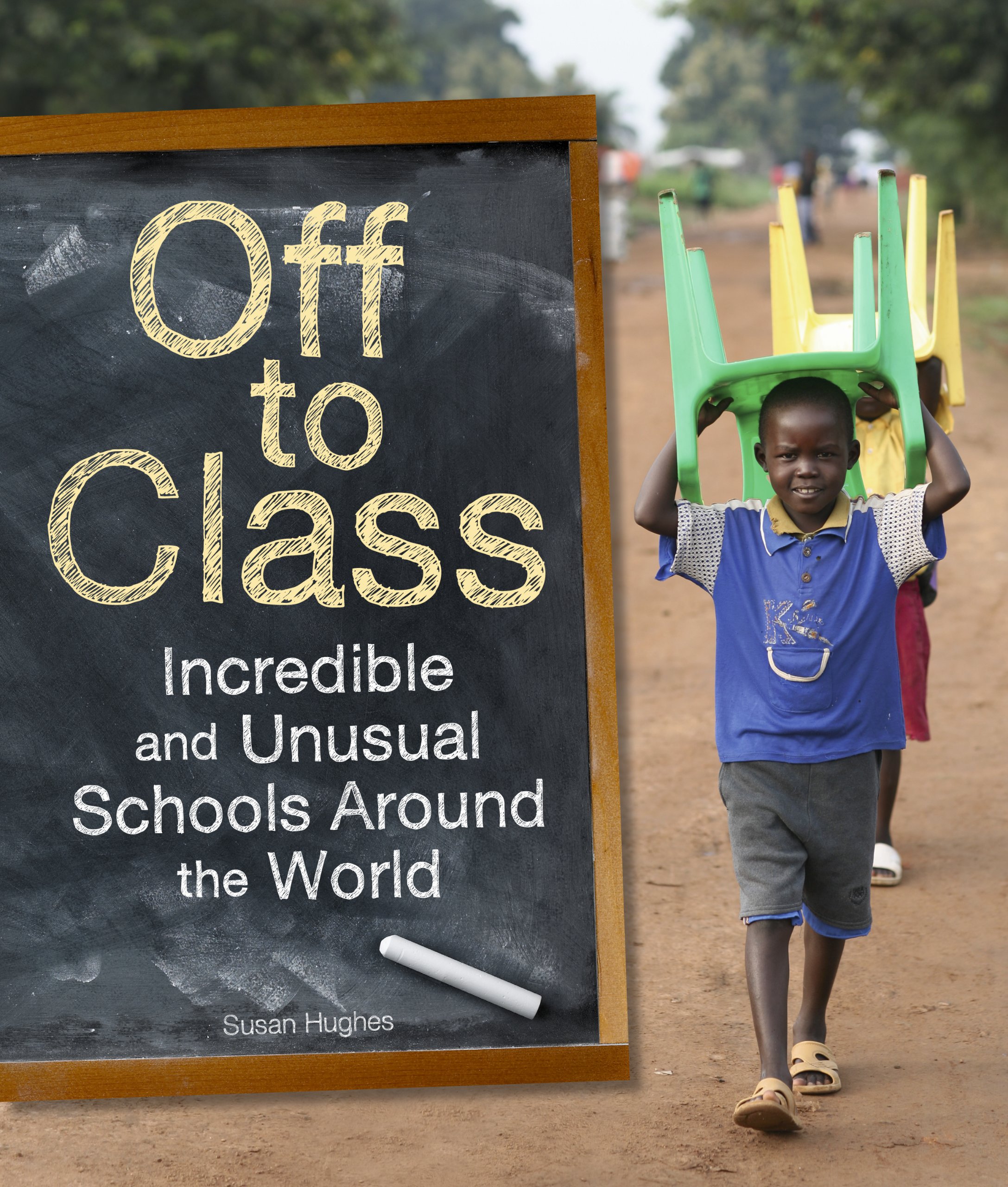



Travel around the globe to visit some of the world's most incredible schools, and meet the students who attend them, in this best-selling and award-winning nonfiction pick for ages 9 to 12 When North American kids picture a school, odds are they see rows of desks, stacks of textbooks, and linoleum hallways. They probably don’t picture caves, boats, or train platforms but there are schools in caves, and on boats and on train platforms. There’s a whole world of unusual schools out there! But the most amazing thing about these schools isn’t their location or what they look like. It’s that they provide a place for students who face some of the toughest environmental and cultural challenges, and live some of the most unique lifestyles, to learn. Education is not readily available for kids everywhere, and many communities are strapped for the resources that would make it easier for kids to go to school. In short, it’s not always easy getting kids off to class but people around the world are finding creative ways to do it. In Off to Class , readers will travel to dozens of countries to visit some of these incredible schools, and, through personal interviews, meet the students who attend them, too. And their stories aren't just inspiring they'll also get kids to think about school and the world in a whole new way! Skipping Stones Honor Award Winner, 2012 Shortlisted for the ForeWord Magazine Book of the Year Award, Juvenile Non-fiction category, 2011 " Off to Class is an easy-to-read yet detailed book that should, at the very least, be in every school library, if not every classroom and home." Quill & Quire , starred review "The strong emphasis on humanitarianism will move, excite, and inspire those reading... Off to Class will encourage them to help to 'be the change they wish to see in the world.'" School Library Journal "Hughes's examples of grassroots education in action are inspirational and informative." Publishers Weekly Susan Hughes is a writer and editor, and has been writing both fiction and non-fiction children’s books for over twenty years. Her book Coming to Canada was shortlisted for the Hackmatack Award and the Norma Fleck Award for Non-fiction, as well as the Red Cedar Book Award. She lives in Toronto. From Chapter 1: Bangladesh Boat Schools Water, Water, Everywhere Has your school ever closed because of the weather? Lots of kids miss a day here and there because of snow or extreme heat. But in Bangladesh, students can miss months at a time during monsoon season, when heavy rains cause floods. Even when schools are open, it can be impossible for kids to get there. Climate change is making the flooding even more extreme by melting glaciers in the Himalayas. The runoff swells rivers and makes them overflow their banks. The floods damage farms, schools, and other buildings. In the past few years, thousands of schools have been damaged, and hundreds have been destroyed completely. Unsinkable Schools After seeing many of his friends and family members miss out on an education, an architect named Mohammed Rezwan decided he was not going to let floods stop any more children from getting to school. He figured that the best way to beat the rising waters is to rise with themon a boat. I thought that if the children cannot come to the school, then the school should come to them,” he explains. He raised enough money to open the first school boat in 2002. Now there are ninety boats that travel along a 250-kilometer (155 mile) stretch of rivers and streams in northwestern Bangladesh, giving thousands of kids the chance to learn. Ahoy, (class) mates! Boat school is the combination of a school bus and schoolhouse,” says Mohammed. Six days a week, each boat stops at different villages along the shore, picking up children who are mostly in the same grade. When the classroom is fullabout thirty to thirty-five studentsthe work begins. For about three hours, the students have lessons in math, reading, writing, English, Bengali, the environment, and conservation. Then the boat returns all the students to their riverbank stops. From there, the boat moves on to pick up another set of students for another three-hour lesson. Each boat offers three sets of lessons a day. Sidebar: All aboard If it weren’t for the boats coming to pick up the children at their doorsteps,” many young girls might not be going to school at all. Their parents wouldn’t let them travel out of the village to the nearest government school because it is dangerous and takes them away from their chores for too long. Now that the boat schools come to them, the girls have time to both learn and work. Wireless waves Even though the boats float from place to place, they have electricity to run up to four computers, a printer, a DVD player, and CD player. Solar panels on the roofs provide all the electricity they need. The boats are connected to the internet through wireless technology. Besides all the modern technology,