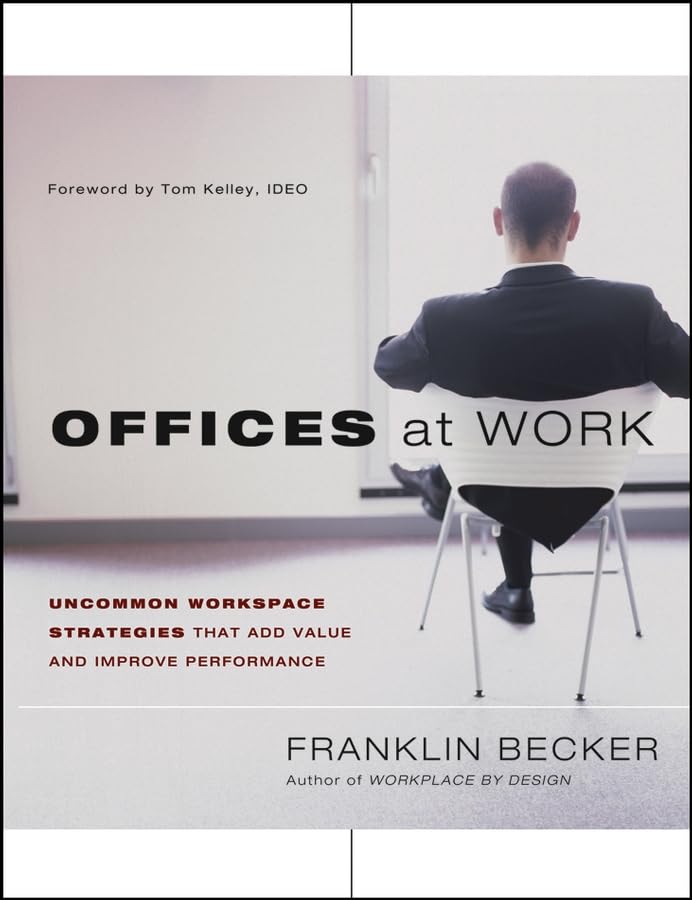
Offices at Work: Uncommon Workspace Strategies that Add Value and Improve Performance (Jossey Bass Business & Management Series)
$13.49
by Franklin Becker



Most Fortune 500 companies still struggle with workplace planning and design issues. Millions of dollars are invested each year by companies with the expectation that new buildings and major renovations will help transform their culture, spark innovation, and herald new work patterns that strengthen performance while reducing costs. But, as Franklin Becker points out, popular trends do not always make good sense. Offices at Work addresses the fundamental design issues that organizational leaders confront such as: How do we create a low-cost flexible environment that motivates employees and stimulates learning? - Is it worth our spending the time, money, and effort to consolidate our disparate buildings into a new corporate campus? - How else can we address status concerns besides giving people offices? Order your copy today! “…a useful reference source on a topic that is rearely explored in this level of detail...” ( Human Resources , Feb. 2005) “Managers—even otherwise enlightened managers—are implicitly or explicitly asking the office space question in a certain kind of utilitarian way. They are essentially saying, “What is the quickest, cheapest way I can get all 4,000 of my people a desk, a chair, a wastebasket?” With Offices at Work , Franklin Becker has a wake up call for businesses around the world. There are rewards to be gained from fine-tuning your office environment. Far from being a mere utility, space can be a strategic tool that influences the attitude and behavior and even the performance of your employees. Focusing attention on the “final frontier” of inner space will be time well spent.” --From the Foreword by Tom Kelley “Using an excellent balance of hard data, case studies, and real world anecdotes, Professor Becker takes the logistically challenging and culturally complex topic of workplace design and offers a well-written and accessible approach to creating competitive advantage. Covering topics ranging from different types of office layout to productivity, innovation, and change management, Professor Becker cites best (and worst) practices to provide new insights for experts as well as novices. This is a must read for anyone interested in workplace design, corporate culture, branding, change management, organizational dynamics, or corporate real estate.” -- Thomas Osmund , vice president, Goldman Sachs “Managers--even otherwise enlightened managers--are implicitly or explicitly asking the office space question in a certain kind of utilitarian way. They are essentially saying, “What is the quickest, cheapest way I can get all 4,000 of my people a desk, a chair, a wastebasket?” With Offices at Work , Franklin Becker has a wake up call for businesses around the world. There are rewards to be gained from fine-tuning your office environment. Far from being a mere utility, space can be a strategic tool that influences the attitude and behavior and even the performance of your employees. Focusing attention on the “final frontier” of inner space will be time well spent.” --From the Foreword by Tom Kelley “Using an excellent balance of hard data, case studies, and real world anecdotes, Professor Becker takes the logistically challenging and culturally complex topic of workplace design and offers a well-written and accessible approach to creating competitive advantage. Covering topics ranging from different types of office layout to productivity, innovation, and change management, Professor Becker cites best (and worst) practices to provide new insights for experts as well as novices. This is a must read for anyone interested in workplace design, corporate culture, branding, change management, organizational dynamics, or corporate real estate.” -- Thomas Osmund , vice president, Goldman Sachs Most Fortune 500 companies still struggle with workplace planning and design issues. Millions of dollars are invested each year by companies with the expectation that new buildings and major renovations will help transform their culture, spark innovation, and herald new work patterns that strengthen performance while reducing costs. But, as Franklin Becker points out, popular trends do not always make good sense. Offices at Work addresses the fundamental design issues that organizational leaders confront such as: How do we create a low-cost flexible environment that motivates employees and stimulates learning? - Is it worth our spending the time, money, and effort to consolidate our various buildings into a new corporate campus? - How else can we address status concerns besides giving people offices? Using real world examples presented in a friendly and accessible style, Becker provides a broad range of insights and practical explanations for why different solutions work and make sense. He offers guidance to managers faced with the task of balancing choice and diversity with standardization and uniformity. Becker also discusses the relative benefits of an open versus closed office plan and