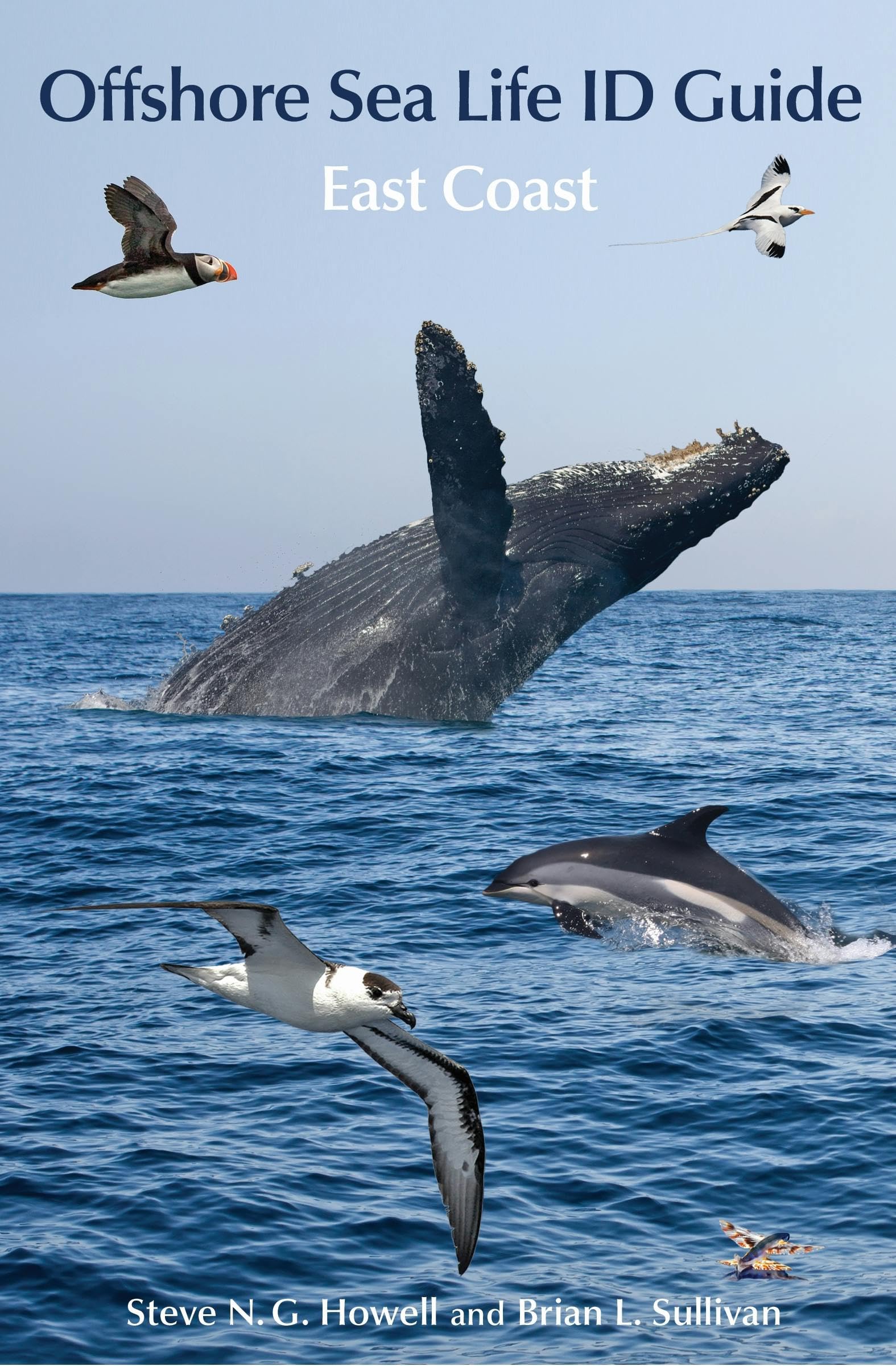
Offshore Sea Life ID Guide: East Coast (Princeton Field Guides)
$12.76
by Steve N. G. Howell



The first compact field guide to offshore sea life of the East Coast Two-thirds of our planet lies out of sight of land, just offshore beyond the horizon. What wildlife might you see out there? This handy guide, designed for quick use on day trips off the East Coast, helps you put a name to what you find, from whales and dolphins to shearwaters, turtles, and even flying fish. Carefully crafted color plates show species as they typically appear at sea, and expert text highlights identification features. Essential for anyone heading out on a whale-watching or birding trip, this guidebook provides a handy gateway to the wonders of the ocean. Over 100 color photos and composite plates - Includes whales, dolphins, birds, sharks, turtles, flying fish, and more - Accessible and informative text reveals what to look for - Great for beginners and experts alike "[T]his handy little booklet . . . serves as a pocket-guide to sort out both the most commonly seen, as well as rarer species you might come across. Slender enough to slip into your purse, this is not an exhaustive catalog of flora and fauna, nor is it an in-depth exploration of behavior or ecosystem dynamics. Instead it is exactly what the casually interested wildlife observer will want to have when on an offshore vacation--simple, concise, accurate and presented in a friendly, conversational way." ---Examiner.com "This is a neat little book that fits handily in the pocket, and I can easily see myself using it while ‘on deck'. Surely most naturalists would want to follow up by consulting specialized (and often weighty) texts before or after the trip, but while at sea, it will be hard to beat Howell and Sullivan's offering." ---Steve Shultz, Carolina Bird Club Newsletter "Filled with concise information and accurate illustrations, this terrific field guide will be a handy, quick reference for the layperson and serious naturalist on boat trips off the West Coast of the United States. No other useful guides for this region deal with both marine mammals and seabirds in the same book." --Sophie Webb, coauthor of Field Guide to Marine Mammals of the Pacific Coast "Intended for beginner- and moderate-level naturalists as well as tourists on whale-watching and birding trips, this field guide presents a fresh, new format. Images are nicely formatted and the text is clear, light, and humorous while being informative and scientifically accurate." --Peter Pyle, author of Identification Guide to North American Birds Steve N.G. Howell is an international bird tour leader with WINGS and a research associate at the California Academy of Sciences. His other books include Petrels, Albatrosses, and Storm-Petrels of North America and The Amazing World of Flyingfish (both Princeton). Brian L. Sullivan is eBird program codirector and photographic editor for Birds of North America Online at the Cornell Lab of Ornithology, and a coauthor of The Crossley ID Guide: Raptors (Princeton). Howell and Sullivan are the coauthors of Offshore Sea Life ID Guide: West Coast (Princeton). Offshore Sea Life ID Guide East Coast By STEVE N. G. HOWELL, Brian L. Sullivan PRINCETON UNIVERSITY PRESS Copyright © 2016 Steve N. G. Howell, Brian L. Sullivan All rights reserved. ISBN: 978-0-691-16621-6 Contents Introduction, 5, Acknowledgments, 11, Some Words Explained, 11, Marine Mammals, 12, Whales, 12, Pilot Whales and Beaked Whales, 16, Dolphins, 18, Rarer Whales and Dolphins, 22, Seabirds, 26, Gulls, 26, Shearwaters and Petrels, 28, Storm-Petrels, 32, Alcids, 34, Phalaropes, 39, Terns, 40, Jaegers, 42, Skuas, 44, Tropicbirds, 45, Gannet and Boobies, 46, Frigatebird, 47, Rarer Seabirds, 48, Sea Turtles, 50, Flyingfish and Flying Squid, 52, Other Fish, 55, Billfish and Sharks, 56, Other Big Fish, 58, Rarer Big Fish, 59, Seaweeds, 60, Jellyfish and Cousins, 61, Landbirds, 62, Species Codes, Scientific Names, and Index, 63, CHAPTER 1 Marine Mammals Unlike seabirds, marine mammals spend most of their time underwater, coming to the surface to breathe, and rarely do you see the whole animal. Views can be brief, and we provide the clues needed to identify species based on what you are likely to see — a fin, a blow, a tail going down. As with 'seabirds,' some 'marine mammals' live along the coast, such as Harbor Seals and Gray Seals (see p. 5). We do not treat these species because they're not really offshore creatures; they can be seen more easily from land. Other marine mammals can be seen from shore on occasion, although to see them up close you'll still want to go out on a boat. Things to look for with whales and dolphins are group size, general behavior, dorsal fin size and shape, any patterns or markings, and, for the larger whales, shape and size of the blow and how soon the dorsal fin appears relative to when you see the blow. Whales: Very large swimming creatures 12 Beaked Whales and Pilot Whales: Medium-sized, often in gr