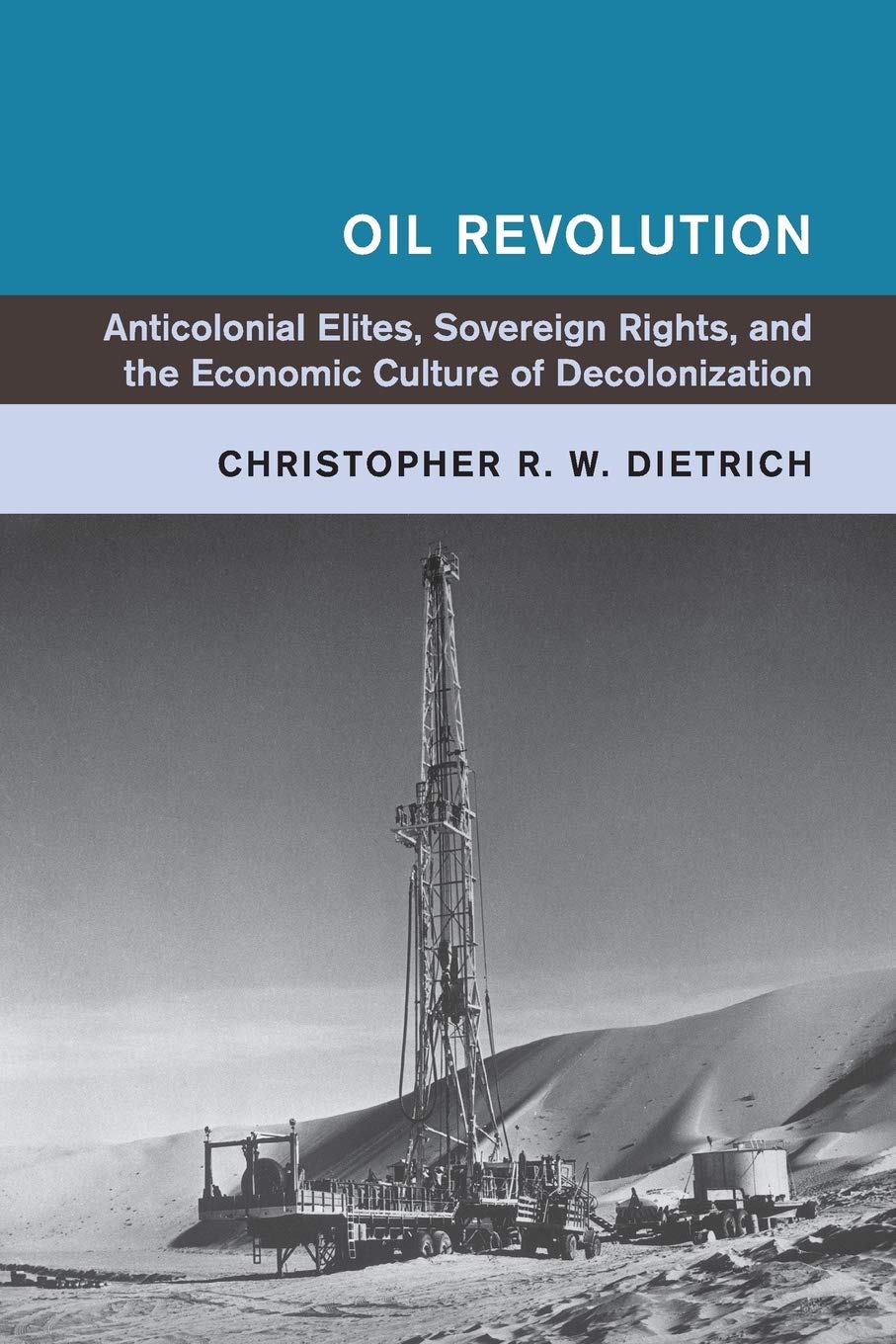
Oil Revolution: Anticolonial Elites, Sovereign Rights, and the Economic Culture of Decolonization (Global and International History)
$21.00
by Christopher R. W. Dietrich



"Marx once observed that ideas can have a material force in history. Dietrich's new book presents powerful evidence in support of that proposition. He shows how a set of ideas about a postcolonial state's right to control its natural resources, oil in particular, transformed the world economy between the late 1940s and the early 1970s.... The originality of the research, especially the excavation of the pivotal role played by transnational oil elites, makes the book an important resource for scholars of international history and international political economy. Indeed, no concise, thorough, and readable narrative of this period in oil history has been available until the publication of this book." -Journal of Interdisciplinary History Through innovative and expansive research, Oil Revolution analyzes the tensions faced and networks created by anti-colonial oil elites during the age of decolonization following World War II. This new community of elites stretched across Iran, Iraq, Saudi Arabia, Venezuela, Algeria, and Libya. First through their western educations and then in the United Nations, the Arab League, and the Organization of Petroleum Exporting Countries, these elites transformed the global oil industry. Their transnational work began in the early 1950s and culminated in the 1973-4 energy crisis and in the 1974 declaration of a New International Economic Order in the United Nations. Christopher R. W. Dietrich examines how these elites brokered and balanced their ambitions via access to oil, the most important natural resource of the modern era. 'Beautifully researched, this compelling book is a testament to Dr Dietrich's keen ability to elucidate this critical period of twentieth century global history.' Margot E. Salomon, London School of Economics and Political Science 'Dietrich's Oil Revolution is a triumph of research and writing. This is an indispensable book, illuminating the central role petroleum played in the transition from the global Keynesianism of the 1960s to the neoliberalism of the 1980s. A tour-de-force synthesis of intellectual, political, and economic history.' Greg Grandin, New York University 'A game-changing account of where the ideas that matter to the world economy come from. Dietrich traces the work of the Arab and kindred anticolonial intellectuals who led the successful movement for national sovereignty over natural resources.' Robert Vitalis, University of Pennsylvania and author of the forthcoming Oilcraft 'As Dietrich shows in this brilliant and essential new account, the oil crisis of 1973-74 culminated in a decades-long anti-colonial campaign, waged by Third World elites for control of economic resources. Dietrich expands our understanding of the politics of oil and achieves new vantage on global change. His achievement is vital reading for students of post-1945 international politics and economics.' Daniel Sargent, University of California, Berkeley 'An outstanding book on the relationship between sovereignty and international economic justice, highlighting how the search for fairer oil prices changed some of the most fundamental aspects of international affairs.' O. A. Westad, Harvard University and author of The Cold War: A World History Oil Revolution chronicles the rise and fall of anti-colonial oil elites who forged a new international culture of economic dissent from the 1950s to the 1970s. Christopher R. W. Dietrich is Assistant Professor of History at Fordham University, New York. He has been awarded fellowships from the Woodrow Wilson Foundation, the American Historical Association, the National History Center, Yale University, Connecticut, the University of Texas, Austin, and the Society for Historians of American Foreign Relations.