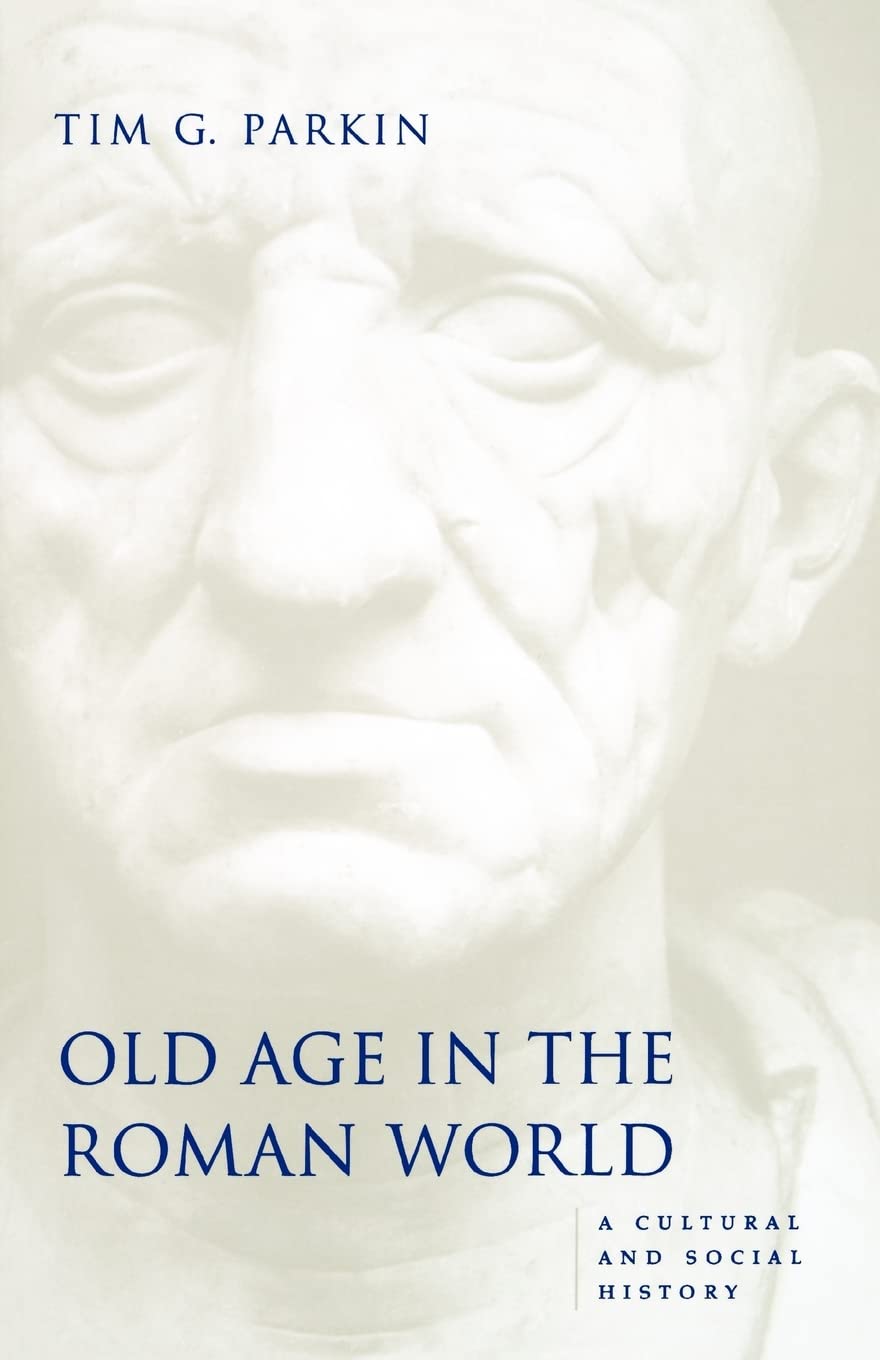
Old Age in the Roman World: A Cultural and Social History (Ancient Society and History)
$35.00
by Tim G. Parkin



Classical authors such as Cicero and Plutarch would have us believe that the elderly were revered, active citizens of ancient Rome. But upon closer inspection, it appears that older people may not have enjoyed as respected or as powerful a place in Roman society as has been supposed. In this highly original work, Tim Parkin considers the many issues related to aging and the aged in the classical Roman world. Drawing on both his expertise in demography and his knowledge of ancient history and literature, he coaxes new insights from a variety of sources, including legal documents on the "rules of age," representations of old age in classical literature, epigraphic evidence from tombstones, Greco-Roman medical texts, and papyri from Roman Egypt. Analyzing such diverse sources, he offers valuable new views of old age―not only of men in public life but of men and women in marriage, sexual relationships, and the family. Parkin detects a general lack of interest in old age per se in the early empire, which in itself may provide clues regarding the treatment of older people in the Roman world. Noting that privileges granted to the aged generally took the form of exemptions from duties rather than positive benefits, he argues that the elderly were granted no privileged status or ongoing social roles. At the same time they were both permitted―and expected―to continue to participate actively in society for as long as they were able. An innovative and ambitious work, Old Age in the Roman World paints a compelling, heretofore unseen picture of what it meant to grow old in antiquity. As a work of both social and cultural history, it broadens our knowledge of the ancient world and encourages us to reexamine our treatment of older people today. Parkin's substantial and sophisticated study of the social and legal aspects of aging and the aged in the classical Roman world provides striking insights into the differences between growing old in Roman antiquity and in the modern West. ―Donald G. Kyle, American Historical Review An important and original contribution to the growing body of scholarship on aging in Greece and Rome . . . Highly recommended. ― Choice Parkin is especially well-qualified to attempt a study of this scope . . . The result is a welcome addition to the scholarship on old age in the Roman world, one with which subsequent scholars will have to reckon . . . Parkin is a consistently astute scholar whose method can be a model to others trying to understand an aspect of ancient society as complex as aging . . . One of the strengths of his work is that he considers the physical and emotional reality of old age. ―Judith de Luce, New England Classical Journal The most thorough study of the period . . . Roman old age . . . provided ideas and representations that we have been using ever since. ―David G. Troyansky, Gerontologist This is a learned book . . . [Parkin] is as well versed in modern scholarship as in the ancient evidence . . . Throughout, Parkin is thorough, sober, and meticulous. ―Mark Golden, American Journal of Philology This is a remarkable and highly-readable reconstruction of what can and cannot be learned from the scant surviving sources about old age in the distant past . . . This fascinating study points to important long-run continuities as well as changes in the experience of old age, and convincingly de-romanticises the history of old age. ―Pat Thane, Ageing and Society A comprehensive, enduring work . . . Refined learning and clarity of thought, notably on methodological difficulties, lead to fresh conclusions (the old were not privileged but expected to go on doing what they did as best they could); what makes the book a pleasure to read is its humanity and its easy style. ―Barbara Levick, Greece and Rome Parkin draws on an enormous range of evidence, from epigraphy and papyri to medical and legal texts, all of it interpreted with a sophisticated critical sense. More importantly, he considers this material through a framework derived from a clear understanding of the parameters of demographic plausibility . . . The work is admirably lucid in its explanations . . . its insights . . . will shape the study of Roman society for decades to come. ―Neville Morley, Journal of Classics Teaching As we would expect from Parkin, the discussion of definitions and demographics is thorough and lucid. ―Mary Harlow, Journal of Roman Studies By working with literary and demographical sources, Parkin attempts to clarify what defined 'old' to the Romans, how the elderly were portrayed in Roman literature, and what life may really have been like for the elderly . . . Parkin's work demonstrates just how much classicists tend to forget about the lives of the Romans after they have served their generalships and consulships or given birth to their children. ―T. Davina McClain, Bryn Mawr Classical Review The current boom in old age studies for Roman antiquity includes Umberto Mattioli's t